




Completed

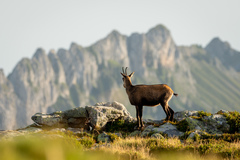
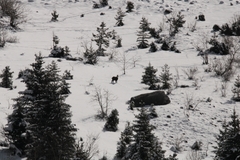


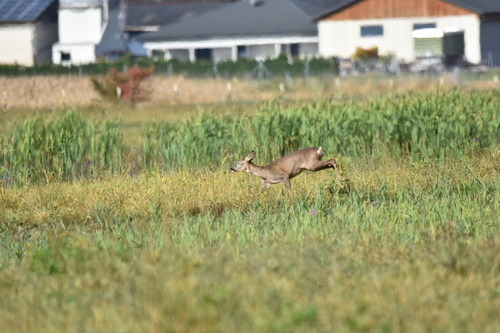
Northern Chamois
Rupicapra rupicapra
Silhouette: Ferran Sayol · PhyloPic
- KingdomAnimalia (Animals)
- PhylumChordata (Chordates)
- ClassMammalia (Mammals)
- OrderArtiodactyla (Even-toed Ungulates and Cetaceans)
- FamilyBovidae (Bovids)
- GenusRupicapra (Chamois)
- SpeciesRupicapra rupicapra (Northern Chamois)
In 3 days ~90% in a week >90%
65 Verified sightings at Vanoise National Park From 2019 to 2026
945 In all 8 parks
November Best month
☀️ Diurnal When it's spotted

Completed
About the Northern Chamois
The chamois (French: [ʃamwa]; Rupicapra rupicapra), or Alpine chamois, is a species of goat-antelope native to mountainous parts of Europe and Western Asia, from the Pyrenees and the Cantabrian Mountain Range, the Alps, the Apennines, the Dinarides, the Tatra to the Carpathian Mountains, the Balkan Mountains, the Rila–Rhodope massif, Pindus, the northeastern mountains of Turkey, and the Caucasus. It has also been introduced to the South Island of New Zealand. Some subspecies of chamois are strictly protected in the EU under the European Habitats Directive.
The chamois is a very small bovid. A fully grown chamois reaches a height of 70–80 cm (28–31 in) and measures 107–137 cm (42–54 in). Males, which weigh 30–60 kg (66–132 lb), are slightly larger than females, which weigh 25–45 kg (55–99 lb). Both males and females have short, straightish horns which are hooked backwards near the tip, the horn of the male being thicker. In summer, the fur has a rich brown colour which turns to a light grey in winter. Distinct characteristics are white contrasting marks on the sides of the head with pronounced black stripes below the eyes, a white rump and a black stripe along the... Wikipedia →
Sounds
Alarm call0:04
Germany · 2024
© b_hirschmann · XC1051295 · CC BY-NC-ND 4.0
Call0:38
France · 2022
© Stanislas Wroza · XC733308 · CC BY-NC-SA 4.0
Recording0:08
Austria · 2023
© Lucy Milan Neuhaus · iNaturalist · CC BY 4.0
Recent sightings of Northern Chamois in Vanoise National Park
LIVEiNaturalistGlobal Distribution
Parks Where Found
| # | Park | Country | Daily sighting probability |
|---|---|---|---|
| 1 | Mercantour National Park | 🇫🇷 France | |
| 2 | Tatra National Park | 🇸🇰 Slovakia | |
| 3 | Ecrins National Park | 🇫🇷 France | |
| 4 | Vanoise National Park | 🇫🇷 France | |
| 5 | Triglav National Park | 🇸🇮 Slovenia | |
| 6 | Hohe Tauern National Park | 🇦🇹 Austria | |
| 7 | Arthur's Pass National Park | 🇳🇿 New Zealand | |
| 8 | Fiordland National Park | 🇳🇿 New Zealand |
Zoos & Centres Where Found
| # | Zoo / Centre | Country | |
|---|---|---|---|
| 1 | Zoo Hluboka | 🇨🇿 Czechia | |
| 2 | Parc animalier de Merlet | 🇫🇷 France | |
| 3 | Domaine des Grottes de Han | 🇧🇪 Belgium | |
| 4 | Cumberland Wildpark Grünau | 🇦🇹 Austria | |
| 5 | Hellabrunn Zoo | 🇩🇪 Germany | |
| 6 | Lüneburg Heath Wildlife Park | 🇩🇪 Germany | |
| 7 | wildlife park Feldkirch | 🇦🇹 Austria | |
| 8 | Tierpark Bern | 🇨🇭 Switzerland | |
| 9 | Salzburg Zoo | 🇦🇹 Austria | |
| 10 | Tierpark Lange Erlen | 🇨🇭 Switzerland | |
| 11 | Wildpark Peter und Paul | 🇨🇭 Switzerland | |
| 12 | Вольерный комплекс | 🇷🇺 Russia | |
| 13 | Alpenzoo Innsbruck | 🇦🇹 Austria | |
| 14 | Parc Animalier d'Introd | 🇮🇹 Italy | |
| 15 | Tierpark Biel / Parc Zoologique Bienne | 🇨🇭 Switzerland | |
| 16 | Cumberland Wildpark | 🇦🇹 Austria | |
| 17 | Zoo Schlichtweg 11 in München | 🇩🇪 Germany | |
| 18 | Zoo Siebenbrunner Straße 6 in München | 🇩🇪 Germany |
Closest Relatives at Vanoise National Park




Before you go
What are the chances of seeing a Northern Chamois in Vanoise National Park?
Likely
About 50% of wildlife watchers report a Northern Chamois sighting in Vanoise National Park on a given day, based on 65 verified sightings from GBIF citizen-science data from 2019 to 2026. It is the 3rd most-seen of the 8 mammals we can rate there. Over three days the chance rises to about 90%, and over a week to over 90%, if each day is a fresh chance.
When is the best time to see a Northern Chamois in Vanoise National Park?
November
In that month about 80% of wildlife watchers report a Northern Chamois in Vanoise National Park on a given day, against under 5% in March, the lowest month.
What time of day is best to see a Northern Chamois?
Between 10 am and 1 pm
Across all the parks we cover, that three-hour window holds the most Northern Chamois sightings with a recorded time, and about 9 in 10 of them come between 6 am and 6 pm: it is a daytime animal.
Is Vanoise National Park the best place to see a Northern Chamois?
4th of 8
Of the 8 parks where we can rate Northern Chamois sightings, Vanoise National Park ranks 4th at about 50%. The best odds are in Mercantour National Park (France, about 80%), Tatra National Park (Slovakia, about 70%) and Ecrins National Park (France, about 50%). All parks ranked.
Where does the Northern Chamois sighting chance come from?
GBIF citizen-science records
It is estimated from how often the Northern Chamois is recorded against all the mammals logged in Vanoise National Park (65 verified sightings from 2019 to 2026), calibrated against known sighting rates. Figures are rounded to the nearest 10% because citizen-science data supports honest approximations, not decimals, and months with records from fewer than five people show "—". How it works.
