Shoebill

Shoebill

Balaeniceps rex

Silhouette: Tom Tarrant (photo), John E. McCormack, Michael G. Harvey, Brant C. Faircloth, Nicholas G. Crawford, Travis C. Glenn, Robb T. Brumfield & T. Michael Keesey · PhyloPic

LCNTVUVulnerableENCR
Daily sighting probability <5% · Rare
at Virunga National Park

In 3 days <5% in a week ~10%

8 Verified sightings at Virunga National Park From 2019 to 2026
108 In all 4 parks
February Best month

About the Shoebill

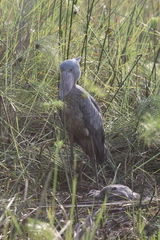
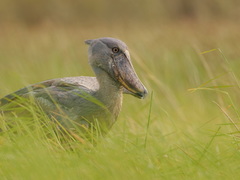
The shoebill (Balaeniceps rex), also known as the whale-headed stork, whalebill, and shoe-billed stork, is a large long-legged wading bird. It is named for its enormous, shoe-shaped bill. It has a somewhat stork-like overall form and was previously classified as a stork in the order Ciconiiformes, but genetic evidence has now placed it along with pelicans, herons, and its closest relative, the hamerkop, all in the order Pelecaniformes. Adults are mainly grey, while juveniles are browner. It lives in tropical East Africa in large swamps from South Sudan down to Zambia.

The shoebill may have been known to Ancient Egyptians, but was not classified by Europeans until the 19th century, after skins and eventually live specimens were brought to Europe. John Gould very briefly described it in 1850 from the skin of a specimen collected on the upper White Nile by English traveler Mansfield Parkyns. Gould provided a more detailed description in the following year. He placed the species in its own genus Balaeniceps and coined the binomial name Balaeniceps rex, from Latin balaena 'whale' and caput/ceps 'head'. Other common names are whalebill, shoe-billed stork, and whale-headed... Wikipedia →

Global Distribution

Parks Where Found

# Park Country Daily sighting probability
1 Murchison Falls National Park 🇺🇬 Uganda
~10%
2 Virunga National Park 🇨🇩 Democratic Republic of the Congo
<5%
3 Queen Elizabeth National Park 🇺🇬 Uganda
<5%
4 Lake Mburo National Park 🇺🇬 Uganda
<5%

Cities Where Found

# City Country Daily sighting probability
1 Kampala 🇺🇬 Uganda
<5%

Zoos & Centres Where Found

# Zoo / Centre Country
1 Everland 🇰🇷 South Korea In captivity
2 Busch Gardens Tampa 🇺🇸 United States In captivity
3 Pairi Daiza 🇧🇪 Belgium In captivity
4 Walsrode World Bird Park 🇩🇪 Germany In captivity
5 výzkumný chov jelenů 🇨🇿 Czechia In captivity
6 San Diego Zoo Safari Park 🇺🇸 United States In captivity
7 Dallas Zoo 🇺🇸 United States In captivity
8 Uganda Wildlife Conservation Education Center 🇺🇬 Uganda In captivity
9 Chiba Zoological Park 🇯🇵 Japan In captivity
10 ZooTampa 🇺🇸 United States In captivity
11 Houston Zoo 🇺🇸 United States In captivity
12 Ueno Zoo 🇯🇵 Japan In captivity
13 Exmoor Zoo 🇬🇧 United Kingdom In captivity
14 Kobe Animal Kingdom 🇯🇵 Japan In captivity
15 Johor Zoo 🇲🇾 Malaysia In captivity
16 Aqua Park Shinagawa 🇯🇵 Japan In captivity
17 Dallas World Aquarium 🇺🇸 United States In captivity
18 Children's Aquarium at Fair Park 🇺🇸 United States In captivity
19 Paupau Aqua Garden 🇯🇵 Japan In captivity
20 Rákosův pavilon 🇨🇿 Czechia In captivity
21 Art Aquarium Museum 🇯🇵 Japan In captivity
22 Mořský svět 🇨🇿 Czechia In captivity
23 Oslo Reptilpark 🇳🇴 Norway In captivity
24 Singapore Miniature Zoo 🇸🇬 Singapore In captivity
25 Sunshine Aquarium 🇯🇵 Japan In captivity
26 zookoutek Kamýk 🇨🇿 Czechia In captivity

Before you go

What are the chances of seeing a Shoebill in Virunga National Park?

Rare

Under 5% of wildlife watchers report a Shoebill sighting in Virunga National Park on a given day, based on 8 verified sightings from GBIF citizen-science data from 2019 to 2026. It is the 286th most-seen of the 316 birds we can rate there. Over three days the chance rises to under 5%, and over a week to about 10%, if each day is a fresh chance.

When is the best time to see a Shoebill in Virunga National Park?

February

In that month about 10% of wildlife watchers report a Shoebill in Virunga National Park on a given day, against under 5% in March to January, the lowest months. That is one of Virunga National Park's driest months, with about 20 mm of rain against 250 mm in May.

Is Virunga National Park the best place to see a Shoebill?

2nd of 4

Of the 4 parks where we can rate Shoebill sightings, Virunga National Park ranks 2nd at under 5%. The best odds are in Murchison Falls National Park (Uganda, about 10%).

Which relatives of the Shoebill live in Virunga National Park?

Same order: Pelecaniformes

The closest relatives of the Shoebill that you can see in Virunga National Park (order Pelecaniformes, Pelicans, Herons, Ibises, and Allies) are Hadada (about 30%), Hamerkop (about 30%) and Goliath Heron (about 20%), with each one's daily chance of a sighting.

Where does the Shoebill sighting chance come from?

GBIF citizen-science records

It is estimated from how often the Shoebill is recorded against all the birds logged in Virunga National Park (8 verified sightings from 2019 to 2026), calibrated against known sighting rates. Figures are rounded to the nearest 10% because citizen-science data supports honest approximations, not decimals, and months with records from fewer than five people show "—". How it works.

← Back to Virunga National Park