Coarse Chameleon

Coarse Chameleon

Trioceros rudis

Silhouette: T. Michael Keesey (from a photograph by Frank Glaw, Jörn Köhler, Ted M. Townsend & Miguel Vences) · PhyloPic

LCLeast ConcernNTVUENCR
Daily sighting probability ~80% · Very likely
at Volcanoes National Park

In 3 days >90%

55 Verified sightings at Volcanoes National Park From 2019 to 2026
89 In all 2 parks
January Best month
☀️ Diurnal When it's spotted

About the Coarse Chameleon

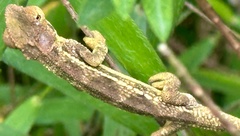
The coarse chameleon (Trioceros rudis), also known as the rudis chameleon, Ruwenzori side-striped chameleon or the Rwenzori bearded chameleon, is a chameleon from western Uganda, Rwanda, Burundi, and eastern DR Congo. Contrary to common belief, this species does not inhabit Mount Meru, Tanzania. Tanzania chameleons called T. rudis are in fact T. sternfeldi.

This chameleon is often found in open habitats, inhabiting low bushes and shrubs (often described as 'patchy open country") in the transitional zones between grasslands, reedbeds and montane heath. T. rudis is small (10 to 15 cm (3.9 to 5.9 in)) and lacks horns or occipital lobes. It has a long tail and a small crest.

Chamaeleo rudis at the Reptarium.cz Reptile Database Chamaeleo Research Group [Japanese] Wikipedia →

Global Distribution

Parks Where Found

# Park Country Daily sighting probability
1 Volcanoes National Park 🇷🇼 Rwanda
~80%
2 Virunga National Park 🇨🇩 Democratic Republic of the Congo
~60%

Before you go

What are the chances of seeing a Coarse Chameleon in Volcanoes National Park?

Very likely

About 80% of wildlife watchers report a Coarse Chameleon sighting in Volcanoes National Park on a given day, based on 55 verified sightings from GBIF citizen-science data from 2019 to 2026. Over three days the chance rises to over 90%, if each day is a fresh chance.

When is the best time to see a Coarse Chameleon in Volcanoes National Park?

January, June–July and September

In those months about 90% of wildlife watchers report a Coarse Chameleon in Volcanoes National Park on a given day, against about 30% in November, the lowest month. Those are among Volcanoes National Park's driest months, with about 80 mm of rain a month against 250 mm in April.

What time of day is best to see a Coarse Chameleon?

Between 9 am and noon

Across all the parks we cover, that three-hour window holds the most Coarse Chameleon sightings with a recorded time, and about 9 in 10 of them come between 6 am and 6 pm: it is a daytime animal.

Is Volcanoes National Park the best place to see a Coarse Chameleon?

Yes

Of the 2 parks where we can rate Coarse Chameleon sightings, Volcanoes National Park has the highest daily chance: about 80%. Next come Virunga National Park (Democratic Republic of the Congo, about 60%).

Where does the Coarse Chameleon sighting chance come from?

GBIF citizen-science records

It is estimated from how often the Coarse Chameleon is recorded against all the reptiles logged in Volcanoes National Park (55 verified sightings from 2019 to 2026), calibrated against known sighting rates. Figures are rounded to the nearest 10% because citizen-science data supports honest approximations, not decimals, and months with records from fewer than five people show "—". How it works.

← Back to Volcanoes National Park
