European Polecat

European Polecat

Mustela putorius

Silhouette: PhyloPic

LCLeast ConcernNTVUENCR
Daily sighting probability <5% · Rare
at Wadden Sea National Park

In 3 days ~10% in a week ~30%

6 Verified sightings at Wadden Sea National Park From 2019 to 2026
6 In 1 park
November Best month
☀️ Diurnal When it's spotted

About the European Polecat

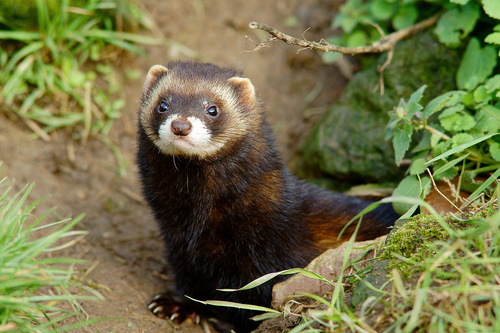
The European polecat (Mustela putorius), also known as the western polecat, is a mustelid species occurring in Europe and the Rif mountains. It is of a generally dark brown colour, with a pale underbelly and a dark mask across the face. Occasionally, colour mutations including albinos, leucists, isabellinists, xanthochromists, amelanists, and erythrists occur. It has a shorter, more compact body than other Mustela species, a more powerfully built skull and dentition, is less agile, and is well known for having the characteristic ability to secrete a particularly foul-smelling liquid to mark its territory.

It is much less territorial than other mustelids, with animals of the same sex frequently sharing home ranges. Like other mustelids, the European polecat is polygamous, with pregnancy occurring after mating, following induced ovulation. It usually gives birth in early summer to litters consisting of five to ten kits, which become independent at the age of two to three months. The European polecat feeds on small rodents, birds, amphibians and reptiles. It occasionally cripples its prey by piercing its brain with its teeth and stores it, still living, in its burrow for future consumption.

The European polecat originated in Western Europe during the Middle Pleistocene, with its closest living relatives being the steppe polecat, the black-footed ferret and the European mink. With the two former species, it can produce fertile offspring, though hybrids between it and the latter species tend to be sterile, and are distinguished from their parent species by their larger size and more valuable pelts.

The European polecat is thought to be the sole ancestor of the ferret, which was domesticated more than 2,000 years ago for the purpose of hunting vermin. The species has otherwise been historically viewed negatively by humans. In Britain especially, the polecat was persecuted by gamekeepers, and became synonymous with promiscuity in early English literature. During modern times, the polecat is still scantly represented in popular culture when compared to other rare British mammals, and misunderstandings of its behaviour still persist in some rural areas. Since 2008, it has been classified as Least Concern on the IUCN Red List due to its wide range and large numbers. Wikipedia →
Global Distribution

Parks Where Found

# Park Country Daily sighting probability
1 Wadden Sea National Park 🇩🇪 Germany
<5%

More parks will be added in future updates.

Zoos & Centres Where Found

# Zoo / Centre Country
1 Skansen 🇸🇪 Sweden In captivity
2 Safari Madrid 🇪🇸 Spain In captivity
3 Ähtäri Zoo 🇫🇮 Finland In captivity
4 Skandinavisk Dyrepark 🇩🇰 Denmark In captivity
5 Novosibirsk Zoo 🇷🇺 Russia In captivity
6 Körösvölgyi Állatpark 🇭🇺 Hungary In captivity
7 Natur- und Tierpark Goldau 🇨🇭 Switzerland In captivity
8 Tierpark Hagenbeck 🇩🇪 Germany In captivity
9 Kharkiv Zoo 🇺🇦 Ukraine In captivity
10 Wildwood Discovery Park 🇬🇧 United Kingdom In captivity
11 New Forest Wildlife Park 🇬🇧 United Kingdom In captivity
12 British Wildlife Centre 🇬🇧 United Kingdom In captivity
13 Pyrénées Animal Park 🇫🇷 France In captivity
14 Alpenzoo Innsbruck 🇦🇹 Austria In captivity
15 Gauntlet Birds of Prey 🇬🇧 United Kingdom In captivity
16 Kharkiv Dolphinarium 🇺🇦 Ukraine In captivity
17 Baltic Sea Science Center 🇸🇪 Sweden In captivity
18 Hankensbüttel Otter Centre 🇩🇪 Germany In captivity
19 LBV-Vogel- und Umweltstation Regenstauf Station für Greifvögel und Eulen 🇩🇪 Germany In captivity

Before you go

What are the chances of seeing a European Polecat in Wadden Sea National Park?

Rare

Under 5% of wildlife watchers report a European Polecat sighting in Wadden Sea National Park on a given day, based on 6 verified sightings from GBIF citizen-science data from 2019 to 2026. It is the 17th most-seen of the 20 mammals we can rate there. Over three days the chance rises to about 10%, and over a week to about 30%, if each day is a fresh chance.

When is the best time to see a European Polecat in Wadden Sea National Park?

August and October–November

In those months about 10% of wildlife watchers report a European Polecat in Wadden Sea National Park on a given day, against under 5% in September and December–July, the lowest months.

What time of day is best to see a European Polecat?

Between 11 am and 2 pm

Across all the parks we cover, that three-hour window holds the most European Polecat sightings with a recorded time, and about 7 in 10 of them come between 6 am and 6 pm: it is a daytime animal.

Where else can you see a European Polecat?

Only Wadden Sea National Park, in our data

Wadden Sea National Park is the only park on Wallace's Line with enough records to rate European Polecat sightings: under 5% of wildlife watchers there report one on a given day.

Where does the European Polecat sighting chance come from?

GBIF citizen-science records

It is estimated from how often the European Polecat is recorded against all the mammals logged in Wadden Sea National Park (6 verified sightings from 2019 to 2026), calibrated against known sighting rates. Figures are rounded to the nearest 10% because citizen-science data supports honest approximations, not decimals, and months with records from fewer than five people show "—". How it works.

← Back to Wadden Sea National Park