Fallow Deer

Fallow Deer

Dama dama

Silhouette: Anthony Caravaggi · PhyloPic

LCLeast ConcernNTVUENCR
Daily sighting probability ~10% · With luck
at Wadden Sea National Park

In 3 days ~30% in a week ~50%

35 Verified sightings at Wadden Sea National Park From 2019 to 2026
324 In all 12 parks
February Best month
🌅 Crepuscular When it's spotted

About the Fallow Deer

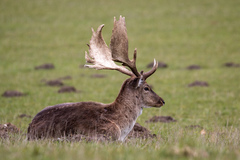
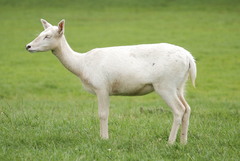
The European fallow deer (Dama dama), also known as the common fallow deer or simply fallow deer, is a species of deer native to Eurasia. It is one of two living species of fallow deer alongside the Persian fallow deer (Dama mesopotamica). It is historically native to Turkey and possibly the Italian Peninsula, Balkan Peninsula, and the island of Rhodes near Anatolia. During the Pleistocene it inhabited much of Europe, and has been reintroduced to its prehistoric distribution by humans. It has also been introduced to other regions in the world.

Some taxonomists include the rarer Persian fallow deer as a subspecies (D. d. mesopotamica), with both species being grouped together as the fallow deer, while others treat it as a different species (D. mesopotamica). The white-tailed deer (Odocoileus virginianus) was once classified as Dama virginiana and the mule deer or black-tailed deer (Odocoileus hemionus) as Dama hemionus; they were given a separate genus in the 19th century.

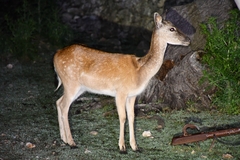
The male fallow deer is known as a buck, the female is a doe, and the young a fawn. Globally, adult bucks are 140–160 cm (55–63 in) long, 85–95 cm (33–37 in) in shoulder height, and... Wikipedia →

Sounds

Calls of females1:07

Italy · 2017

© Luca Baghino · XC987682 · CC BY-NC-SA 4.0

Call0:16

United Kingdom · 1977

© Simon Elliott · XC960555 · CC BY-NC-ND 4.0

Recording0:23

United Kingdom · 2024

© funny_dawg · iNaturalist · CC BY-NC 4.0

Global Distribution

Parks Where Found

# Park Country Daily sighting probability
1 Kosciuszko National Park 🇦🇺 Australia
~60%
2 Aigüestortes National Park 🇪🇸 Spain
~50%
3 Doñana National Park 🇪🇸 Spain
~30%
4 Grampians National Park 🇦🇺 Australia
~10%
5 Nahuel Huapi National Park 🇦🇷 Argentina
~10%
6 Great Otway National Park 🇦🇺 Australia
~10%
7 Lamington National Park 🇦🇺 Australia
~10%
8 Springbrook National Park 🇦🇺 Australia
~10%
9 Wadden Sea National Park 🇩🇪 Germany
~10%
10 Pyrénées National Park 🇫🇷 France
~10%
11 Blue Mountains National Park 🇦🇺 Australia
~10%
12 Garden Route National Park 🇿🇦 South Africa
<5%

Cities Where Found

# City Country Daily sighting probability
1 London 🇬🇧 United Kingdom
~20%
2 Dublin 🇮🇪 Ireland
~10%
3 Sydney 🇦🇺 Australia
<5%
4 Paris 🇫🇷 France
<5%
5 Melbourne 🇦🇺 Australia
<5%

Zoos & Centres Where Found

# Zoo / Centre Country
1 Pairi Daiza 🇧🇪 Belgium In captivity
2 Tierpark Berlin 🇩🇪 Germany In captivity
3 Dublin Zoo 🇮🇪 Ireland In captivity
4 Cabarceno Natural Park 🇪🇸 Spain In captivity
5 Ostrava Zoo 🇨🇿 Czechia In captivity
6 Kolmården Wildlife Park 🇸🇪 Sweden In captivity
7 Zoo Hluboka 🇨🇿 Czechia In captivity
8 Zoobotánico Jerez 🇪🇸 Spain In captivity
9 Parc animalier de Merlet 🇫🇷 France In captivity
10 Медвино 🇺🇦 Ukraine In captivity
11 réserve biologique des monts d'Azur 🇫🇷 France In captivity
12 Taronga Western Plains Zoo 🇦🇺 Australia In captivity
13 Parc Omega 🇨🇦 Canada In captivity
14 Wildwald Voßwinkel 🇩🇪 Germany In captivity
15 Bioparque Estrella 🇲🇽 Mexico In captivity
16 Wildpark Schloss Tambach 🇩🇪 Germany In captivity
17 Natural Bridge Wildlife Ranch 🇺🇸 United States In captivity
18 Wildpark (Dülmen) 🇩🇪 Germany In captivity
19 Espace Rambouillet 🇫🇷 France In captivity
20 Bioparque Estrella 🇲🇽 Mexico In captivity
21 Whipsnade Zoo 🇬🇧 United Kingdom In captivity
22 Beijing Wildlife Park 🇨🇳 China In captivity
23 Al Ain Zoo 🇦🇪 United Arab Emirates In captivity
24 Parque Lecocq 🇺🇾 Uruguay In captivity
25 African Lion Safari 🇨🇦 Canada In captivity
26 Wildgehege Glauer Tal 🇩🇪 Germany In captivity
27 Global Wildlife Center 🇺🇸 United States In captivity
28 Лосиная Биостанция 🇷🇺 Russia In captivity
29 La Reserva del Castillo de las Guardas 🇪🇸 Spain In captivity
30 Domaine des Grottes de Han 🇧🇪 Belgium In captivity
31 Serengeti Park 🇩🇪 Germany In captivity
32 Tierpark Sababurg 🇩🇪 Germany In captivity
33 Woburn Safari Park 🇬🇧 United Kingdom In captivity
34 Tennessee Safari Park 🇺🇸 United States In captivity
35 Kyushu African Safari 🇯🇵 Japan In captivity
36 Wildlife Safari 🇺🇸 United States In captivity
37 Longleat Safari and Adventure Park 🇬🇧 United Kingdom In captivity
38 Tiergarten Hannover 🇩🇪 Germany In captivity
39 Wildpark Duttenstein 🇩🇪 Germany In captivity
40 Badoca Safari Park 🇵🇹 Portugal In captivity
41 Parc animalier de Sainte-Croix 🇫🇷 France In captivity
42 Bratislava Zoo 🇸🇰 Slovakia In captivity
43 Safari Park Open Zoo 🇹🇭 Thailand In captivity
44 West Midland Safari Park 🇬🇧 United Kingdom In captivity
45 West Midlands Safari Park 🇬🇧 United Kingdom In captivity
46 Kristiansand Zoo and Amusement Park 🇳🇴 Norway In captivity
47 Ecological Center of Sonora 🇲🇽 Mexico In captivity
48 Zoofari 🇲🇽 Mexico In captivity
49 Virginia Safari Park 🇺🇸 United States In captivity
50 Safari Aitana 🇪🇸 Spain In captivity

Before you go

What are the chances of seeing a Fallow Deer in Wadden Sea National Park?

With luck

About 10% of wildlife watchers report a Fallow Deer sighting in Wadden Sea National Park on a given day, based on 35 verified sightings from GBIF citizen-science data from 2019 to 2026. It is the 8th most-seen of the 20 mammals we can rate there. Over three days the chance rises to about 30%, and over a week to about 50%, if each day is a fresh chance.

When is the best time to see a Fallow Deer in Wadden Sea National Park?

February

In that month about 20% of wildlife watchers report a Fallow Deer in Wadden Sea National Park on a given day, against under 5% in November, the lowest month.

What time of day is best to see a Fallow Deer?

Between 6 and 9 pm

Across all the parks we cover, that three-hour window holds the most Fallow Deer sightings with a recorded time, and about 6 in 10 of them come between 6 am and 6 pm: it is most active around dawn and dusk.

Which relatives of the Fallow Deer live in Wadden Sea National Park?

Same family: Cervidae

The closest relatives of the Fallow Deer that you can see in Wadden Sea National Park (family Cervidae, Deer) are Western Roe Deer (about 30%) and Red Deer (about 10%), with each one's daily chance of a sighting.

Where does the Fallow Deer sighting chance come from?

GBIF citizen-science records

It is estimated from how often the Fallow Deer is recorded against all the mammals logged in Wadden Sea National Park (35 verified sightings from 2019 to 2026), calibrated against known sighting rates. Figures are rounded to the nearest 10% because citizen-science data supports honest approximations, not decimals, and months with records from fewer than five people show "—". How it works.

← Back to Wadden Sea National Park