

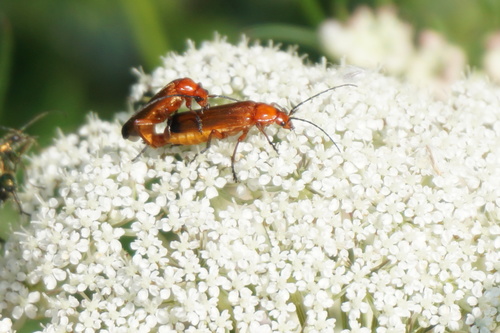
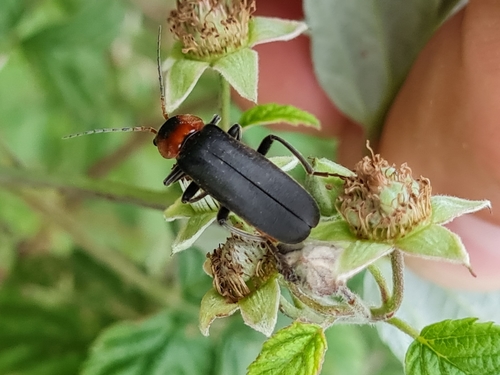
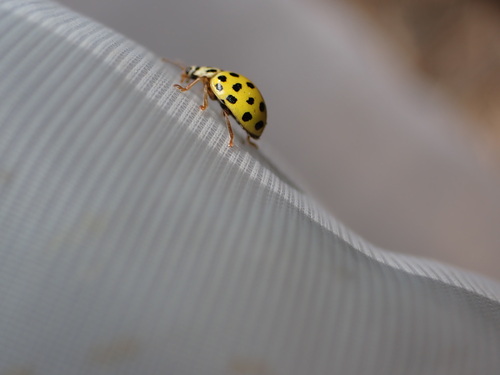
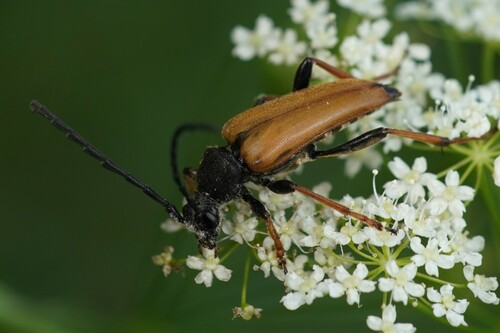
Wharf Borer

Wharf Borer

Nacerdes melanura

Daily sighting probability <5% · Rare
at Wadden Sea National Park

In 3 days ~10% in a week ~20%

9 Verified sightings at Wadden Sea National Park From 2019 to 2026
9 In 1 park
June Best month
☀️ Diurnal When it's spotted

About the Wharf Borer

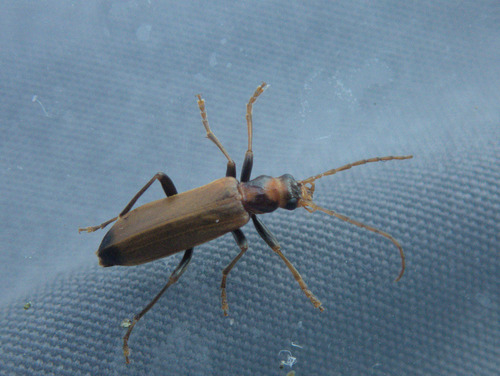
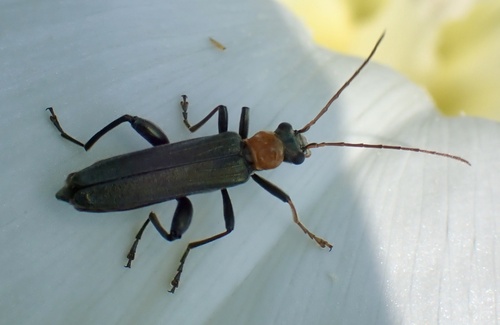
The wharf borer, Nacerdes melanura, belongs to the insect order Coleoptera, the beetles. They belong to the family Oedemeridae, known as false blister beetles. Wharf borers are present in all the states of the USA except for Florida. It takes about a year to develop from an egg to an adult. The name 'wharf borer' comes from the larval stage of this insect, which often lingers on pilings and timbers of wharves, especially along coastal areas. The adult beetles are identifiable via a black band across the end of both elytra. In addition, wharf borers are distinct from other members of the family Oedemeridae due to the presence of a single spur on the tibia of the forelegs and the distance between both eyes (twice the length of one eye). The female beetle oviposits eggs on rotten wood, on which the larvae hatch, burrow, then feed. Adults do not eat and depend on stored energy reserves accumulated as a larva. They are considered a pest because they damage wood used in building infrastructures.

The female of this beetle will lay eggs in any damp, decaying timber which has been attacked by fungus. The eggs are creamy white, slightly curved with tapered ends. The larvae... Wikipedia →

Global Distribution

Parks Where Found

# Park Country Daily sighting probability
1 Wadden Sea National Park 🇩🇪 Germany
<5%

More parks will be added in future updates.

Cities Where Found

# City Country Daily sighting probability
1 Istanbul 🇹🇷 Turkey
~10%
2 Shanghai 🇨🇳 China
~10%
3 Philadelphia 🇺🇸 United States
~10%
4 New York City 🇺🇸 United States
<5%
5 Montreal 🇨🇦 Canada
<5%
6 Baltimore 🇺🇸 United States
<5%
7 Barcelona 🇪🇸 Spain
<5%
8 Birmingham 🇬🇧 United Kingdom
<5%
9 London 🇬🇧 United Kingdom
<5%
10 Toronto 🇨🇦 Canada
<5%

Before you go

What are the chances of seeing a Wharf Borer in Wadden Sea National Park?

Rare

Under 5% of wildlife watchers report a Wharf Borer sighting in Wadden Sea National Park on a given day, based on 9 verified sightings from GBIF citizen-science data from 2019 to 2026. It is the 536th most-seen of the 818 insects we can rate there. Over three days the chance rises to about 10%, and over a week to about 20%, if each day is a fresh chance.

When is the best time to see a Wharf Borer in Wadden Sea National Park?

June and July

In those months about 10% of wildlife watchers report a Wharf Borer in Wadden Sea National Park on a given day, against under 5% in August to May, the lowest months.

What time of day is best to see a Wharf Borer?

Between 3 and 6 pm

Across all the parks we cover, that three-hour window holds the most Wharf Borer sightings with a recorded time, and about 9 in 10 of them come between 6 am and 6 pm: it is a daytime animal.

Where else can you see a Wharf Borer?

Only Wadden Sea National Park, in our data

Wadden Sea National Park is the only park on Wallace's Line with enough records to rate Wharf Borer sightings: under 5% of wildlife watchers there report one on a given day.

Where does the Wharf Borer sighting chance come from?

GBIF citizen-science records

It is estimated from how often the Wharf Borer is recorded against all the insects logged in Wadden Sea National Park (9 verified sightings from 2019 to 2026), calibrated against known sighting rates. Figures are rounded to the nearest 10% because citizen-science data supports honest approximations, not decimals, and months with records from fewer than five people show "—". How it works.

← Back to Wadden Sea National Park