Yellow-Barred Brindle

Yellow-Barred Brindle

Acasis viretata

Daily sighting probability <5% · Rare
at Wadden Sea National Park

In 3 days ~10% in a week ~20%

6 Verified sightings at Wadden Sea National Park From 2019 to 2026
29 In all 4 parks
August Best month
🌅 Crepuscular When it's spotted

About the Yellow-Barred Brindle

Acasis viretata, the yellow-barred brindle, is a moth of the family Geometridae. The species was first described by Jacob Hübner in 1799. It is found across most of Europe and throughout the Palearctic to Korea. In northern India it is represented by Acacis viretata himalayica (Prout, 1958). It is also present in North America. This species occurs in many different habitats, including deciduous and mixed forests, rocky slopes and valleys, as well as bushy meadows, bogs and taiga areas. In the Alps, it can still be found at an altitude of 1700 meters.

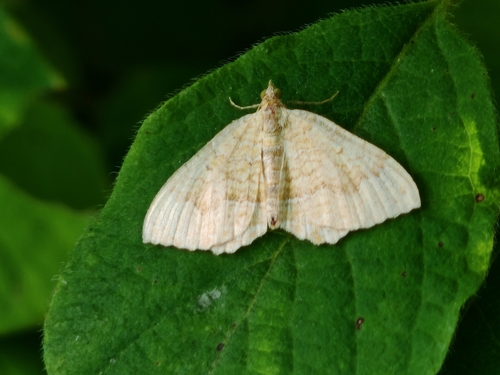
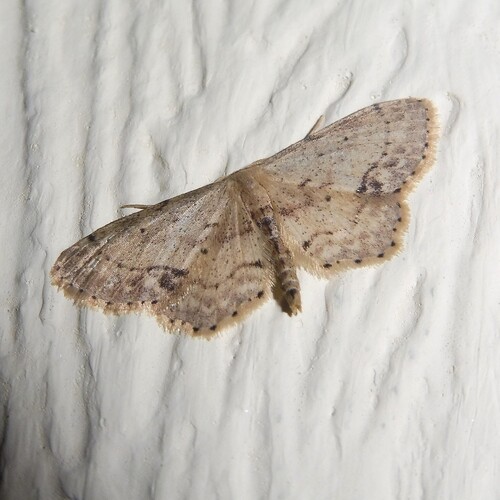
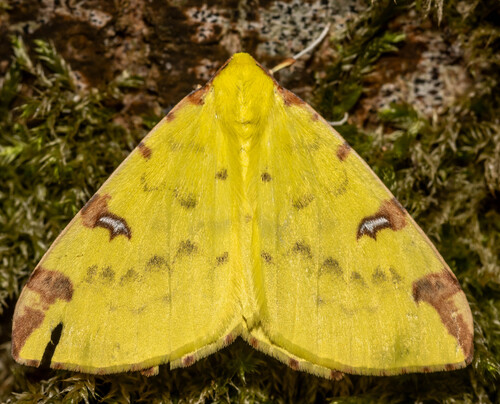
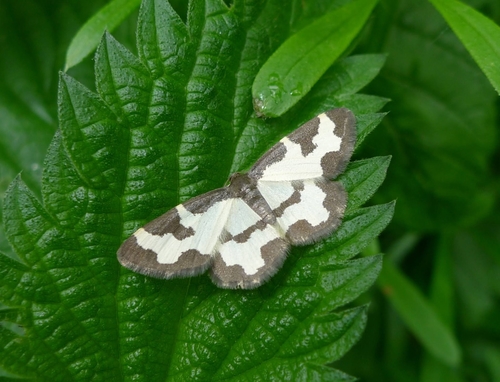
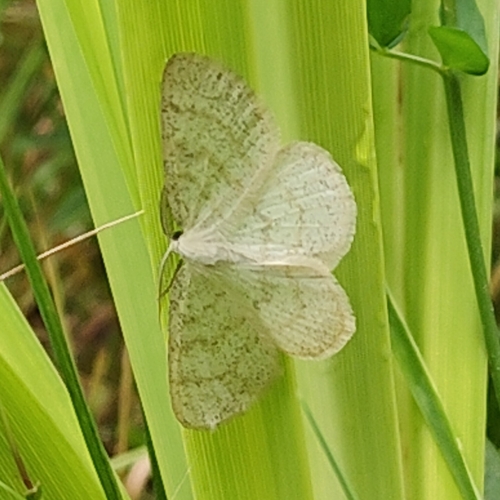
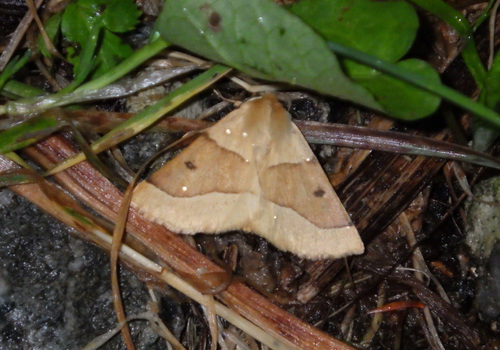
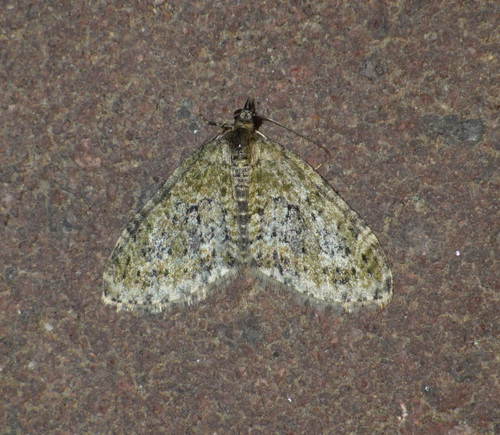
The wingspan ranges from 25–29 mm.It is slender, grey-green moth. The green colour fades quickly and older specimens tend to look yellowish. The forewing is yellowish olive-green, in the middle with a broad, grey transverse band that has wavy inner and outer edges. Along the outer edge of the wing there is a white band interrupted by small, black double spots, this is a characteristic feature. The hindwing is rather small with long hair fringes, silky greyish-white.

The caterpillar is green, more or less tinged with pinkish; it has three interrupted pink lines on the back, the central one sometimes inclining to purple, and broken up into large wine-red to red heart-shaped spots; the head is brown, sometimes marked with purplish, and there are two tiny points on the last segment. It varies in the green tint and also in marking.

Adults are on wing from mid-April to October in two generations in western Europe. The larvae feed on a wide variety of plants, including Rhamnus frangula, Hedera helix, Ligustrum, Ilex aquifolium, Cornus sanguinea and Sorbus aucuparia Wikipedia →

Global Distribution

Parks Where Found

# Park Country Daily sighting probability
1 Cairngorms National Park 🇬🇧 United Kingdom
~10%
2 Bavarian Forest National Park 🇩🇪 Germany
<5%
3 Pyrénées National Park 🇫🇷 France
<5%
4 Wadden Sea National Park 🇩🇪 Germany
<5%

Cities Where Found

# City Country Daily sighting probability
1 Liverpool 🇬🇧 United Kingdom
~10%
2 London 🇬🇧 United Kingdom
~10%
3 Birmingham 🇬🇧 United Kingdom
~10%
4 Manchester 🇬🇧 United Kingdom
<5%
5 Copenhagen 🇩🇰 Denmark
<5%

Before you go

What are the chances of seeing a Yellow-Barred Brindle in Wadden Sea National Park?

Rare

Under 5% of wildlife watchers report a Yellow-Barred Brindle sighting in Wadden Sea National Park on a given day, based on 6 verified sightings from GBIF citizen-science data from 2019 to 2026. It is the 699th most-seen of the 818 insects we can rate there. Over three days the chance rises to about 10%, and over a week to about 20%, if each day is a fresh chance.

When is the best time to see a Yellow-Barred Brindle in Wadden Sea National Park?

August

In that month about 10% of wildlife watchers report a Yellow-Barred Brindle in Wadden Sea National Park on a given day, against under 5% in September to July, the lowest months.

What time of day is best to see a Yellow-Barred Brindle?

Between 5 and 8 am

Across all the parks we cover, that three-hour window holds the most Yellow-Barred Brindle sightings with a recorded time, and about 6 in 10 of them come between 6 am and 6 pm: it is most active around dawn and dusk.

Which relatives of the Yellow-Barred Brindle live in Wadden Sea National Park?

Same family: Geometridae

The closest relatives of the Yellow-Barred Brindle that you can see in Wadden Sea National Park (family Geometridae, Geometer Moths) are Riband Wave (about 10%), Yellow Shell Moth (about 10%) and Small Engrailed (about 10%), with each one's daily chance of a sighting.

Where does the Yellow-Barred Brindle sighting chance come from?

GBIF citizen-science records

It is estimated from how often the Yellow-Barred Brindle is recorded against all the insects logged in Wadden Sea National Park (6 verified sightings from 2019 to 2026), calibrated against known sighting rates. Figures are rounded to the nearest 10% because citizen-science data supports honest approximations, not decimals, and months with records from fewer than five people show "—". How it works.

← Back to Wadden Sea National Park