Cape Gannet

Cape Gannet

Morus capensis

Silhouette: Raju Mondal · PhyloPic

LCNTVUENEndangeredCR
Daily sighting probability <5% · Rare
at West Coast National Park

In 3 days ~10% in a week ~20%

57 Verified sightings at West Coast National Park From 2019 to 2026
954 In all 6 parks
September Best month
☀️ Diurnal When it's spotted

About the Cape Gannet

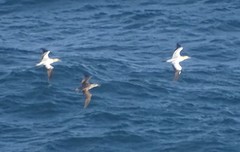
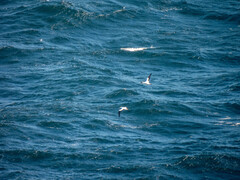
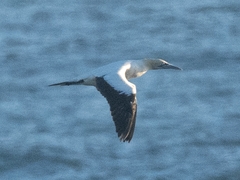
The Cape gannet (Morus capensis) is a large seabird of the gannet family, Sulidae. They are easily identified by their large size, black and white plumage and distinctive yellow crown and hindneck. The pale blue bill is pointed with fine serrations near the tip; perhaps because of the depth and speed of the gannet's dive when fishing (depending on altitude, gannets hit the water at speeds of between 40 and 86 km/h (25 and 53 mph)), its beak has no external nostrils into which the water might be forced. The widely mentioned maximum speed of 120 km/h has never been measured and published.

German naturalist Hinrich Lichtenstein described the Cape gannet in 1823. The Sulidae, the gannets and boobies, appeared about 30 million years ago. Early Sulidae fossils most resembled the boobies, although they were more aquatic, with the gannets splitting off later, about 16 million years ago. The gannets evolved in the northern hemisphere, later colonising the southern oceans. The most ancient extant species may be the Abbott's booby, possibly the sole survivor of an otherwise extinct separate lineage. A 2011 genetic study of nuclear and mitochondrial DNA suggests that the ancestor... Wikipedia →

Sounds

Uncertain0:34

South Africa · 2026

© JJSUN · XC1079085 · CC BY-NC-SA 4.0

Call1:14

South Africa · 2017

© Peter Boesman · XC392575 · CC BY-NC-ND 4.0

Colony with thousands calling1:11

South Africa · 2019

© Frank Lambert · XC515406 · CC BY-NC-ND 4.0

Global Distribution

Parks Where Found

# Park Country Daily sighting probability
1 Table Mountain National Park 🇿🇦 South Africa
~10%
2 Garden Route National Park 🇿🇦 South Africa
~10%
3 De Hoop Nature Reserve 🇿🇦 South Africa
~10%
4 iSimangaliso Wetland Park 🇿🇦 South Africa
~10%
5 West Coast National Park 🇿🇦 South Africa
<5%
6 Addo Elephant National Park 🇿🇦 South Africa
<5%

Cities Where Found

# City Country Daily sighting probability
1 Durban 🇿🇦 South Africa
<5%

Zoos & Centres Where Found

# Zoo / Centre Country
1 World of Birds Wildlife Sanctuary and Monkey Park 🇿🇦 South Africa In captivity
2 East London Aquarium 🇿🇦 South Africa In captivity
3 Southern African Foundation for the Conservation of Coastal Birds 🇿🇦 South Africa In captivity

Before you go

What are the chances of seeing a Cape Gannet in West Coast National Park?

Rare

Under 5% of wildlife watchers report a Cape Gannet sighting in West Coast National Park on a given day, based on 57 verified sightings from GBIF citizen-science data from 2019 to 2026. It is the 142nd most-seen of the 192 birds we can rate there. Over three days the chance rises to about 10%, and over a week to about 20%, if each day is a fresh chance.

When is the best time to see a Cape Gannet in West Coast National Park?

June and September

In those months about 10% of wildlife watchers report a Cape Gannet in West Coast National Park on a given day, against under 5% in July–August and October–May, the lowest months. Those are among West Coast National Park's wettest months, with about 50 mm of rain a month against 5 mm in February.

What time of day is best to see a Cape Gannet?

Between 8 and 11 am

Across all the parks we cover, that three-hour window holds the most Cape Gannet sightings with a recorded time, and about 9 in 10 of them come between 6 am and 6 pm: it is a daytime animal.

Which relatives of the Cape Gannet live in West Coast National Park?

Same order: Suliformes

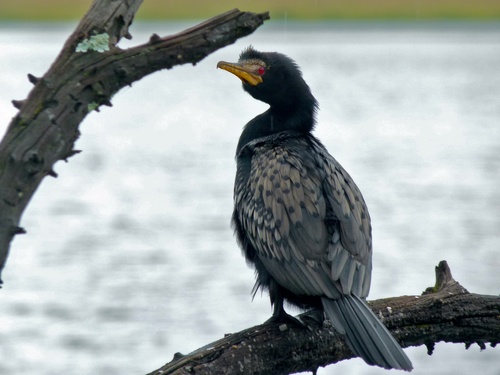
The closest relatives of the Cape Gannet that you can see in West Coast National Park (order Suliformes, Gannets, Cormorants, and Allies) are Great Cormorant (about 40%), Crowned Cormorant (about 30%) and Cape Cormorant (about 20%), with each one's daily chance of a sighting.

Where does the Cape Gannet sighting chance come from?

GBIF citizen-science records

It is estimated from how often the Cape Gannet is recorded against all the birds logged in West Coast National Park (57 verified sightings from 2019 to 2026), calibrated against known sighting rates. Figures are rounded to the nearest 10% because citizen-science data supports honest approximations, not decimals, and months with records from fewer than five people show "—". How it works.

← Back to West Coast National Park