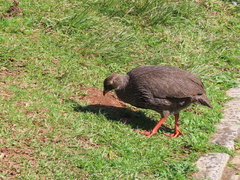

Cape Spurfowl

Cape Spurfowl

Pternistis capensis

Silhouette: Amanda Kuhlman · PhyloPic

LCLeast ConcernNTVUENCR
Daily sighting probability ~80% · Very likely
at West Coast National Park

In 3 days >90%

1,674 Verified sightings at West Coast National Park From 2019 to 2026
4,616 In all 4 parks
March Best month
☀️ Diurnal When it's spotted

About the Cape Spurfowl

The Cape spurfowl or Cape francolin (Pternistis capensis) is a gamebird in the pheasant family Phasianidae. It is endemic to southern Africa, where it is the largest francolin. It occurs in the Western Cape province of South Africa, and locally northwards to southern Namibia. It has adapted to alien vegetation and a variety of human-altered habitats, but scrubby roosting and nesting space is a prerequisite. The species is not threatened.

The English ornithologist John Latham described the Cape spurfowl in his A General Synopsis of Birds in 1783. He used the English name "Cape partridge", but did not introduce a Latin name. Six years later in 1789, when the German naturalist Johann Friedrich Gmelin updated Carl Linnaeus's Systema Naturae, he included a terse description of the Cape spurfowl, coined the binomial name Tetrao capensis and cited Latham's work. The specific epithet capensis is the Latin for the Cape of Good Hope. The species is now placed in the genus Pternistis that was introduced by the German naturalist Johann Georg Wagler in 1832. The Cape spurfowl is considered as monotypic: no subspecies are recognised. Its closest relative is the Natal spurfowl, which... Wikipedia →

Sounds

Call0:08

South Africa · 2024

© Nick Talbot · XC944472 · CC BY-NC-SA 4.0

Song0:12

South Africa · 2017

© Peter Boesman · XC392672 · CC BY-NC-ND 4.0

Recording0:19

South Africa · 2026

© Marion Maclean · iNaturalist · CC BY-NC 4.0

Global Distribution

Parks Where Found

# Park Country Daily sighting probability
1 West Coast National Park 🇿🇦 South Africa
~80%
2 De Hoop Nature Reserve 🇿🇦 South Africa
~60%
3 Table Mountain National Park 🇿🇦 South Africa
~30%
4 Garden Route National Park 🇿🇦 South Africa
<5%

Cities Where Found

# City Country Daily sighting probability
1 Cape Town 🇿🇦 South Africa
~20%

Before you go

What are the chances of seeing a Cape Spurfowl in West Coast National Park?

Very likely

About 80% of wildlife watchers report a Cape Spurfowl sighting in West Coast National Park on a given day, based on 1,674 verified sightings from GBIF citizen-science data from 2019 to 2026. It is the most-seen of the 192 birds we can rate there. Over three days the chance rises to over 90%, if each day is a fresh chance.

When is the best time to see a Cape Spurfowl in West Coast National Park?

March

In that month over 90% of wildlife watchers report a Cape Spurfowl in West Coast National Park on a given day, against about 70% in January and February, the lowest months. That is one of West Coast National Park's driest months, with about 15 mm of rain against 70 mm in June.

What time of day is best to see a Cape Spurfowl?

Between 3 and 6 pm

Across all the parks we cover, that three-hour window holds the most Cape Spurfowl sightings with a recorded time, and nearly all of them come between 6 am and 6 pm: it is a daytime animal.

Is West Coast National Park the best place to see a Cape Spurfowl?

Yes

Of the 4 parks where we can rate Cape Spurfowl sightings, West Coast National Park has the highest daily chance: about 80%. Next come De Hoop Nature Reserve (South Africa, about 60%) and Table Mountain National Park (South Africa, about 30%).

Where does the Cape Spurfowl sighting chance come from?

GBIF citizen-science records

It is estimated from how often the Cape Spurfowl is recorded against all the birds logged in West Coast National Park (1,674 verified sightings from 2019 to 2026), calibrated against known sighting rates. Figures are rounded to the nearest 10% because citizen-science data supports honest approximations, not decimals, and months with records from fewer than five people show "—". How it works.

← Back to West Coast National Park