Pied Starling

Pied Starling

Lamprotornis bicolor

Silhouette: Rafael Maia · PhyloPic

LCLeast ConcernNTVUENCR
Daily sighting probability ~50% · Likely
at West Coast National Park

In 3 days ~80% in a week >90%

596 Verified sightings at West Coast National Park From 2019 to 2026
1,120 In all 6 parks
June Best month
☀️ Diurnal When it's spotted

About the Pied Starling

The pied starling or African pied starling (Lamprotornis bicolor) is a bird endemic to South Africa, Lesotho and Eswatini. It is common in most of its range, but largely absent from the arid northwest and the eastern lowlands of South Africa. It is found in open habitats such as grassland, karoo scrub, thornbush and agricultural land, and often associates with farm animals.

The pied starling was formally described in 1789 by the German naturalist Johann Friedrich Gmelin in his revised and expanded edition of Carl Linnaeus's Systema Naturae. He placed it with the thrushes in the genus Turdus and coined the binomial name Turdus bicolor. Gmelin based his description on "Le merle brun du cap de Bonne Espérance" that had been described in 1775 by the French polymath Georges-Louis Leclerc, Comte de Buffon in his book Histoire Naturelle des Oiseaux. The pied starling is now placed in the genus Lamprotornis that was introduced in 1820 by the Dutch zoologist Coenraad Jacob Temminck. The species is monotypic: no subspecies are recognised.

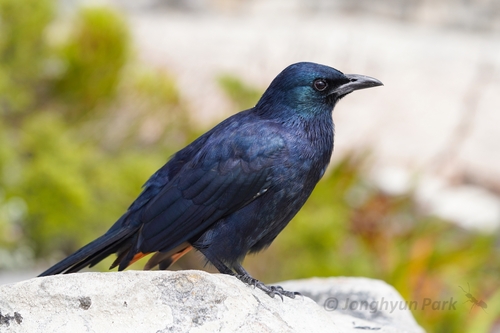
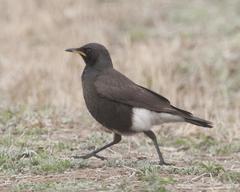
The adult of this 27–28 cm (11 in) long starling has mainly dully glossed black plumage except for a white lower belly and... Wikipedia →

Sounds

Call1:01

South Africa · 2015

© Lynette Rudman · XC277585 · CC BY-NC-SA 4.0

Song0:19

South Africa · 2010

© Charles Hesse · XC62297 · CC BY-NC-ND 2.5

Flight call0:17

South Africa · 2019

© Frank Lambert · XC523670 · CC BY-NC-ND 4.0

Global Distribution

Parks Where Found

# Park Country Daily sighting probability
1 Golden Gate Highlands National Park 🇿🇦 South Africa
~70%
2 West Coast National Park 🇿🇦 South Africa
~50%
3 De Hoop Nature Reserve 🇿🇦 South Africa
~40%
4 Addo Elephant National Park 🇿🇦 South Africa
~30%
5 uMkhuze Game Reserve 🇿🇦 South Africa
<5%
6 Kruger National Park 🇿🇦 South Africa
<5%

Cities Where Found

# City Country Daily sighting probability
1 Pretoria 🇿🇦 South Africa
<5%
2 Johannesburg 🇿🇦 South Africa
<5%

Zoos & Centres Where Found

# Zoo / Centre Country
1 World of Birds Wildlife Sanctuary and Monkey Park 🇿🇦 South Africa In captivity
2 Birds of Eden 🇿🇦 South Africa In captivity

Before you go

What are the chances of seeing a Pied Starling in West Coast National Park?

Likely

About 50% of wildlife watchers report a Pied Starling sighting in West Coast National Park on a given day, based on 596 verified sightings from GBIF citizen-science data from 2019 to 2026. It is the 42nd most-seen of the 192 birds we can rate there. Over three days the chance rises to about 80%, and over a week to over 90%, if each day is a fresh chance.

When is the best time to see a Pied Starling in West Coast National Park?

June and October

In those months about 70% of wildlife watchers report a Pied Starling in West Coast National Park on a given day, against about 30% in December, the lowest month. Those are among West Coast National Park's wettest months, with about 45 mm of rain a month against 5 mm in February.

What time of day is best to see a Pied Starling?

Between 10 am and 1 pm

Across all the parks we cover, that three-hour window holds the most Pied Starling sightings with a recorded time, and nearly all of them come between 6 am and 6 pm: it is a daytime animal.

Is West Coast National Park the best place to see a Pied Starling?

2nd of 6

Of the 6 parks where we can rate Pied Starling sightings, West Coast National Park ranks 2nd at about 50%. The best odds are in Golden Gate Highlands National Park (South Africa, about 70%). All parks ranked.

Which relatives of the Pied Starling live in West Coast National Park?

Same family: Sturnidae

The closest relatives of the Pied Starling that you can see in West Coast National Park (family Sturnidae, Starlings) are European Starling (about 60%) and Wattled Starling (about 10%), with each one's daily chance of a sighting.

Where does the Pied Starling sighting chance come from?

GBIF citizen-science records

It is estimated from how often the Pied Starling is recorded against all the birds logged in West Coast National Park (596 verified sightings from 2019 to 2026), calibrated against known sighting rates. Figures are rounded to the nearest 10% because citizen-science data supports honest approximations, not decimals, and months with records from fewer than five people show "—". How it works.

← Back to West Coast National Park