Red-headed Cisticola

Red-headed Cisticola

Cisticola subruficapilla

Silhouette: Sheatherius · PhyloPic

LCLeast ConcernNTVUENCR
Daily sighting probability ~50% · Likely
at West Coast National Park

In 3 days ~90% in a week >90%

869 Verified sightings at West Coast National Park From 2019 to 2026
1,643 In all 5 parks
July Best month
☀️ Diurnal When it's spotted

About the Red-headed Cisticola

The grey-backed cisticola or red-headed cisticola (Cisticola subruficapilla) is a small passerine bird. This cisticola is a resident breeder in southernmost Angola, Namibia and western South Africa. The grey-backed cisticola is a very common bird of coastal fynbos, karoo shrub and grassy areas on estuarine flats.

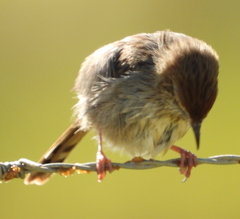
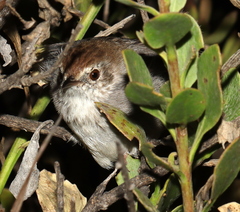
The grey-backed cisticola is a small, 13–14 cm long, vocal, dull-coloured bird with a dark rufous crown to its reddish head. It has a rufous panel in the folded wing. The grey bill is short and straight, and the feet and legs are pinkish-brown. The eye is light brown.

The southern form, "grey-backed cisticola" proper, found in southern Namibia and South Africa has a grey back heavily streaked with black. Its underparts are greyish white. Although cisticolas can be very similar in plumage, this greyish subspecies is quite distinctive. The northern subspecies has a brown back heavily streaked with black and cold buff underparts. It is very similar to the wailing cisticola, Cisticola lais, of eastern South Africa, but that species has warmer buff underparts and does not overlap in range.

The sexes are similar, but juvenile birds are duller with a yellow face... Wikipedia →

Sounds

Call0:15

South Africa · 2022

© Lynette Rudman · XC743094 · CC BY-NC-SA 4.0

Song0:13

South Africa · 2019

© Frank Lambert · XC512645 · CC BY-NC-ND 4.0

Alarm call0:34

South Africa · 2017

© Faansie Peacock · XC388286 · CC BY-NC-SA 4.0

Global Distribution

Parks Where Found

# Park Country Daily sighting probability
1 West Coast National Park 🇿🇦 South Africa
~50%
2 De Hoop Nature Reserve 🇿🇦 South Africa
~30%
3 Table Mountain National Park 🇿🇦 South Africa
~10%
4 Namib-Naukluft National Park 🇳🇦 Namibia
<5%
5 Addo Elephant National Park 🇿🇦 South Africa
<5%

Cities Where Found

# City Country Daily sighting probability
1 Cape Town 🇿🇦 South Africa
<5%

Before you go

What are the chances of seeing a Red-headed Cisticola in West Coast National Park?

Likely

About 50% of wildlife watchers report a Red-headed Cisticola sighting in West Coast National Park on a given day, based on 869 verified sightings from GBIF citizen-science data from 2019 to 2026. It is the 36th most-seen of the 192 birds we can rate there. Over three days the chance rises to about 90%, and over a week to over 90%, if each day is a fresh chance.

When is the best time to see a Red-headed Cisticola in West Coast National Park?

July and October

In those months about 70% of wildlife watchers report a Red-headed Cisticola in West Coast National Park on a given day, against about 30% in December and January, the lowest months. Those are among West Coast National Park's wettest months, with about 40 mm of rain a month against 5 mm in February.

What time of day is best to see a Red-headed Cisticola?

Between 9 am and noon

Across all the parks we cover, that three-hour window holds the most Red-headed Cisticola sightings with a recorded time, and nearly all of them come between 6 am and 6 pm: it is a daytime animal.

Is West Coast National Park the best place to see a Red-headed Cisticola?

Yes

Of the 5 parks where we can rate Red-headed Cisticola sightings, West Coast National Park has the highest daily chance: about 50%. Next come De Hoop Nature Reserve (South Africa, about 30%) and Table Mountain National Park (South Africa, about 10%).

Where does the Red-headed Cisticola sighting chance come from?

GBIF citizen-science records

It is estimated from how often the Red-headed Cisticola is recorded against all the birds logged in West Coast National Park (869 verified sightings from 2019 to 2026), calibrated against known sighting rates. Figures are rounded to the nearest 10% because citizen-science data supports honest approximations, not decimals, and months with records from fewer than five people show "—". How it works.

← Back to West Coast National Park