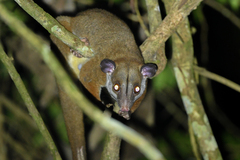
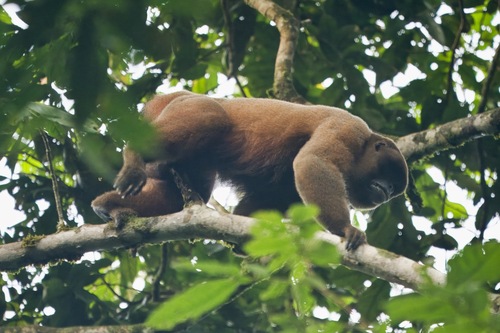
Brown-eared Woolly Opossum

Brown-eared Woolly Opossum

Caluromys lanatus

Silhouette: Milena Cavalcanti, Patricia Pilatti & Diego Astúa · PhyloPic

LCLeast ConcernNTVUENCR
Daily sighting probability ~10% · With luck
at Yasuní National Park

In 3 days ~20% in a week ~50%

6 Verified sightings at Yasuní National Park From 2019 to 2026
13 In all 2 parks
August Best month
☀️🌙 Day & Night When it's spotted

About the Brown-eared Woolly Opossum

The brown-eared woolly opossum (Caluromys lanatus), also known as the western woolly opossum, is an opossum from South America. It was first described by German naturalist Ignaz von Olfers in 1818. The opossum is characterized by a brown to reddish brown coat and similarly colored limbs, yellow to orange underbelly, hairless, brown ears with a hint of pink, and a tail furred on the back for up to half of its length. The brown-eared woolly opossum is nocturnal (active mainly at night), solitary and omnivorous. The IUCN lists it as least concern.

The brown-eared woolly opossum is one of the three members of Caluromys, and is placed in the family Didelphidae. It was first described by German naturalist Ignaz von Olfers as Didelphys lanata in 1818. It was given its present binomial name, Caluromys lanatus, by American zoologist Joel Asaph Allen in 1900.

A 1955 revision of marsupial phylogeny grouped Caluromys, Caluromysiops, Dromiciops (monito del monte) and Glironia (bushy-tailed opossum) under a single subfamily, Microbiotheriinae, noting the dental similarities among these. A 1977 study argued that these similarities are the result of convergent evolution, and placed Caluromys... Wikipedia →

Global Distribution

Parks Where Found

# Park Country Daily sighting probability
1 Yasuní National Park 🇪🇨 Ecuador
~10%
2 Manu National Park 🇵🇪 Peru
~10%

Closest Relatives at Yasuní National Park

No species of the same family or order lives in Yasuní National Park, so these are its closest relatives here: other mammals.

Before you go

What are the chances of seeing a Brown-eared Woolly Opossum in Yasuní National Park?

With luck

About 10% of wildlife watchers report a Brown-eared Woolly Opossum sighting in Yasuní National Park on a given day, based on 6 verified sightings from GBIF citizen-science data from 2019 to 2026. It is the 27th most-seen of the 33 mammals we can rate there. Over three days the chance rises to about 20%, and over a week to about 50%, if each day is a fresh chance.

When is the best time to see a Brown-eared Woolly Opossum in Yasuní National Park?

February, August and November

In those months about 20% of wildlife watchers report a Brown-eared Woolly Opossum in Yasuní National Park on a given day, against under 5% in April–May, July, September–October and December–January, the lowest months.

What time of day is best to see a Brown-eared Woolly Opossum?

Between 6 and 9 pm

Across all the parks we cover, that three-hour window holds the most Brown-eared Woolly Opossum sightings with a recorded time, and about 6 in 10 of them come between 6 pm and 6 am: it is seen both by day and at night.

Is Yasuní National Park the best place to see a Brown-eared Woolly Opossum?

Yes

Of the 2 parks where we can rate Brown-eared Woolly Opossum sightings, Yasuní National Park has the highest daily chance: about 10%. Next come Manu National Park (Peru, about 10%).

Where does the Brown-eared Woolly Opossum sighting chance come from?

GBIF citizen-science records

It is estimated from how often the Brown-eared Woolly Opossum is recorded against all the mammals logged in Yasuní National Park (6 verified sightings from 2019 to 2026), calibrated against known sighting rates. Figures are rounded to the nearest 10% because citizen-science data supports honest approximations, not decimals, and months with records from fewer than five people show "—". How it works.

← Back to Yasuní National Park