Salvin's Curassow

Salvin's Curassow

Mitu salvini

Silhouette: Sheatherius · PhyloPic

LCLeast ConcernNTVUENCR
Daily sighting probability ~10% · With luck
at Yasuní National Park

In 3 days ~20% in a week ~50%

335 Verified sightings at Yasuní National Park From 2019 to 2026
335 In 1 park
June Best month
☀️ Diurnal When it's spotted

About the Salvin's Curassow

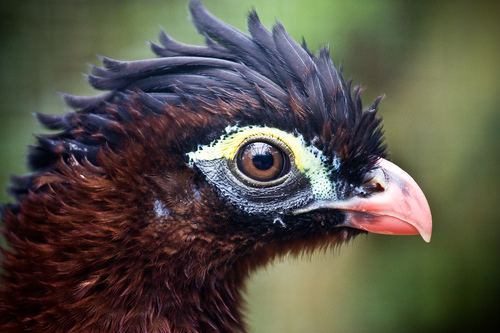
Salvin's curassow (Mitu salvini) is a species of bird in the family Cracidae, the chachalacas, guans, and curassows. It is found in Colombia, Ecuador, and Peru. Salvin's curassow for a time was placed in genus Crax but genetic data confirm that Mitu is a valid genus. Salvin's curassow is monotypic.

Salvin's curassow is 75 to 89 cm (2.5 to 2.9 ft) long and weighs about 3,100 g (6.8 lb). It is mostly black with little gloss. The belly and the end of the tail feathers are white. It has an erectile crest that is usually carried flat.

Salvin's curassow is found east of the Andes in southern Colombia, eastern Ecuador, and northern Peru. It inhabits humid terra firme, primarily at the beginning of the wet season (March to April), and várzea before and after that period. It prefers primary forest. In elevation it ranges as high as about 400 m (1,300 ft) in Ecuador and 600 m (2,000 ft) in Colombia. Historically it had been found up to about 900 m (3,000 ft).

Salvin's curassow is basically sedentary, though pairs may shift their territories seasonally in response to food availability... Wikipedia →

Sounds

Dawn song0:23

Ecuador · 2026

© Manuel Sánchez-Nivicela · XC1163357 · CC BY-NC-ND 4.0

Call0:36

Ecuador · 2025

© Marc Anderson · XC984254 · CC BY-NC-ND 4.0

Song0:42

Ecuador · 1994

© Robert S. Ridgely · XC274924 · CC BY-NC-SA 4.0

Global Distribution

Parks Where Found

# Park Country Daily sighting probability
1 Yasuní National Park 🇪🇨 Ecuador
~10%

More parks will be added in future updates.

Zoos & Centres Where Found

# Zoo / Centre Country
1 Zoo Criadero Tarqui 🇪🇨 Ecuador In captivity

Before you go

What are the chances of seeing a Salvin's Curassow in Yasuní National Park?

With luck

About 10% of wildlife watchers report a Salvin's Curassow sighting in Yasuní National Park on a given day, based on 335 verified sightings from GBIF citizen-science data from 2019 to 2026. It is the 188th most-seen of the 533 birds we can rate there. Over three days the chance rises to about 20%, and over a week to about 50%, if each day is a fresh chance.

When is the best time to see a Salvin's Curassow in Yasuní National Park?

June

In that month about 20% of wildlife watchers report a Salvin's Curassow in Yasuní National Park on a given day, against under 5% in January, April and September, the lowest months.

What time of day is best to see a Salvin's Curassow?

Between 7 and 10 am

Across all the parks we cover, that three-hour window holds the most Salvin's Curassow sightings with a recorded time, and about 8 in 10 of them come between 6 am and 6 pm: it is a daytime animal.

Where else can you see a Salvin's Curassow?

Only Yasuní National Park, in our data

Yasuní National Park is the only park on Wallace's Line with enough records to rate Salvin's Curassow sightings: about 10% of wildlife watchers there report one on a given day.

Which relatives of the Salvin's Curassow live in Yasuní National Park?

Same family: Cracidae

The closest relatives of the Salvin's Curassow that you can see in Yasuní National Park (family Cracidae, Guans, Chachalacas, and Curassows) are Speckled Chachalaca (about 40%), Blue-throated Piping-Guan (about 30%) and Spix's Guan (about 20%), with each one's daily chance of a sighting.

Where does the Salvin's Curassow sighting chance come from?

GBIF citizen-science records

It is estimated from how often the Salvin's Curassow is recorded against all the birds logged in Yasuní National Park (335 verified sightings from 2019 to 2026), calibrated against known sighting rates. Figures are rounded to the nearest 10% because citizen-science data supports honest approximations, not decimals, and months with records from fewer than five people show "—". How it works.

← Back to Yasuní National Park