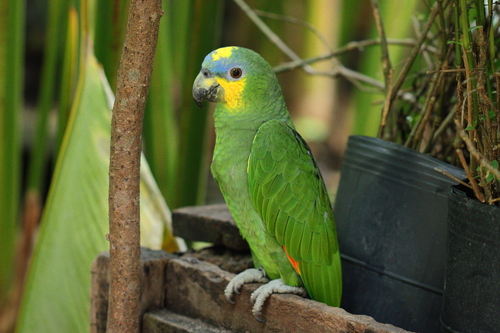
Cobalt-winged Parakeet

Cobalt-winged Parakeet

Brotogeris cyanoptera

Silhouette: Myriam Ramirez · PhyloPic

LCLeast ConcernNTVUENCR
Daily sighting probability ~50% · Likely
at Yasuní National Park

In 3 days ~90% in a week >90%

1,953 Verified sightings at Yasuní National Park From 2019 to 2026
4,752 In all 6 parks
October Best month
☀️ Diurnal When it's spotted

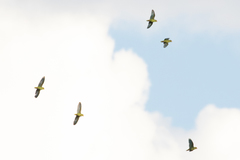
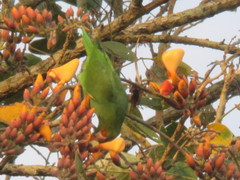
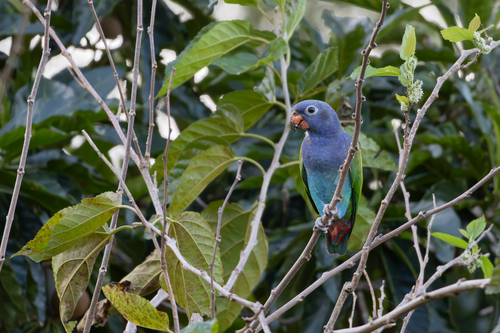
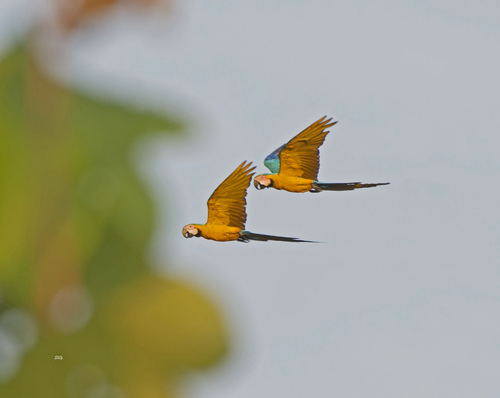
About the Cobalt-winged Parakeet

The cobalt-winged parakeet (Brotogeris cyanoptera) is a species of bird in subfamily Arinae of the family Psittacidae, the African and New World parrots. It is found in Bolivia, Brazil, Colombia, Ecuador, Guyana, Peru, and Venezuela.

The International Ornithological Committee and the Clements taxonomy attribute the first description of the cobalt-winged parakeet to August von Pelzeln, dated 1870. Pelzeln called it Sittace cyanoptera and separated it from what is now the orange-chinned parakeet (Brotogeris jugularis). Peters, in his Check-list of Birds of the World, cited Tommaso Salvadori (1891) as the originator, and this citation is used by BirdLife International's Handbook of the Birds of the World.

The cobalt-winged parakeet has these three subspecies: Subspecies B. c. gustavi has been treated as a separate species by some authors. The cobalt-winged and golden-winged parakeet (B. chrysoptera) are sister species. The cobalt-winged parakeet is 18 to 20 cm (7.1 to 7.9 in) long and weighs an average of 67 g (2.4 oz). The species is almost... Wikipedia →

Sounds

Song0:19

Brazil · 2026

© JAYRSON ARAUJO DE OLIVEIRA · XC1186238 · CC BY-NC-SA 4.0

Call0:26

Ecuador · 2024

© Manuel Sánchez-Nivicela · XC1163907 · CC BY-NC-ND 4.0

Flight call0:37

Colombia · 2022

© Frank Lambert · XC1141374 · CC BY-NC-ND 4.0

Global Distribution

Parks Where Found

# Park Country Daily sighting probability
1 Yasuní National Park 🇪🇨 Ecuador
~50%
2 Tambopata National Reserve 🇵🇪 Peru
~40%
3 Cuyabeno Wildlife Reserve 🇪🇨 Ecuador
~40%
4 Sierra de la Macarena National Park 🇨🇴 Colombia
~20%
5 Manu National Park 🇵🇪 Peru
~20%
6 Amacayacu National Natural Park 🇨🇴 Colombia
~10%

Zoos & Centres Where Found

# Zoo / Centre Country
1 Parque Natural de Pucallpa 🇵🇪 Peru In captivity
2 Loro Parque 🇪🇸 Spain In captivity
3 Agroflori Parque de las Aves 🇧🇴 Bolivia In captivity
4 Selva Viva Park 🇵🇪 Peru In captivity
5 Aquarium Paradise 🇮🇳 India In captivity

Before you go

What are the chances of seeing a Cobalt-winged Parakeet in Yasuní National Park?

Likely

About 50% of wildlife watchers report a Cobalt-winged Parakeet sighting in Yasuní National Park on a given day, based on 1,953 verified sightings from GBIF citizen-science data from 2019 to 2026. It is the 5th most-seen of the 533 birds we can rate there. Over three days the chance rises to about 90%, and over a week to over 90%, if each day is a fresh chance.

When is the best time to see a Cobalt-winged Parakeet in Yasuní National Park?

August and October

In those months about 60% of wildlife watchers report a Cobalt-winged Parakeet in Yasuní National Park on a given day, against about 30% in April, the lowest month.

What time of day is best to see a Cobalt-winged Parakeet?

Between 9 am and noon

Across all the parks we cover, that three-hour window holds the most Cobalt-winged Parakeet sightings with a recorded time, and about 9 in 10 of them come between 6 am and 6 pm: it is a daytime animal.

Which relatives of the Cobalt-winged Parakeet live in Yasuní National Park?

Same family: Psittacidae

The closest relatives of the Cobalt-winged Parakeet that you can see in Yasuní National Park (family Psittacidae, New World and African Parrots) are Mealy Parrot (about 40%), Blue-headed Parrot (about 40%) and Red-bellied Macaw (about 40%), with each one's daily chance of a sighting.

Where does the Cobalt-winged Parakeet sighting chance come from?

GBIF citizen-science records

It is estimated from how often the Cobalt-winged Parakeet is recorded against all the birds logged in Yasuní National Park (1,953 verified sightings from 2019 to 2026), calibrated against known sighting rates. Figures are rounded to the nearest 10% because citizen-science data supports honest approximations, not decimals, and months with records from fewer than five people show "—". How it works.

← Back to Yasuní National Park