About the Trinidad Bat-Cave Roach
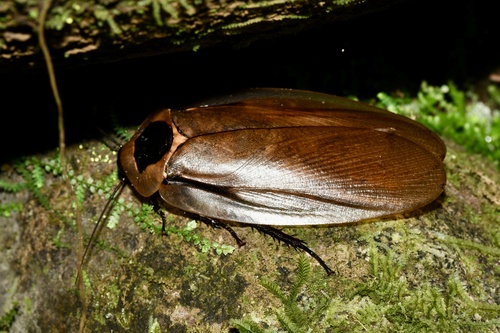
Eublaberus distanti, known as the Six-spotted cockroach, Four-spotted cockroach, Four-spot cockroach, or Trinidad bat-cave cockroach, is a primarily cave-dwelling Central and South American cockroach of the genus Eublaberus (Hebard, 1920) and named after William Lucas Distant.
Nymphs turn a dark brown, and the common name "six spotted cockroach" refers to six yellow spots along the sides of the nymph. Adults of both genders have wings but do not fly. They grow to approximately 6.4 cm (2.5 in) in length. Males are generally smaller than females, with longer wings, and a small rear sternite compared to females.
E. distanti are found in Trinidad and Tobago, Guatemala, Costa Rica, Panama, Colombia, French Guiana, Suriname, Guyana, Brazil, and Peru. E. distanti in Trinidad were observed to prefer relatively dry guano-rich areas in caves, but are occasionally found in rotting logs, under decaying litter, in epiphytes, and in "the rot holes and hollows of trees, particularly those that house bats." Nymphs burrow in organically rich soil on cave floors until their 6th or 7th instar, then climb onto rocky, often guano-covered walls. Caves with guano support typically... Wikipedia →