Ensatina

Ensatina

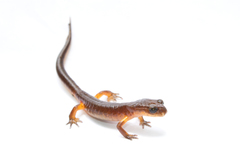
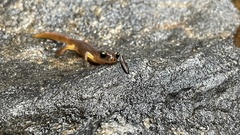
Ensatina eschscholtzii

Silhouette: C. Camilo Julián-Caballero · PhyloPic

LCLeast ConcernNTVUENCR Endemic
Daily sighting probability ~10% · With luck
at Yosemite National Park

In 3 days ~30% in a week ~60%

39 Verified sightings at Yosemite National Park From 2019 to 2026
560 In all 5 parks
December Best month
☀️🌙 Day & Night When it's spotted

About the Ensatina

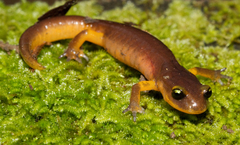
The ensatina (Ensatina eschscholtzii) is a species complex of plethodontid (lungless) salamanders found in coniferous forests, oak woodland and chaparral from British Columbia, through Washington, Oregon, across California (where all seven subspecies variations are located), all the way down to Baja California in Mexico. The genus Ensatina originated approximately 21.5 million years ago. It is usually considered as monospecific, being represented by a single species, Ensatina eschscholtzii, with several subspecies forming a ring species.

The subspecies Ensatina e. eschscholtzii, the Monterey ensatina, can be found in Santa Cruz and Monterey Counties and into the California coastal mountains. With a head-to-tail length of just between 3–5 in (7.6–12.7 cm), E. e. eschecholtzi can be identified primarily by its tail, which is narrower at the base; it is the only subspecies that has such a tail structure, as well as five toes on the hind limbs.

Males often have longer tails than the females, and many of these salamanders have lighter-colored limbs, compared to the rest of the body. The adult females lay eggs underground, often in sets of threes, which hatch directly into... Wikipedia →

Global Distribution

Parks Where Found

# Park Country Daily sighting probability
1 Redwood National Park 🇺🇸 United States
~60%
2 Sequoia and Kings Canyon National Parks 🇺🇸 United States
~30%
3 Yosemite National Park 🇺🇸 United States
~10%
4 Olympic National Park 🇺🇸 United States
~10%
5 Great Bear Rainforest 🇨🇦 Canada
<5%

Cities Where Found

# City Country Daily sighting probability
1 Portland 🇺🇸 United States
~20%
2 Seattle 🇺🇸 United States
~10%
3 Vancouver 🇨🇦 Canada
~10%
4 San Francisco 🇺🇸 United States
<5%

Zoos & Centres Where Found

# Zoo / Centre Country
1 Vancouver Aquarium 🇨🇦 Canada In captivity

Before you go

What are the chances of seeing an Ensatina in Yosemite National Park?

With luck

About 10% of wildlife watchers report an Ensatina sighting in Yosemite National Park on a given day, based on 39 verified sightings from GBIF citizen-science data from 2019 to 2026. It is the 5th most-seen of the 9 amphibians we can rate there. Over three days the chance rises to about 30%, and over a week to about 60%, if each day is a fresh chance.

When is the best time to see an Ensatina in Yosemite National Park?

February and December

In those months about 30% of wildlife watchers report an Ensatina in Yosemite National Park on a given day, against under 5% in January and July, the lowest months. Those are among Yosemite National Park's wettest months, with about 170 mm of rain a month against 25 mm in September.

What time of day is best to see an Ensatina?

Between 1 and 4 pm

Across all the parks we cover, that three-hour window holds the most Ensatina sightings with a recorded time, and about 7 in 10 of them come between 6 am and 6 pm: it is seen both by day and at night.

Is Yosemite National Park the best place to see an Ensatina?

3rd of 5

Of the 5 parks where we can rate Ensatina sightings, Yosemite National Park ranks 3rd at about 10%. The best odds are in Redwood National Park (United States, about 60%) and Sequoia and Kings Canyon National Parks (United States, about 30%).

Where does the Ensatina sighting chance come from?

GBIF citizen-science records

It is estimated from how often the Ensatina is recorded against all the amphibians logged in Yosemite National Park (39 verified sightings from 2019 to 2026), calibrated against known sighting rates. Figures are rounded to the nearest 10% because citizen-science data supports honest approximations, not decimals, and months with records from fewer than five people show "—". How it works.

← Back to Yosemite National Park