Rocky Mountain Parnassian

Rocky Mountain Parnassian

Parnassius smintheus

Daily sighting probability ~10% · With luck
at Yosemite National Park

In 3 days ~20% in a week ~40%

21 Verified sightings at Yosemite National Park From 2019 to 2026
571 In all 9 parks
August Best month
☀️ Diurnal When it's spotted

About the Rocky Mountain Parnassian

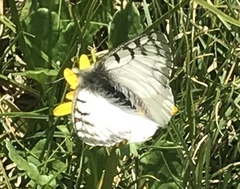
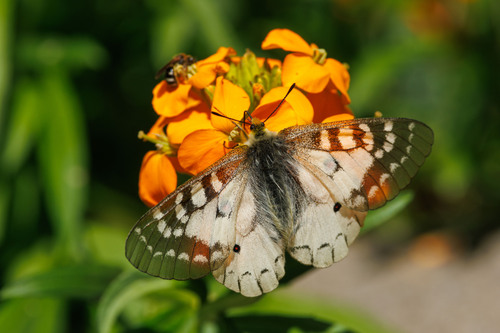
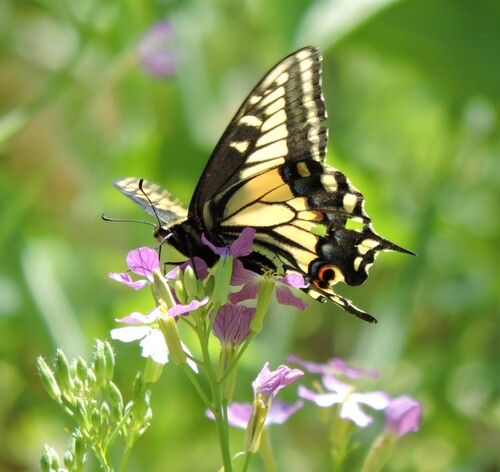
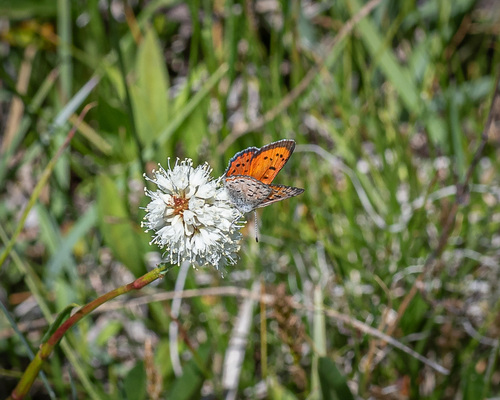
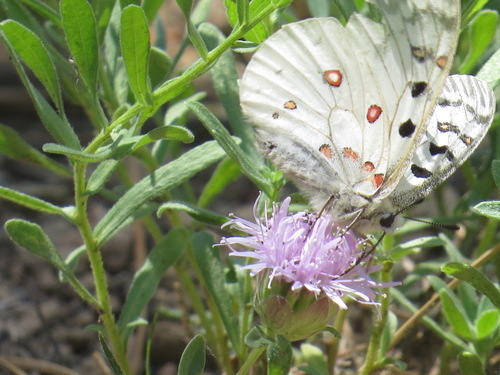
Parnassius smintheus, the Rocky Mountain parnassian or Rocky Mountain apollo, is a high-altitude butterfly found in the Rocky Mountains throughout the United States and Canada. It is a member of the snow Apollo genus (Parnassius) of the swallowtail family (Papilionidae). The butterfly ranges in color from white to pale yellow-brown, with red and black markings that indicate to predators it is unpalatable.

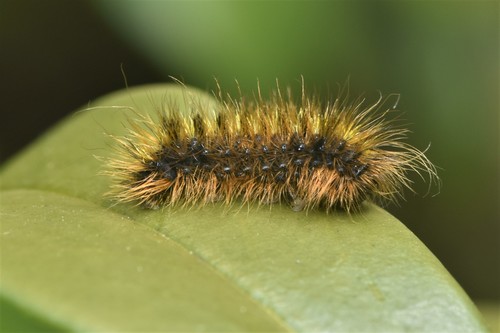
Parnassius smintheus primarily feeds on the leaves of the Sedum lanceolatum plant as larvae and on its nectar as adults. The butterfly tends to reside in meadows and avoids forests, because it strongly prefers light. The males of this species fly from meadow to meadow frequently to find females and food resources, whereas females are more likely to avoid flying. The males seem to have mate choice in this species, as they emerge from the pupae earlier than the females and patrol for females, heavily preferring newly emerged females that have not yet flown.

Although the species is not yet endangered, the climate change and human activity over the last few decades have reduced its viable habitats, and this process is continuing. The range of the butterfly is based... Wikipedia →
Global Distribution

Parks Where Found

# Park Country Daily sighting probability
1 Rocky Mountain National Park 🇺🇸 United States
~30%
2 Kluane National Park 🇨🇦 Canada
~20%
3 Yellowstone National Park 🇺🇸 United States
~20%
4 Glacier National Park 🇺🇸 United States
~20%
5 Olympic National Park 🇺🇸 United States
~10%
6 Grand Teton National Park 🇺🇸 United States
~10%
7 Yosemite National Park 🇺🇸 United States
~10%
8 Sequoia and Kings Canyon National Parks 🇺🇸 United States
~10%
9 Banff National Park 🇨🇦 Canada
~10%

Before you go

What are the chances of seeing a Rocky Mountain Parnassian in Yosemite National Park?

With luck

About 10% of wildlife watchers report a Rocky Mountain Parnassian sighting in Yosemite National Park on a given day, based on 21 verified sightings from GBIF citizen-science data from 2019 to 2026. It is the 81st most-seen of the 227 insects we can rate there. Over three days the chance rises to about 20%, and over a week to about 40%, if each day is a fresh chance.

When is the best time to see a Rocky Mountain Parnassian in Yosemite National Park?

July to October

In those months about 10% of wildlife watchers report a Rocky Mountain Parnassian in Yosemite National Park on a given day, against under 5% in November to June, the lowest months. Those are among Yosemite National Park's driest months, with about 30 mm of rain a month against 220 mm in January.

What time of day is best to see a Rocky Mountain Parnassian?

Between 11 am and 2 pm

Across all the parks we cover, that three-hour window holds the most Rocky Mountain Parnassian sightings with a recorded time, and about 9 in 10 of them come between 6 am and 6 pm: it is a daytime animal.

Is Yosemite National Park the best place to see a Rocky Mountain Parnassian?

7th of 9

Of the 9 parks where we can rate Rocky Mountain Parnassian sightings, Yosemite National Park ranks 7th at about 10%. The best odds are in Rocky Mountain National Park (United States, about 30%), Kluane National Park (Canada, about 20%) and Yellowstone National Park (United States, about 20%).

Where does the Rocky Mountain Parnassian sighting chance come from?

GBIF citizen-science records

It is estimated from how often the Rocky Mountain Parnassian is recorded against all the insects logged in Yosemite National Park (21 verified sightings from 2019 to 2026), calibrated against known sighting rates. Figures are rounded to the nearest 10% because citizen-science data supports honest approximations, not decimals, and months with records from fewer than five people show "—". How it works.

← Back to Yosemite National Park