Gisborne Cockroach

Gisborne Cockroach

Drymaplaneta semivitta

Daily sighting probability ~10% · With luck
at Abel Tasman National Park

In 3 days ~30% in a week ~50%

6 Verified sightings at Abel Tasman National Park From 2019 to 2026
6 In 1 park
July Best month
🌙 Nocturnal When it's spotted

About the Gisborne Cockroach

Drymaplaneta semivitta is a species of cockroach native to Australia and introduced to New Zealand. In New Zealand, it is known as the Gisborne cockroach, after the city of Gisborne where it was first discovered in the country. It has also been claimed to have first appeared in Tauranga in 1954, probably arriving on a log shipment.

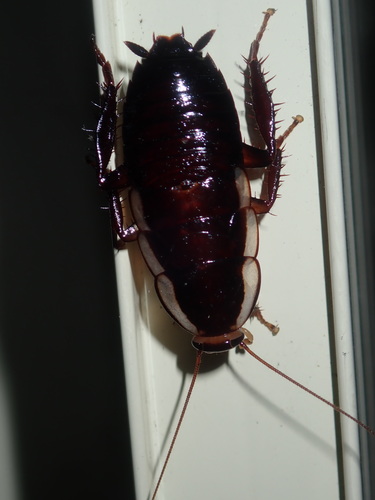
One of the larger cockroaches, Drymaplaneta semivitta is about 20–45mm long and 12–15mm wide. It is a glossy dark brown, with distinctive tan or white coloured translucent stripes along each side of its head. Unlike many cockroaches, it has no vestigial wings.

In males, the third and fourth maxillary palps are enlarged, and the hind tibiae are flattened and expanded. Drymaplaneta semivitta is often found in wood material, such as timber or bark chips. It feeds off organic material but does not normally infest food. In cold weather, it can be found in roof cavities and the empty spaces between walls. D. semivitta is generally regarded as harmless.

Hex-2-enal is present in the defensive secretions of D. semivitta. This chemical also occurs in some other species of Drymaplaneta. Drymaplaneta... Wikipedia →
Global Distribution

Parks Where Found

# Park Country Daily sighting probability
1 Abel Tasman National Park 🇳🇿 New Zealand
~10%

More parks will be added in future updates.

Cities Where Found

# City Country Daily sighting probability
1 Auckland 🇳🇿 New Zealand
~10%
2 Perth 🇦🇺 Australia
~10%
3 Melbourne 🇦🇺 Australia
~10%
4 Sydney 🇦🇺 Australia
<5%

Closest Relatives at Abel Tasman National Park

No species of the same family or order lives in Abel Tasman National Park, so these are its closest relatives here: other insects.

Before you go

What are the chances of seeing a Gisborne Cockroach in Abel Tasman National Park?

With luck

About 10% of wildlife watchers report a Gisborne Cockroach sighting in Abel Tasman National Park on a given day, based on 6 verified sightings from GBIF citizen-science data from 2019 to 2026. It is the 44th most-seen of the 64 insects we can rate there. Over three days the chance rises to about 30%, and over a week to about 50%, if each day is a fresh chance.

When is the best time to see a Gisborne Cockroach in Abel Tasman National Park?

June and July

In those months about 20% of wildlife watchers report a Gisborne Cockroach in Abel Tasman National Park on a given day, against under 5% in February, April–May and August–October, the lowest months.

What time of day is best to see a Gisborne Cockroach?

Between 6 and 9 pm

Across all the parks we cover, that three-hour window holds the most Gisborne Cockroach sightings with a recorded time, and nearly all of them come between 6 pm and 6 am: it is mostly seen at night.

Where else can you see a Gisborne Cockroach?

Only Abel Tasman National Park, in our data

Abel Tasman National Park is the only park on Wallace's Line with enough records to rate Gisborne Cockroach sightings: about 10% of wildlife watchers there report one on a given day.

Where does the Gisborne Cockroach sighting chance come from?

GBIF citizen-science records

It is estimated from how often the Gisborne Cockroach is recorded against all the insects logged in Abel Tasman National Park (6 verified sightings from 2019 to 2026), calibrated against known sighting rates. Figures are rounded to the nearest 10% because citizen-science data supports honest approximations, not decimals, and months with records from fewer than five people show "—". How it works.

← Back to Abel Tasman National Park