
Manuka Beetle

Manuka Beetle

Pyronota festiva

Endemic
Daily sighting probability ~10% · With luck
at Abel Tasman National Park

In 3 days ~30% in a week ~50%

9 Verified sightings at Abel Tasman National Park From 2019 to 2026
26 In all 3 parks
December Best month
☀️ Diurnal When it's spotted

About the Manuka Beetle

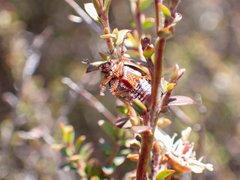
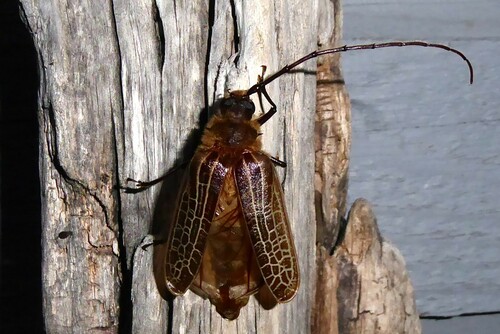
Pyronota festiva, commonly known as mānuka beetle or mānuka chafer, as well as the Kerewai Beetle is a member of the genus Pyronota of the beetle family Scarabaeidae (order Coleoptera). It is a scarab beetle endemic to New Zealand, and is commonly found in mānuka trees (Leptospermum scoparium), hence the beetle's name. In some areas it is considered a pasture pest.

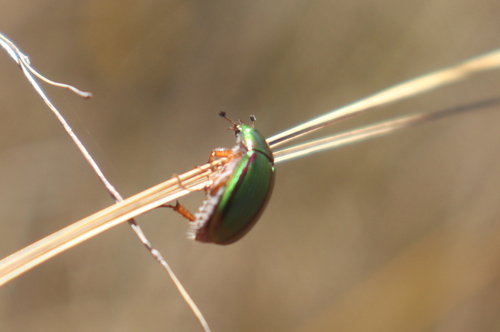
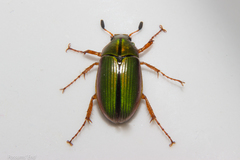
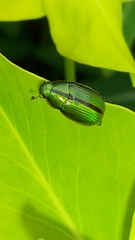
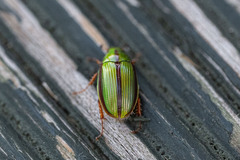
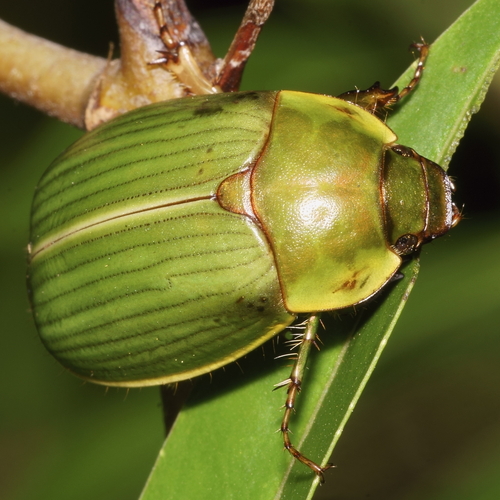
The mānuka beetle is bright green with shades of blue and yellow on areas of its back. Its dark longitudinal stripe down the back of its hard wing case is often brown or yellow. It can vary in length between 3 and 25mm in length, but the most common is 9mm. They are a part of the superfamily Scarabaeoidea and are characterized for their modified prothorax and have a large coxae. Their antennae is a lamellate antennal club and has a head with anterior margins which are either semicircular or emarginate mesocoxae, strongly oblique.

The mānuka beetle is a part of the subfamily Melolonthinaes, which is characterized by its stout body and glossy exterior, and the presence of either labrums or mandibles. These appear as segments either elongated or as oval lobes which can be folded together tightly to form compact... Wikipedia →

Global Distribution

Parks Where Found

# Park Country Daily sighting probability
1 Arthur's Pass National Park 🇳🇿 New Zealand
~10%
2 Abel Tasman National Park 🇳🇿 New Zealand
~10%
3 Fiordland National Park 🇳🇿 New Zealand
~10%

Before you go

What are the chances of seeing a Manuka Beetle in Abel Tasman National Park?

With luck

About 10% of wildlife watchers report a Manuka Beetle sighting in Abel Tasman National Park on a given day, based on 9 verified sightings from GBIF citizen-science data from 2019 to 2026. It is the 35th most-seen of the 64 insects we can rate there. Over three days the chance rises to about 30%, and over a week to about 50%, if each day is a fresh chance.

When is the best time to see a Manuka Beetle in Abel Tasman National Park?

December

In that month about 30% of wildlife watchers report a Manuka Beetle in Abel Tasman National Park on a given day, against under 5% in February to November, the lowest months.

What time of day is best to see a Manuka Beetle?

Between 1 and 4 pm

Across all the parks we cover, that three-hour window holds the most Manuka Beetle sightings with a recorded time, and about 9 in 10 of them come between 6 am and 6 pm: it is a daytime animal.

Is Abel Tasman National Park the best place to see a Manuka Beetle?

Among the best

Of the 3 parks where we can rate Manuka Beetle sightings, Abel Tasman National Park ranks 2nd at about 10%, level with the leaders once rounded. The best odds are in Arthur's Pass National Park (New Zealand, about 10%).

Which relatives of the Manuka Beetle live in Abel Tasman National Park?

Same family: Scarabaeidae

The closest relatives of the Manuka Beetle that you can see in Abel Tasman National Park (family Scarabaeidae, Scarabs) are Tanguru Chafer (about 20%) and Large Sand Scarab (about 10%), with each one's daily chance of a sighting.

Where does the Manuka Beetle sighting chance come from?

GBIF citizen-science records

It is estimated from how often the Manuka Beetle is recorded against all the insects logged in Abel Tasman National Park (9 verified sightings from 2019 to 2026), calibrated against known sighting rates. Figures are rounded to the nearest 10% because citizen-science data supports honest approximations, not decimals, and months with records from fewer than five people show "—". How it works.

← Back to Abel Tasman National Park