South Island Pied Oystercatcher

South Island Pied Oystercatcher

Haematopus finschi

Silhouette: terngirl · PhyloPic

LCLeast ConcernNTVUENCR Endemic
Daily sighting probability ~40% · Likely
at Abel Tasman National Park

In 3 days ~80% in a week >90%

299 Verified sightings at Abel Tasman National Park From 2019 to 2026
959 In all 5 parks
February Best month
☀️ Diurnal When it's spotted

About the South Island Pied Oystercatcher

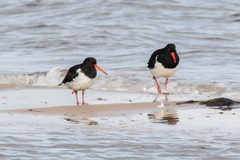
The South Island oystercatcher or South Island pied oystercatcher (Haematopus finschi) is one of two common oystercatcher species found in New Zealand. Its name is often contracted to the acronym "SIPO" (rhyming with "typo"). The indigenous Māori name is tōrea.

The South Island oystercatcher is easily identifiable as a pied oystercatcher – a large wader with striking black and white plumage, long red-orange bill, and red legs. It is distinguished from the pied morph of the variable oystercatcher by a white lower back, more white on the wing, and a demarcation line of black and white further forward on the breast, and from the pied oystercatcher of Australia by a longer bill and shorter legs, as well as the forward demarcation line of white on the back being pointed rather than square. It is 46 cm in length; its wingspan is 80–86 cm; it weighs 550 g.

The South Island oystercatcher is endemic to New Zealand where it breeds inland on the South Island, after which most... Wikipedia →

Sounds

Flight call0:32

New Zealand · 2018

© Romuald Mikusek · XC405508 · CC BY-NC-SA 4.0

Call1:05

New Zealand · 2016

© Dan Lane · XC345376 · CC BY-NC-SA 4.0

Call0:33

New Zealand · 2010

© Daniel Lane · XC46627 · CC BY-NC-SA 3.0

Global Distribution

Parks Where Found

# Park Country Daily sighting probability
1 Abel Tasman National Park 🇳🇿 New Zealand
~40%
2 Fiordland National Park 🇳🇿 New Zealand
~20%
3 Aoraki Mount Cook National Park 🇳🇿 New Zealand
~10%
4 Rakiura National Park 🇳🇿 New Zealand
~10%
5 Arthur's Pass National Park 🇳🇿 New Zealand
~10%

Cities Where Found

# City Country Daily sighting probability
1 Auckland 🇳🇿 New Zealand
~30%

Zoos & Centres Where Found

# Zoo / Centre Country
1 Ōtorohanga Kiwi House 🇳🇿 New Zealand In captivity

Before you go

What are the chances of seeing a South Island Pied Oystercatcher in Abel Tasman National Park?

Likely

About 40% of wildlife watchers report a South Island Pied Oystercatcher sighting in Abel Tasman National Park on a given day, based on 299 verified sightings from GBIF citizen-science data from 2019 to 2026. It is the 17th most-seen of the 69 birds we can rate there. Over three days the chance rises to about 80%, and over a week to over 90%, if each day is a fresh chance.

When is the best time to see a South Island Pied Oystercatcher in Abel Tasman National Park?

February

In that month about 60% of wildlife watchers report a South Island Pied Oystercatcher in Abel Tasman National Park on a given day, against about 20% in October and November, the lowest months.

What time of day is best to see a South Island Pied Oystercatcher?

Between 2 and 5 pm

Across all the parks we cover, that three-hour window holds the most South Island Pied Oystercatcher sightings with a recorded time, and nearly all of them come between 6 am and 6 pm: it is a daytime animal.

Is Abel Tasman National Park the best place to see a South Island Pied Oystercatcher?

Yes

Of the 5 parks where we can rate South Island Pied Oystercatcher sightings, Abel Tasman National Park has the highest daily chance: about 40%. Next come Fiordland National Park (New Zealand, about 20%) and Aoraki Mount Cook National Park (New Zealand, about 10%).

Where does the South Island Pied Oystercatcher sighting chance come from?

GBIF citizen-science records

It is estimated from how often the South Island Pied Oystercatcher is recorded against all the birds logged in Abel Tasman National Park (299 verified sightings from 2019 to 2026), calibrated against known sighting rates. Figures are rounded to the nearest 10% because citizen-science data supports honest approximations, not decimals, and months with records from fewer than five people show "—". How it works.

← Back to Abel Tasman National Park