Spotted Shag

Spotted Shag

Phalacrocorax punctatus

Silhouette: L. Shyamal · PhyloPic

LCLeast ConcernNTVUENCR Endemic
Daily sighting probability ~10% · With luck
at Abel Tasman National Park

In 3 days ~40% in a week ~60%

156 Verified sightings at Abel Tasman National Park From 2019 to 2026
1,038 In all 3 parks
December Best month
☀️ Diurnal When it's spotted

About the Spotted Shag

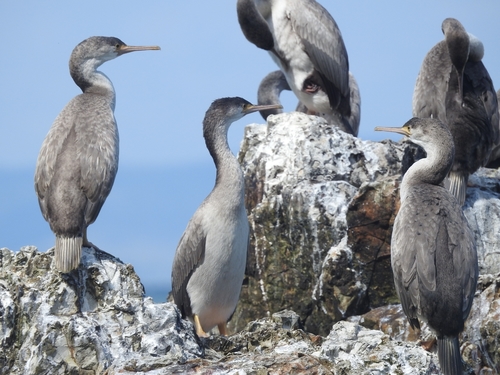
The spotted shag or pārekareka (Phalacrocorax punctatus) is a species of cormorant endemic to New Zealand. Though originally classified as Phalacrocorax punctatus, it is sufficiently different in appearance from typical members of that genus that for a time it was placed in a separate genus, Stictocarbo, along with a similar species, the Pitt shag. Subsequent genetic studies show that the spotted shag's lineage is nested within the typical shags.

The spotted shag was initially called the 'crested shag' by Johann Forster. He shot the bird while hunting with the English Naval Explorer James Cook during the second voyage of James Cook. Swedish naturalist Anders Sparrman was Forster's assistant, he described the spotted shag in 1786 as Pelicanus punctatus.

French ornithologist Charles Lucien Bonaparte erected the separate genus Stictocarbo for it in 1855. It was later returned to its original genus. In 1930, the Stewart Island population was described as a separate species, the blue shag (Stictocarbo steadi), distinguished by its narrow rather than broad white stripe on its head and neck.

A 2014 molecular study by Kennedy and Spencer found that the spotted shag belongs to... Wikipedia →

Sounds

Call0:16

New Zealand · 2021

© David Boyle · XC664263 · CC BY-NC-SA 4.0

Global Distribution

Parks Where Found

# Park Country Daily sighting probability
1 Rakiura National Park 🇳🇿 New Zealand
~40%
2 Abel Tasman National Park 🇳🇿 New Zealand
~10%
3 Fiordland National Park 🇳🇿 New Zealand
~10%

Zoos & Centres Where Found

# Zoo / Centre Country
1 Auckland Zoo 🇳🇿 New Zealand In captivity

Before you go

What are the chances of seeing a Spotted Shag in Abel Tasman National Park?

With luck

About 10% of wildlife watchers report a Spotted Shag sighting in Abel Tasman National Park on a given day, based on 156 verified sightings from GBIF citizen-science data from 2019 to 2026. It is the 35th most-seen of the 69 birds we can rate there. Over three days the chance rises to about 40%, and over a week to about 60%, if each day is a fresh chance.

When is the best time to see a Spotted Shag in Abel Tasman National Park?

March, July–August and October–December

In those months about 20% of wildlife watchers report a Spotted Shag in Abel Tasman National Park on a given day, against about 10% in January–February, April–June and September, the lowest months.

What time of day is best to see a Spotted Shag?

Between 11 am and 2 pm

Across all the parks we cover, that three-hour window holds the most Spotted Shag sightings with a recorded time, and about 9 in 10 of them come between 6 am and 6 pm: it is a daytime animal.

Is Abel Tasman National Park the best place to see a Spotted Shag?

2nd of 3

Of the 3 parks where we can rate Spotted Shag sightings, Abel Tasman National Park ranks 2nd at about 10%. The best odds are in Rakiura National Park (New Zealand, about 40%).

Which relatives of the Spotted Shag live in Abel Tasman National Park?

Same genus: Phalacrocorax

The closest relatives of the Spotted Shag that you can see in Abel Tasman National Park (genus Phalacrocorax, Typical Old World Cormorants) are Australian Pied Cormorant (about 30%) and Great Cormorant (about 10%), with each one's daily chance of a sighting.

Where does the Spotted Shag sighting chance come from?

GBIF citizen-science records

It is estimated from how often the Spotted Shag is recorded against all the birds logged in Abel Tasman National Park (156 verified sightings from 2019 to 2026), calibrated against known sighting rates. Figures are rounded to the nearest 10% because citizen-science data supports honest approximations, not decimals, and months with records from fewer than five people show "—". How it works.

← Back to Abel Tasman National Park