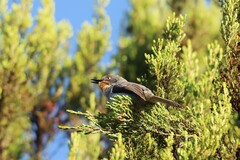
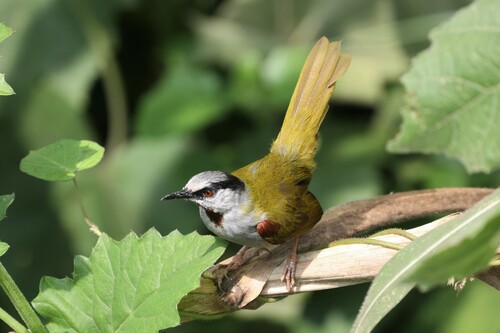
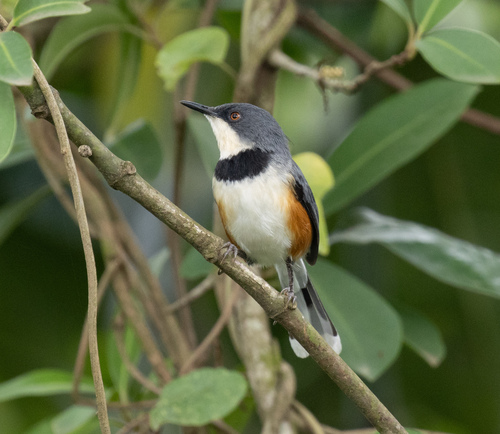
Chestnut-throated Apalis

Chestnut-throated Apalis

Apalis porphyrolaema

Silhouette: Sheatherius · PhyloPic

LCLeast ConcernNTVUENCR
Daily sighting probability ~20% · Possible
at Aberdare National Park

In 3 days ~50% in a week ~80%

87 Verified sightings at Aberdare National Park From 2019 to 2026
1,268 In all 5 parks
March Best month
☀️ Diurnal When it's spotted

About the Chestnut-throated Apalis

The chestnut-throated apalis (Apalis porphyrolaema) is a species of bird in the cisticola family Cisticolidae. The Kabobo apalis, originally described as a distinct species, is usually treated as a subspecies A. p. kaboboensis of the chestnut-throated apalis today. It is itself sometimes considered to be the same species as the Chapin's apalis.

The species is found in Burundi, Democratic Republic of the Congo, Kenya, Rwanda, Tanzania and Uganda, where it is a species of highland forests above 1600 m. The chestnut-throated apalis is a 12 cm long apalis with mostly grey plumage. The nominate subspecies and the subspecies affinis both have chestnut throats, whereas the Kabobo apalis has an entirely grey throat but paler undersides.

The chestnut-throated apalis feeds on insects and other small invertebrates, which are obtained by gleaning from leaves and twigs, hover gleaning and hawking in the air. Wikipedia →

Sounds

Song0:37

Uganda · 2022

© Peter Boesman · XC739402 · CC BY-NC-ND 4.0

Duet0:17

Kenya · 2018

© Bram Piot · XC434324 · CC BY-NC-SA 4.0

Alarm call0:27

Uganda · 2005

© András Schmidt · XC703486 · CC BY-NC-SA 4.0

Global Distribution

Parks Where Found

# Park Country Daily sighting probability
1 Nyungwe National Park 🇷🇼 Rwanda
~30%
2 Bwindi Impenetrable National Park 🇺🇬 Uganda
~30%
3 Aberdare National Park 🇰🇪 Kenya
~20%
4 Volcanoes National Park 🇷🇼 Rwanda
~20%
5 Virunga National Park 🇨🇩 Democratic Republic of the Congo
~10%

Before you go

What are the chances of seeing a Chestnut-throated Apalis in Aberdare National Park?

Possible

About 20% of wildlife watchers report a Chestnut-throated Apalis sighting in Aberdare National Park on a given day, based on 87 verified sightings from GBIF citizen-science data from 2019 to 2026. It is the 48th most-seen of the 217 birds we can rate there. Over three days the chance rises to about 50%, and over a week to about 80%, if each day is a fresh chance.

When is the best time to see a Chestnut-throated Apalis in Aberdare National Park?

March

In that month about 40% of wildlife watchers report a Chestnut-throated Apalis in Aberdare National Park on a given day, against about 10% in May and October, the lowest months.

What time of day is best to see a Chestnut-throated Apalis?

Between 7 and 10 am

Across all the parks we cover, that three-hour window holds the most Chestnut-throated Apalis sightings with a recorded time, and about 7 in 10 of them come between 6 am and 6 pm: it is a daytime animal.

Is Aberdare National Park the best place to see a Chestnut-throated Apalis?

3rd of 5

Of the 5 parks where we can rate Chestnut-throated Apalis sightings, Aberdare National Park ranks 3rd at about 20%. The best odds are in Nyungwe National Park (Rwanda, about 30%) and Bwindi Impenetrable National Park (Uganda, about 30%).

Which relatives of the Chestnut-throated Apalis live in Aberdare National Park?

Same genus: Apalis

The closest relatives of the Chestnut-throated Apalis that you can see in Aberdare National Park (genus Apalis, Apalises) are Gray Apalis (about 20%) and Black-throated Apalis (about 10%), with each one's daily chance of a sighting.

Where does the Chestnut-throated Apalis sighting chance come from?

GBIF citizen-science records

It is estimated from how often the Chestnut-throated Apalis is recorded against all the birds logged in Aberdare National Park (87 verified sightings from 2019 to 2026), calibrated against known sighting rates. Figures are rounded to the nearest 10% because citizen-science data supports honest approximations, not decimals, and months with records from fewer than five people show "—". How it works.

← Back to Aberdare National Park