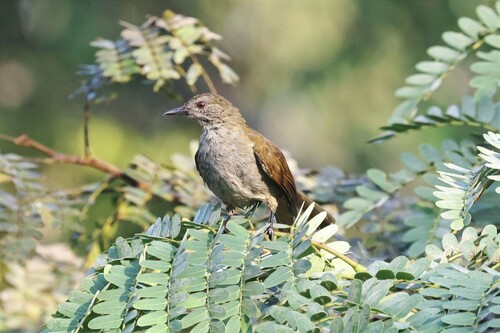
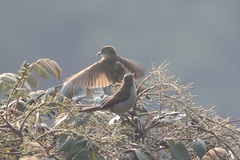
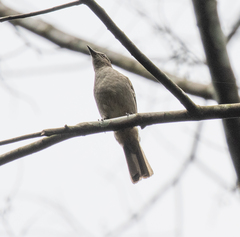
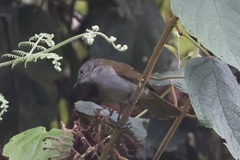
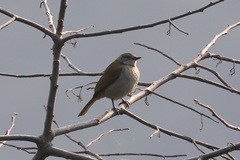
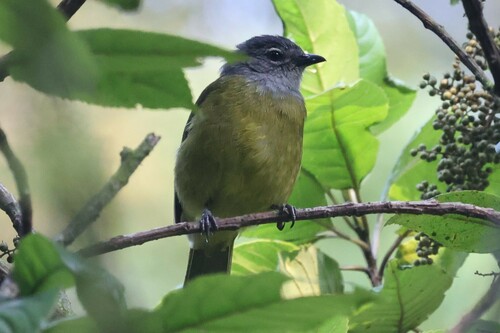
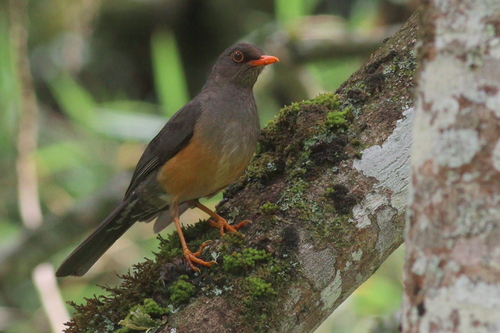
Slender-billed Greenbul

Slender-billed Greenbul

Stelgidillas gracilirostris

Silhouette: PhyloPic

LCLeast ConcernNTVUENCR
Daily sighting probability <5% · Rare
at Aberdare National Park

In 3 days ~10% in a week ~20%

15 Verified sightings at Aberdare National Park From 2019 to 2026
1,516 In all 9 parks
August Best month
☀️ Diurnal When it's spotted

About the Slender-billed Greenbul

The slender-billed greenbul (Stelgidillas gracilirostris) is a species in the monotypic genus Stelgidillas of the bulbul family of passerine birds. It is found in western and central Africa. Its natural habitats are subtropical or tropical dry forest, subtropical or tropical moist lowland forest, and subtropical or tropical moist montane forest.

The slender-billed greenbul was formally described in 1844 by the English naturalist Hugh Edwin Strickland under the binomial name Andropadus gracilirostris from a specimen collected on the island of Fernando Pó (now Bioko) off the west coast of Africa.

A molecular phylogenetic study of the bulbuls published in 2007 found that Andropadus was non-monophyletic. In the subsequent rearrangement to create monophyletic genera, the slender-billed greenbul was moved to the genus Stelgidillas that had been introduced by Harry C. Oberholser in 1899.

Formerly, some authorities also considered the following species (or subspecies) as species within the genus Stelgidillas: Toro olive greenbul (as Stelgidillas hypochloris) Two subspecies of the slender-billed greenbul are recognized:

Congo... Wikipedia →

Sounds

Song0:16

Ivory Coast · 2022

© Étienne Leroy · XC704576 · CC BY-NC-SA 4.0

Call0:44

Uganda · 2022

© Peter Boesman · XC740003 · CC BY-NC-ND 4.0

Call0:22

Kenya · 2017

© James Bradley · XC388660 · CC BY-NC-SA 4.0

Global Distribution

Parks Where Found

# Park Country Daily sighting probability
1 Bwindi Impenetrable National Park 🇺🇬 Uganda
~40%
2 Kibale National Park 🇺🇬 Uganda
~30%
3 Odzala-Kokoua National Park 🇨🇬 Republic of the Congo
~20%
4 Semuliki National Park 🇺🇬 Uganda
~20%
5 Taï National Park 🇨🇮 Ivory Coast
~10%
6 Nyungwe National Park 🇷🇼 Rwanda
~10%
7 Aberdare National Park 🇰🇪 Kenya
<5%
8 Queen Elizabeth National Park 🇺🇬 Uganda
<5%
9 Masai Mara National Reserve 🇰🇪 Kenya
<5%

Cities Where Found

# City Country Daily sighting probability
1 Nairobi 🇰🇪 Kenya
<5%
2 Kampala 🇺🇬 Uganda
<5%

Before you go

What are the chances of seeing a Slender-billed Greenbul in Aberdare National Park?

Rare

Under 5% of wildlife watchers report a Slender-billed Greenbul sighting in Aberdare National Park on a given day, based on 15 verified sightings from GBIF citizen-science data from 2019 to 2026. It is the 135th most-seen of the 217 birds we can rate there. Over three days the chance rises to about 10%, and over a week to about 20%, if each day is a fresh chance.

When is the best time to see a Slender-billed Greenbul in Aberdare National Park?

April–May, July–August and October

In those months about 10% of wildlife watchers report a Slender-billed Greenbul in Aberdare National Park on a given day, against under 5% in June, September and November–March, the lowest months.

What time of day is best to see a Slender-billed Greenbul?

Between 7 and 10 am

Across all the parks we cover, that three-hour window holds the most Slender-billed Greenbul sightings with a recorded time, and about 8 in 10 of them come between 6 am and 6 pm: it is a daytime animal.

Which relatives of the Slender-billed Greenbul live in Aberdare National Park?

Same family: Pycnonotidae

The closest relatives of the Slender-billed Greenbul that you can see in Aberdare National Park (family Pycnonotidae, Bulbuls) are Common Bulbul (about 70%), Kikuyu Mountain Greenbul (about 20%) and Yellow-whiskered Greenbul (about 10%), with each one's daily chance of a sighting.

Where does the Slender-billed Greenbul sighting chance come from?

GBIF citizen-science records

It is estimated from how often the Slender-billed Greenbul is recorded against all the birds logged in Aberdare National Park (15 verified sightings from 2019 to 2026), calibrated against known sighting rates. Figures are rounded to the nearest 10% because citizen-science data supports honest approximations, not decimals, and months with records from fewer than five people show "—". How it works.

← Back to Aberdare National Park