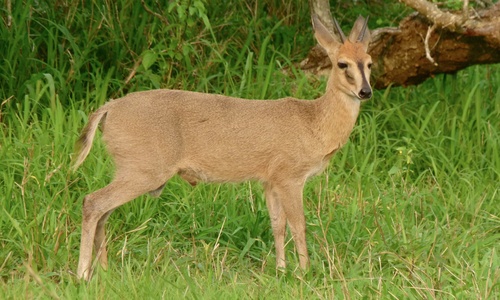
Blue Duiker

Blue Duiker

Philantomba monticola

Silhouette: [unknown] · PhyloPic

LCLeast ConcernNTVUENCR
Daily sighting probability ~10% · With luck
at Addo Elephant National Park

In 3 days ~20% in a week ~40%

25 Verified sightings at Addo Elephant National Park From 2019 to 2026
62 In all 3 parks
October Best month
☀️ Diurnal When it's spotted

About the Blue Duiker

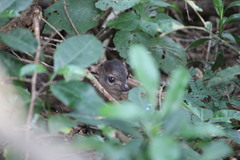
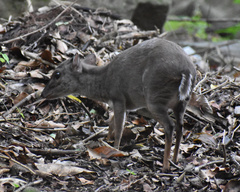
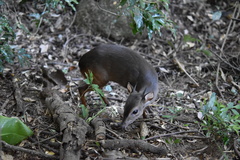
The blue duiker (Philantomba monticola) is a small antelope found in central, southern and eastern Africa. It is the smallest species of duiker. The species was first described by Swedish naturalist Carl Peter Thunberg in 1789. 12 subspecies are identified. The blue duiker reaches 32–41 centimetres (13–16 in) at the shoulder and weighs 3.5–9 kilograms (7.7–19.8 lb). Sexually dimorphic, the females are slightly larger than the males. The dark tail measures slightly above 10 centimetres (3.9 in). It has short, spiky horns, around 5 centimetres (2.0 in) long and hidden in hair tufts. The subspecies show a great degree of variation in their colouration. The blue duiker bears a significant resemblance to Maxwell's duiker.

Activity is diurnal (limited to daytime). Secretive and cautious, the blue duiker confines itself to the forest fringes. Territorial, individuals of opposite sexes form pairs and occupy territories, nearly 0.4–0.8 hectares (0.0015–0.0031 sq mi) large and marked by preorbital gland secretions. The blue duiker feeds on fallen fruits, foliage, flowers and pieces of bark, provided mainly by the forest canopies in their habitat. The age when sexual maturity is gained has been given differently by different studies. The species is monogamous, with pairs remaining together throughout the year. The length of the gestational period has been estimated from as little as four months to as long as seven months. Births occur throughout the year, though the birth rate might fall in the dry season. The calf is mainly kept in hiding and weaning occurs at 2.5 to 3 months.

The habitat consists of a variety of forests, including old-growth, secondary, and gallery forests. Forests are preferred as these provide the animal with shelter through the dense understory and forage through the canopy. Though categorized as Least Concern by the International Union for Conservation of Nature and Natural Resources (IUCN), the blue duiker is under threat from extensive bushmeat hunting across its range. Wikipedia →

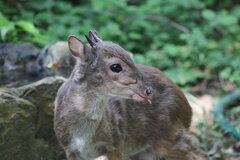
Sounds

Mating call0:20

Central African Republic · 2025

© Antoine Ede · XC1063990 · CC BY-NC-SA 4.0

Mating call0:20

Central African Republic · 2025

© Antoine Ede, Dzanga-Sangha protected Areas · XC1039986 · CC BY-NC-SA 4.0

Global Distribution

Parks Where Found

# Park Country Daily sighting probability
1 Odzala-Kokoua National Park 🇨🇬 Republic of the Congo
~20%
2 Garden Route National Park 🇿🇦 South Africa
~10%
3 Addo Elephant National Park 🇿🇦 South Africa
~10%

Zoos & Centres Where Found

# Zoo / Centre Country
1 Abilene Zoological Gardens 🇺🇸 United States In captivity
2 Safari West 🇺🇸 United States In captivity
3 Kansas City Zoo 🇺🇸 United States In captivity
4 Dallas Zoo 🇺🇸 United States In captivity
5 The Maryland Zoo 🇺🇸 United States In captivity
6 Wildlife World Zoo 🇺🇸 United States In captivity
7 Central Florida Zoo and Botanical Gardens 🇺🇸 United States In captivity
8 Xcaret 🇲🇽 Mexico In captivity
9 Colchester Zoo 🇬🇧 United Kingdom In captivity
10 San Francisco Zoo 🇺🇸 United States In captivity
11 Night Safari 🇸🇬 Singapore In captivity
12 ZooTampa 🇺🇸 United States In captivity
13 Singapore Zoo 🇸🇬 Singapore In captivity
14 Virginia Zoological Park 🇺🇸 United States In captivity
15 San Antonio Zoo 🇺🇸 United States In captivity
16 Mesker Park Zoo and Botanic Garden 🇺🇸 United States In captivity
17 Fresno Chaffee Zoo 🇺🇸 United States In captivity
18 The Abilene Zoo 🇺🇸 United States In captivity
19 Giraffe House 🇿🇦 South Africa In captivity
20 Mystic Monkeys & Feathers 🇿🇦 South Africa In captivity
21 River Wonders 🇸🇬 Singapore In captivity
22 Elephant Sanctuary, The Crags, Plettenberg Bay 🇿🇦 South Africa In captivity
23 African Dawn Bird and Wildlife Sanctuary 🇿🇦 South Africa In captivity
24 Hattiesburg Zoo 🇺🇸 United States In captivity
25 Chattanooga Zoo at Warner Park 🇺🇸 United States In captivity
26 Limbe Wildlife Centre 🇨🇲 Cameroon In captivity
27 Bioparc Fuengirola 🇪🇸 Spain In captivity
28 Birds of Eden 🇿🇦 South Africa In captivity
29 Cango Wildlife Ranch 🇿🇦 South Africa In captivity
30 Randers Tropical Zoo 🇩🇰 Denmark In captivity
31 Lawnwood snake sanctuary 🇿🇦 South Africa In captivity
32 Tortoise Sanctuary 🇹🇿 Tanzania In captivity
33 Sobela Ocean Aquarium 🇺🇸 United States In captivity
34 Snakeroom Serpentarium 🇪🇸 Spain In captivity

Before you go

What are the chances of seeing a Blue Duiker in Addo Elephant National Park?

With luck

About 10% of wildlife watchers report a Blue Duiker sighting in Addo Elephant National Park on a given day, based on 25 verified sightings from GBIF citizen-science data from 2019 to 2026. It is the 33rd most-seen of the 44 mammals we can rate there. Over three days the chance rises to about 20%, and over a week to about 40%, if each day is a fresh chance.

When is the best time to see a Blue Duiker in Addo Elephant National Park?

April to February

In those months about 10% of wildlife watchers report a Blue Duiker in Addo Elephant National Park on a given day, against under 5% in March, the lowest month.

What time of day is best to see a Blue Duiker?

Between 9 am and noon

Across all the parks we cover, that three-hour window holds the most Blue Duiker sightings with a recorded time, and about 9 in 10 of them come between 6 am and 6 pm: it is a daytime animal.

Is Addo Elephant National Park the best place to see a Blue Duiker?

3rd of 3

Of the 3 parks where we can rate Blue Duiker sightings, Addo Elephant National Park ranks 3rd at about 10%. The best odds are in Odzala-Kokoua National Park (Republic of the Congo, about 20%) and Garden Route National Park (South Africa, about 10%).

Which relatives of the Blue Duiker live in Addo Elephant National Park?

Same family: Bovidae

The closest relatives of the Blue Duiker that you can see in Addo Elephant National Park (family Bovidae, Bovids) are Greater Kudu (about 50%), African Buffalo (about 50%) and Khama (about 50%), with each one's daily chance of a sighting.

Where does the Blue Duiker sighting chance come from?

GBIF citizen-science records

It is estimated from how often the Blue Duiker is recorded against all the mammals logged in Addo Elephant National Park (25 verified sightings from 2019 to 2026), calibrated against known sighting rates. Figures are rounded to the nearest 10% because citizen-science data supports honest approximations, not decimals, and months with records from fewer than five people show "—". How it works.

← Back to Addo Elephant National Park