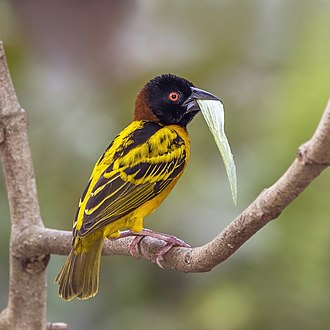
Red-headed Quelea

Red-headed Quelea

Quelea erythrops

Silhouette: Sheatherius · PhyloPic

LCLeast ConcernNTVUENCR
Daily sighting probability <5% · Rare
at Akagera National Park

In 3 days <5% in a week ~10%

9 Verified sightings at Akagera National Park From 2019 to 2026
125 In all 8 parks
October Best month
☀️ Diurnal When it's spotted

About the Red-headed Quelea

The red-headed quelea (Quelea erythrops) is a species of bird in the family Ploceidae. It is found in Angola, Benin, Botswana, Burkina Faso, Burundi, Cameroon, Central African Republic, Chad, Republic of the Congo, Democratic Republic of the Congo, Ivory Coast, Equatorial Guinea, Eswatini, Ethiopia, Gabon, Gambia, Ghana, Guinea, Guinea-Bissau, Kenya, Liberia, Malawi, Mali, Mozambique, Niger, Nigeria, Rwanda, São Tomé and Príncipe, Senegal, Sierra Leone, South Africa, South Sudan, Tanzania, Togo, Uganda, Zambia, and Zimbabwe.

The red-headed quelea was collected by Carl Weiss on Sao Tome island in 1847, and after its arrival at the Hamburg Museum described for science for the first time by Gustav Hartlaub in 1848, who named it Ploceus erythrops. In 1951, Hans von Boetticher regarded the cardinal quelea and red-headed quelea sufficiently different from the red-billed quelea to create a new genus Queleopsis.

The species epithet erythrops derives from the Greek word ἐρυθρός (eruthros), meaning "red" and ὄψ (ops) meaning "eye" or "face", referring to the rufous or red face. Ludwig Reichenbach gave the species its first English name in 1863: red-headed dioch. Other... Wikipedia →

Sounds

Call0:05

Mozambique · 2017

© Gary Allport · XC391200 · CC BY-NC-SA 4.0

Global Distribution

Parks Where Found

# Park Country Daily sighting probability
1 Kidepo Valley National Park 🇺🇬 Uganda
<5%
2 Ruaha National Park 🇹🇿 Tanzania
<5%
3 Murchison Falls National Park 🇺🇬 Uganda
<5%
4 Akagera National Park 🇷🇼 Rwanda
<5%
5 Queen Elizabeth National Park 🇺🇬 Uganda
<5%
6 Kibale National Park 🇺🇬 Uganda
<5%
7 Lake Mburo National Park 🇺🇬 Uganda
<5%
8 Serengeti National Park 🇹🇿 Tanzania
<5%

Cities Where Found

# City Country Daily sighting probability
1 Brazzaville 🇨🇬 Republic of the Congo
~10%
2 Durban 🇿🇦 South Africa
<5%

Before you go

What are the chances of seeing a Red-headed Quelea in Akagera National Park?

Rare

Under 5% of wildlife watchers report a Red-headed Quelea sighting in Akagera National Park on a given day, based on 9 verified sightings from GBIF citizen-science data from 2019 to 2026. It is the 290th most-seen of the 320 birds we can rate there. Over three days the chance rises to under 5%, and over a week to about 10%, if each day is a fresh chance.

When is the best time to see a Red-headed Quelea in Akagera National Park?

February and October

In those months about 10% of wildlife watchers report a Red-headed Quelea in Akagera National Park on a given day, against under 5% in March–September and November–January, the lowest months.

What time of day is best to see a Red-headed Quelea?

Between 7 and 10 am

Across all the parks we cover, that three-hour window holds the most Red-headed Quelea sightings with a recorded time, and about 9 in 10 of them come between 6 am and 6 pm: it is a daytime animal.

Is Akagera National Park the best place to see a Red-headed Quelea?

Among the best

Of the 8 parks where we can rate Red-headed Quelea sightings, Akagera National Park ranks 4th at under 5%, level with the leaders once rounded. The best odds are in Kidepo Valley National Park (Uganda, under 5%), Ruaha National Park (Tanzania, under 5%) and Murchison Falls National Park (Uganda, under 5%).

Where does the Red-headed Quelea sighting chance come from?

GBIF citizen-science records

It is estimated from how often the Red-headed Quelea is recorded against all the birds logged in Akagera National Park (9 verified sightings from 2019 to 2026), calibrated against known sighting rates. Figures are rounded to the nearest 10% because citizen-science data supports honest approximations, not decimals, and months with records from fewer than five people show "—". How it works.

← Back to Akagera National Park