Black-necked Red-Cotinga

Black-necked Red-Cotinga

Phoenicircus nigricollis

Silhouette: Edwin Price · PhyloPic

LCLeast ConcernNTVUENCR
Daily sighting probability ~10% · With luck
at Amacayacu National Natural Park

In 3 days ~20% in a week ~40%

52 Verified sightings at Amacayacu National Natural Park From 2019 to 2026
156 In all 3 parks
September Best month
☀️ Diurnal When it's spotted

About the Black-necked Red-Cotinga

The black-necked red cotinga (Phoenicircus nigricollis) is a species of bird in the family Cotingidae, the cotingas. It is found in Brazil, Colombia, Ecuador, Peru, and Venezuela. The black-necked red cotinga shares genus Phoenicircus with the Guianan red cotinga (P. carnifex) and the two form a superspecies.

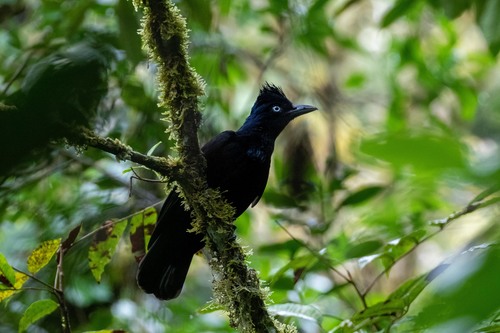
Both are monotypic. The black-necked red cotinga is 22 to 24 cm (8.7 to 9.4 in) long and weighs about 93 g (3.3 oz). The sexes have different plumage. Adults have distinctive forehead feathers that project forward, partially concealing the nostrils, and prominent bristles around the base of the bill. Adult males have a red to rosy red crown on an otherwise glossy blackish head and neck. Their back is also glossy blackish and their rump and uppertail coverts red to rosy red. Their wings are glossy blackish. Their tail is red to rosy red with a black bar across the end. Their underparts are red to rosy red. Females are larger than males. They have a dull reddish crown and ear coverts on an otherwise olive face; their upperparts and wings are also olive. Their tail is dull reddish. Their underparts are red. Both sexes have a dark brown... Wikipedia →

Sounds

Call0:15

Brazil · 2025

© JAYRSON ARAUJO DE OLIVEIRA · XC1044575 · CC BY-NC-SA 4.0

Song0:32

Brazil · 2018

© GABRIEL LEITE · XC431882 · CC BY-NC-SA 4.0

Call?1:00

Peru · 2011

© David Geale · XC87208 · CC BY-NC-ND 2.5

Global Distribution

Parks Where Found

# Park Country Daily sighting probability
1 Amacayacu National Natural Park 🇨🇴 Colombia
~10%
2 Yasuní National Park 🇪🇨 Ecuador
<5%
3 Cuyabeno Wildlife Reserve 🇪🇨 Ecuador
<5%

Before you go

What are the chances of seeing a Black-necked Red-Cotinga in Amacayacu National Natural Park?

With luck

About 10% of wildlife watchers report a Black-necked Red-Cotinga sighting in Amacayacu National Natural Park on a given day, based on 52 verified sightings from GBIF citizen-science data from 2019 to 2026. It is the 191st most-seen of the 436 birds we can rate there. Over three days the chance rises to about 20%, and over a week to about 40%, if each day is a fresh chance.

When is the best time to see a Black-necked Red-Cotinga in Amacayacu National Natural Park?

September and October

In those months about 20% of wildlife watchers report a Black-necked Red-Cotinga in Amacayacu National Natural Park on a given day, against under 5% in April, June–August and December, the lowest months.

What time of day is best to see a Black-necked Red-Cotinga?

Between 7 and 10 am

Across all the parks we cover, that three-hour window holds the most Black-necked Red-Cotinga sightings with a recorded time, and about 7 in 10 of them come between 6 am and 6 pm: it is a daytime animal.

Is Amacayacu National Natural Park the best place to see a Black-necked Red-Cotinga?

Yes

Of the 3 parks where we can rate Black-necked Red-Cotinga sightings, Amacayacu National Natural Park has the highest daily chance: about 10%. Next come Yasuní National Park (Ecuador, under 5%) and Cuyabeno Wildlife Reserve (Ecuador, under 5%).

Which relatives of the Black-necked Red-Cotinga live in Amacayacu National Natural Park?

Same family: Cotingidae

The closest relatives of the Black-necked Red-Cotinga that you can see in Amacayacu National Natural Park (family Cotingidae, Cotingas) are Várzea Schiffornis (about 20%), White-winged Becard (about 20%) and Black-tailed Tityra (about 10%), with each one's daily chance of a sighting.

Where does the Black-necked Red-Cotinga sighting chance come from?

GBIF citizen-science records

It is estimated from how often the Black-necked Red-Cotinga is recorded against all the birds logged in Amacayacu National Natural Park (52 verified sightings from 2019 to 2026), calibrated against known sighting rates. Figures are rounded to the nearest 10% because citizen-science data supports honest approximations, not decimals, and months with records from fewer than five people show "—". How it works.

← Back to Amacayacu National Natural Park