Purple-throated Fruitcrow

Purple-throated Fruitcrow

Querula purpurata

Silhouette: Edwin Price · PhyloPic

LCLeast ConcernNTVUENCR
Daily sighting probability ~10% · With luck
at Amacayacu National Natural Park

In 3 days ~20% in a week ~50%

70 Verified sightings at Amacayacu National Natural Park From 2019 to 2026
7,107 In all 19 parks
October Best month
☀️ Diurnal When it's spotted

About the Purple-throated Fruitcrow

The purple-throated fruitcrow (Querula purpurata) is a species of bird in the family Cotingidae, the cotingas. It is found in Costa Rica, Panama, Nicaragua, and in every mainland South American country except Argentina, Chile, Paraguay, and Uruguay.

The purple-throated fruitcrow was originally described as Muscicapa purpurata, mistakenly placing it with the Old World flycatchers. It was eventually moved to its present genus Querula that was erected in 1816. It is the only member of that genus and has no subspecies.

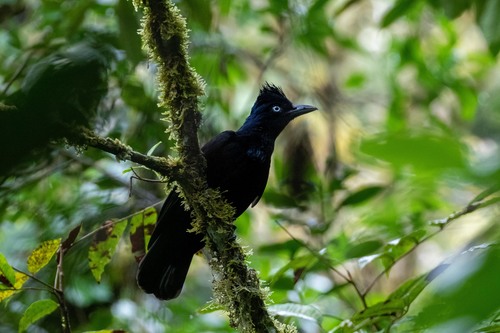
The purple-throated fruitcrow is 25 to 30 cm (9.8 to 12 in) long and weighs 91 to 133 g (3.2 to 4.7 oz). Adult males have glossy black upperparts and duller black underparts. Their throat feathers are dark reddish purple; they are long and square-tipped and form a "shield" to the sides and upper breast. Adult females are overall dull black and lack the shield though they may have a few crimson feathers on the throat. Both sexes have a dark brown iris, a pale gray or silver gray bill with a black tip, and dusky gray to black legs and feet. Juveniles have a dull black crown, wings, and tail. They are otherwise brownish black... Wikipedia →

Sounds

Song0:06

Brazil · 2026

© JAYRSON ARAUJO DE OLIVEIRA · XC1186206 · CC BY-NC-SA 4.0

Call0:18

Peru · 2024

© Richard E. Webster · XC962977 · CC BY-NC-SA 4.0

Begging call0:52

Ecuador · 2005

© Olaf Jahn · XC262290 · CC BY-NC-SA 4.0

Global Distribution

Parks Where Found

# Park Country Daily sighting probability
1 Soberanía National Park 🇵🇦 Panama
~30%
2 Utría National Natural Park 🇨🇴 Colombia
~30%
3 Darién National Park 🇵🇦 Panama
~20%
4 Yasuní National Park 🇪🇨 Ecuador
~20%
5 Cahuita National Park 🇨🇷 Costa Rica
~20%
6 San Lorenzo Protected Forest 🇵🇦 Panama
~20%
7 Cuyabeno Wildlife Reserve 🇪🇨 Ecuador
~20%
8 Tambopata National Reserve 🇵🇪 Peru
~20%
9 Tortuguero National Park 🇨🇷 Costa Rica
~10%
10 Gandoca-Manzanillo Wildlife Refuge 🇨🇷 Costa Rica
~10%
11 Amacayacu National Natural Park 🇨🇴 Colombia
~10%
12 Manu National Park 🇵🇪 Peru
~10%
13 Bastimentos Island National Marine Park 🇵🇦 Panama
<5%
14 Farallones de Cali National Natural Park 🇨🇴 Colombia
<5%
15 Sierra de la Macarena National Park 🇨🇴 Colombia
<5%
16 La Amistad International Park (Panama) 🇵🇦 Panama
<5%
17 Chagres National Park 🇵🇦 Panama
<5%
18 Braulio Carrillo National Park 🇨🇷 Costa Rica
<5%
19 Parque Natural Metropolitano 🇵🇦 Panama
<5%

Zoos & Centres Where Found

# Zoo / Centre Country
1 Memphis Zoo 🇺🇸 United States In captivity
2 National Aviary 🇺🇸 United States In captivity
3 Dallas World Aquarium 🇺🇸 United States In captivity

Before you go

What are the chances of seeing a Purple-throated Fruitcrow in Amacayacu National Natural Park?

With luck

About 10% of wildlife watchers report a Purple-throated Fruitcrow sighting in Amacayacu National Natural Park on a given day, based on 70 verified sightings from GBIF citizen-science data from 2019 to 2026. It is the 168th most-seen of the 436 birds we can rate there. Over three days the chance rises to about 20%, and over a week to about 50%, if each day is a fresh chance.

When is the best time to see a Purple-throated Fruitcrow in Amacayacu National Natural Park?

January–June and August–October

In those months about 10% of wildlife watchers report a Purple-throated Fruitcrow in Amacayacu National Natural Park on a given day, against under 5% in July and November–December, the lowest months.

What time of day is best to see a Purple-throated Fruitcrow?

Between 8 and 11 am

Across all the parks we cover, that three-hour window holds the most Purple-throated Fruitcrow sightings with a recorded time, and about 9 in 10 of them come between 6 am and 6 pm: it is a daytime animal.

Is Amacayacu National Natural Park the best place to see a Purple-throated Fruitcrow?

11th of 19

Of the 19 parks where we can rate Purple-throated Fruitcrow sightings, Amacayacu National Natural Park ranks 11th at about 10%. The best odds are in Soberanía National Park (Panama, about 30%), Utría National Natural Park (Colombia, about 30%) and Darién National Park (Panama, about 20%).

Which relatives of the Purple-throated Fruitcrow live in Amacayacu National Natural Park?

Same family: Cotingidae

The closest relatives of the Purple-throated Fruitcrow that you can see in Amacayacu National Natural Park (family Cotingidae, Cotingas) are Várzea Schiffornis (about 20%), White-winged Becard (about 20%) and Black-tailed Tityra (about 10%), with each one's daily chance of a sighting.

Where does the Purple-throated Fruitcrow sighting chance come from?

GBIF citizen-science records

It is estimated from how often the Purple-throated Fruitcrow is recorded against all the birds logged in Amacayacu National Natural Park (70 verified sightings from 2019 to 2026), calibrated against known sighting rates. Figures are rounded to the nearest 10% because citizen-science data supports honest approximations, not decimals, and months with records from fewer than five people show "—". How it works.

← Back to Amacayacu National Natural Park