Reticulated Poison Frog

Reticulated Poison Frog

Ranitomeya ventrimaculata

Silhouette: Steven Traver · PhyloPic

LCLeast ConcernNTVUENCR
Daily sighting probability ~20% · Possible
at Amacayacu National Natural Park

In 3 days ~50% in a week ~80%

8 Verified sightings at Amacayacu National Natural Park From 2019 to 2026
33 In all 2 parks
November Best month
☀️🌙 Day & Night When it's spotted

About the Reticulated Poison Frog

The Amazonian poison frog (Ranitomeya ventrimaculata), known in French as dendrobate à ventre tacheté, is a species of poison dart frog. It is native to South America, where it can be found in Brazil, southeastern Colombia, Ecuador, French Guiana, and Peru.

R. ventrimaculata secretes poison through glands in the skin which protect it from fungi and bacteria as well as from predators, which are also warned to stay clear by the aposematic coloration. It is therefore often included among the poison dart frogs, although its toxin is comparatively weak. R. ventrimaculatus produces its poison by ingestion of a species of mite.

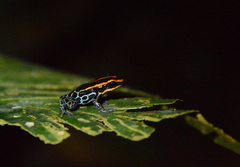
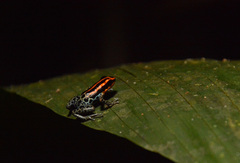
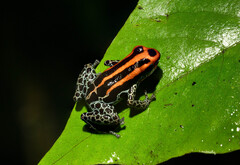
The frog is active during the day. It grows to a size of about 20 millimetres (0.79 in), with males smaller than females. Its base color is black, and it has yellow lines or dots on the back, whereas the belly has bluish or grayish color with interspersed black patches (hence the name "ventrimaculatus"); the color of the belly continues into a netlike pattern on the legs.

R. ventrimaculata reach adulthood at an age of six months. The females attach four to eight eggs to leaves beneath the water level, where they are... Wikipedia →

Global Distribution

Parks Where Found

# Park Country Daily sighting probability
1 Amacayacu National Natural Park 🇨🇴 Colombia
~20%
2 Yasuní National Park 🇪🇨 Ecuador
~20%

Zoos & Centres Where Found

# Zoo / Centre Country
1 Adventure Aquarium 🇺🇸 United States In captivity

Before you go

What are the chances of seeing a Reticulated Poison Frog in Amacayacu National Natural Park?

Possible

About 20% of wildlife watchers report a Reticulated Poison Frog sighting in Amacayacu National Natural Park on a given day, based on 8 verified sightings from GBIF citizen-science data from 2019 to 2026. It is the 4th most-seen of the 8 amphibians we can rate there. Over three days the chance rises to about 50%, and over a week to about 80%, if each day is a fresh chance.

When is the best time to see a Reticulated Poison Frog in Amacayacu National Natural Park?

March and November

In those months about 40% of wildlife watchers report a Reticulated Poison Frog in Amacayacu National Natural Park on a given day, against under 5% in June–July, September and December–February, the lowest months.

What time of day is best to see a Reticulated Poison Frog?

Between 7 and 10 pm

Across all the parks we cover, that three-hour window holds the most Reticulated Poison Frog sightings with a recorded time, and about 7 in 10 of them come between 6 pm and 6 am: it is seen both by day and at night.

Is Amacayacu National Natural Park the best place to see a Reticulated Poison Frog?

Yes

Of the 2 parks where we can rate Reticulated Poison Frog sightings, Amacayacu National Natural Park has the highest daily chance: about 20%. Next come Yasuní National Park (Ecuador, about 20%).

Where does the Reticulated Poison Frog sighting chance come from?

GBIF citizen-science records

It is estimated from how often the Reticulated Poison Frog is recorded against all the amphibians logged in Amacayacu National Natural Park (8 verified sightings from 2019 to 2026), calibrated against known sighting rates. Figures are rounded to the nearest 10% because citizen-science data supports honest approximations, not decimals, and months with records from fewer than five people show "—". How it works.

← Back to Amacayacu National Natural Park