Perez's Snouted Frog

Perez's Snouted Frog

Edalorhina perezi

Silhouette: PhyloPic

LCLeast ConcernNTVUENCR
Daily sighting probability ~20% · Possible
at Amacayacu National Natural Park

In 3 days ~50% in a week ~80%

6 Verified sightings at Amacayacu National Natural Park From 2019 to 2026
87 In all 4 parks
March Best month
☀️ Diurnal When it's spotted

About the Perez's Snouted Frog

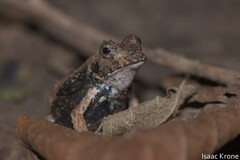
Edalorhina perezi (Perez's snouted frog) is a species of frog in the family Leptodactylidae. It is one of the only two species in the genus Edalorhina in the family Leptodactylidae. This species is diurnal and terrestrial. During mating season both female and male frogs gather around treefall pools. It is found in Brazil, Colombia, Ecuador, and Peru, and Bolivia.

Its natural habitats are subtropical or tropical moist lowland forests and subtropical or tropical moist montane forests. It has also been found in open areas in secondary forest and on cacao plantations. The species listed as least concern on the IUCN Red List and the population is stable.

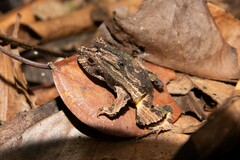
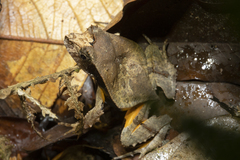
Similar to many other frog species, female Perez's snouted frogs (E. perezi) are larger than males. Males are on average 28–36 mm (1.1–1.4 in) in size and the females are 35–40 mm (1.4–1.6 in). The general color of this frog is very similar to leaf litter, which is a cryptic color protection in its habitat. Dorsum skin color is brown and there are usually many random dark brown markings on the back, such as tubercles and longitudinal ridges. Distinct characteristics of this frog... Wikipedia →

Global Distribution

Parks Where Found

# Park Country Daily sighting probability
1 Manu National Park 🇵🇪 Peru
~30%
2 Tambopata National Reserve 🇵🇪 Peru
~20%
3 Amacayacu National Natural Park 🇨🇴 Colombia
~20%
4 Yasuní National Park 🇪🇨 Ecuador
~10%

Before you go

What are the chances of seeing a Perez's Snouted Frog in Amacayacu National Natural Park?

Possible

About 20% of wildlife watchers report a Perez's Snouted Frog sighting in Amacayacu National Natural Park on a given day, based on 6 verified sightings from GBIF citizen-science data from 2019 to 2026. It is the 7th most-seen of the 8 amphibians we can rate there. Over three days the chance rises to about 50%, and over a week to about 80%, if each day is a fresh chance.

When is the best time to see a Perez's Snouted Frog in Amacayacu National Natural Park?

March

In that month about 40% of wildlife watchers report a Perez's Snouted Frog in Amacayacu National Natural Park on a given day, against under 5% in June–July and September–January, the lowest months. That is one of Amacayacu National Natural Park's wettest months, with about 390 mm of rain against 160 mm in August.

What time of day is best to see a Perez's Snouted Frog?

Between 8 and 11 am

Across all the parks we cover, that three-hour window holds the most Perez's Snouted Frog sightings with a recorded time, and about 7 in 10 of them come between 6 am and 6 pm: it is a daytime animal.

Is Amacayacu National Natural Park the best place to see a Perez's Snouted Frog?

3rd of 4

Of the 4 parks where we can rate Perez's Snouted Frog sightings, Amacayacu National Natural Park ranks 3rd at about 20%. The best odds are in Manu National Park (Peru, about 30%) and Tambopata National Reserve (Peru, about 20%).

Which relatives of the Perez's Snouted Frog live in Amacayacu National Natural Park?

Same order: Anura

The closest relatives of the Perez's Snouted Frog that you can see in Amacayacu National Natural Park (order Anura, Frogs and Toads) are Eastern Cane Toad (about 40%), Three-striped Poison Frog (about 30%) and Waxy Monkey Treefrog (about 20%), with each one's daily chance of a sighting.

Where does the Perez's Snouted Frog sighting chance come from?

GBIF citizen-science records

It is estimated from how often the Perez's Snouted Frog is recorded against all the amphibians logged in Amacayacu National Natural Park (6 verified sightings from 2019 to 2026), calibrated against known sighting rates. Figures are rounded to the nearest 10% because citizen-science data supports honest approximations, not decimals, and months with records from fewer than five people show "—". How it works.

← Back to Amacayacu National Natural Park