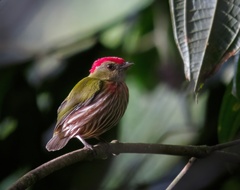
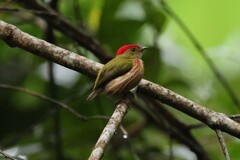
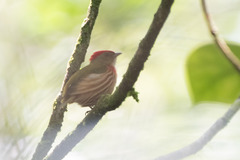
Striolated Manakin

Striolated Manakin

Machaeropterus striolatus

Silhouette: Edwin Price · PhyloPic

LCLeast ConcernNTVUENCR
Daily sighting probability ~10% · With luck
at Amacayacu National Natural Park

In 3 days ~20% in a week ~40%

63 Verified sightings at Amacayacu National Natural Park From 2019 to 2026
484 In all 5 parks
January Best month
☀️ Diurnal When it's spotted

About the Striolated Manakin

The striolated manakin or western striped manakin (Machaeropterus striolatus) is a small South American species of passerine bird in the family Pipridae. It is found in Brazil, Colombia, Ecuador, Guyana, Peru, and Venezuela.

The striolated manakin was originally described by the French naturalist Charles Lucien Bonaparte in 1838 and given the binomial name Pipra striolata. The species is now placed in the genus Machaeropterus that was introduced by Bonaparte in 1854.

The striolated manakin has five subspecies. They were long treated as subspecies of M. regulus with the English name "striped manakin". Following several studies published beginning in 1999, taxonomic systems began separating M. striolatus from M. regulus with the respective English names "western" and "eastern" striped manakin. By 2018 systems were using the current English names "striolated" and "kinglet" manakin for the two.

The five subspecies are: The morphologically similar painted manakin from... Wikipedia →

Sounds

Song0:37

Ecuador · 1994

© John V. Moore · XC259112 · CC BY-NC-SA 4.0

Call0:40

Venezuela · 2010

© Alexandre Renaudier · XC66415 · CC BY-NC-ND 2.5

?0:23

Colombia · 2008

© Pablo Florez · XC77218 · CC BY-NC-ND 2.5

Global Distribution

Parks Where Found

# Park Country Daily sighting probability
1 Sierra de la Macarena National Park 🇨🇴 Colombia
~20%
2 Amacayacu National Natural Park 🇨🇴 Colombia
~10%
3 Podocarpus National Park 🇪🇨 Ecuador
<5%
4 Yasuní National Park 🇪🇨 Ecuador
<5%
5 Farallones de Cali National Natural Park 🇨🇴 Colombia
<5%

Cities Where Found

# City Country Daily sighting probability
1 Cali 🇨🇴 Colombia
<5%

Before you go

What are the chances of seeing a Striolated Manakin in Amacayacu National Natural Park?

With luck

About 10% of wildlife watchers report a Striolated Manakin sighting in Amacayacu National Natural Park on a given day, based on 63 verified sightings from GBIF citizen-science data from 2019 to 2026. It is the 204th most-seen of the 436 birds we can rate there. Over three days the chance rises to about 20%, and over a week to about 40%, if each day is a fresh chance.

When is the best time to see a Striolated Manakin in Amacayacu National Natural Park?

January and September

In those months about 20% of wildlife watchers report a Striolated Manakin in Amacayacu National Natural Park on a given day, against under 5% in February–August and October–December, the lowest months.

What time of day is best to see a Striolated Manakin?

Between 8 and 11 am

Across all the parks we cover, that three-hour window holds the most Striolated Manakin sightings with a recorded time, and about 9 in 10 of them come between 6 am and 6 pm: it is a daytime animal.

Is Amacayacu National Natural Park the best place to see a Striolated Manakin?

2nd of 5

Of the 5 parks where we can rate Striolated Manakin sightings, Amacayacu National Natural Park ranks 2nd at about 10%. The best odds are in Sierra de la Macarena National Park (Colombia, about 20%).

Which relatives of the Striolated Manakin live in Amacayacu National Natural Park?

Same family: Pipridae

The closest relatives of the Striolated Manakin that you can see in Amacayacu National Natural Park (family Pipridae, Manakins) are Golden-headed Manakin (about 20%), Blue-capped Manakin (about 20%) and Orange-crowned Manakin (about 10%), with each one's daily chance of a sighting.

Where does the Striolated Manakin sighting chance come from?

GBIF citizen-science records

It is estimated from how often the Striolated Manakin is recorded against all the birds logged in Amacayacu National Natural Park (63 verified sightings from 2019 to 2026), calibrated against known sighting rates. Figures are rounded to the nearest 10% because citizen-science data supports honest approximations, not decimals, and months with records from fewer than five people show "—". How it works.

← Back to Amacayacu National Natural Park