Várzea Thrush

Várzea Thrush

Turdus sanchezorum

Silhouette: Sharon Wegner-Larsen · PhyloPic

LCLeast ConcernNTVUENCR
Daily sighting probability ~10% · With luck
at Amacayacu National Natural Park

In 3 days ~30% in a week ~60%

80 Verified sightings at Amacayacu National Natural Park From 2019 to 2026
80 In 1 park
November Best month
☀️🌙 Day & Night When it's spotted

About the Várzea Thrush

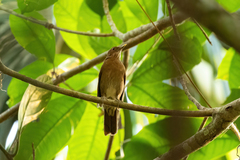
The varzea thrush (Turdus sanchezorum) is a species of bird in the family Turdidae. It is found in Brazil, Colombia, and Peru. The varzea thrush has a somewhat complicated taxonomic history. What became its type specimen was collected in 1961 and identified as a Hauxwell's thrush (Turdus hauxwelli). As more specimens were collected, this individual was thought to be a minority color morph of Hauxwell's. Later encounters with the bird determined that its plumage differences were consistently different and its vocalizations were very different from those of Hauxwell's, and in 2011 it was described as a full species. Genetic work showed that it is not closely related to Hauxwell's but is sister to the unicolored thrush (T. haplochrous) as a member of the spectacled thrush (T. nudigenis) complex. The specific epithet honors the authors' "long-time field companions and friends Manuel Sánchez S. and Marta Chávez de Sánchez". The varzea thrush is monotypic.

The varzea thrush is about 22 to 24 cm (8.7 to 9.4 in) long and weighs about 58 g (2.0 oz). The sexes have the same plumage. Adults have a rich sepia-brown head with a dull orange eye-ring... Wikipedia →

Sounds

Call0:20

Peru · 2010

© David Geale · XC83504 · CC BY-NC-ND 2.5

Uncertain0:23

Ecuador · 2022

© Santiago Varela L. · XC738583 · CC BY-NC-SA 4.0

Song0:38

Brazil · 2014

© GABRIEL LEITE · XC206972 · CC BY-NC-SA 4.0

Global Distribution

Parks Where Found

# Park Country Daily sighting probability
1 Amacayacu National Natural Park 🇨🇴 Colombia
~10%

More parks will be added in future updates.

Before you go

What are the chances of seeing a Várzea Thrush in Amacayacu National Natural Park?

With luck

About 10% of wildlife watchers report a Várzea Thrush sighting in Amacayacu National Natural Park on a given day, based on 80 verified sightings from GBIF citizen-science data from 2019 to 2026. It is the 136th most-seen of the 436 birds we can rate there. Over three days the chance rises to about 30%, and over a week to about 60%, if each day is a fresh chance.

When is the best time to see a Várzea Thrush in Amacayacu National Natural Park?

May and August–November

In those months about 20% of wildlife watchers report a Várzea Thrush in Amacayacu National Natural Park on a given day, against under 5% in January and June, the lowest months.

What time of day is best to see a Várzea Thrush?

Between midnight and 3 am

Across all the parks we cover, that three-hour window holds the most Várzea Thrush sightings with a recorded time, and about 6 in 10 of them come between 6 pm and 6 am: it is seen both by day and at night.

Where else can you see a Várzea Thrush?

Only Amacayacu National Natural Park, in our data

Amacayacu National Natural Park is the only park on Wallace's Line with enough records to rate Várzea Thrush sightings: about 10% of wildlife watchers there report one on a given day.

Where does the Várzea Thrush sighting chance come from?

GBIF citizen-science records

It is estimated from how often the Várzea Thrush is recorded against all the birds logged in Amacayacu National Natural Park (80 verified sightings from 2019 to 2026), calibrated against known sighting rates. Figures are rounded to the nearest 10% because citizen-science data supports honest approximations, not decimals, and months with records from fewer than five people show "—". How it works.

← Back to Amacayacu National Natural Park