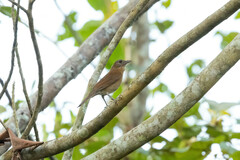
Hauxwell's Thrush

Hauxwell's Thrush

Turdus hauxwelli

Silhouette: Sharon Wegner-Larsen · PhyloPic

LCLeast ConcernNTVUENCR
Daily sighting probability <5% · Rare
at Amacayacu National Natural Park

In 3 days <5% in a week ~10%

16 Verified sightings at Amacayacu National Natural Park From 2019 to 2026
889 In all 5 parks
February Best month
☀️ Diurnal When it's spotted

About the Hauxwell's Thrush

Hauxwell's thrush (Turdus hauxwelli) is a species of bird in the family Turdidae. It is found in Bolivia, Brazil, Colombia, Ecuador, Peru, and possibly Venezuela. Hauxwell's thrush was originally described in 1869 by George Newbold Lawrence with its current binomial Turdus hauxwelli. He wrote:

I have named this species in compliment to Mr. John Hauxwell, the well-known collector on the Upper Amazon and its tributaries. Since then it has had a complicated taxonomic history. During the twentieth century it has been considered by different authors to be a subspecies of the cocoa thrush (T. fumigatus) or the pale-vented thrush (T. obsoletus). By late in the century it had regained its status as a full species. Genetic data published in the early 2000s show that Hauxwell's thrush and the cocoa thrush are sister species and that the pale-vented thrush is not closely related to either of them.

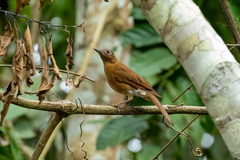
Hauxwell's thrush is monotypic. Hauxwell's thrush is 20 to 23 cm (7.9 to 9.1 in) long and weighs about 69 g (2.4 oz). The sexes have the same plumage. Adults have a rufous-brown head with a dark-streaked whitish throat. Their upperparts, wings, and tail... Wikipedia →

Sounds

Call0:31

Brazil · 2025

© Joost van Bruggen · XC1050502 · CC BY-NC-ND 4.0

Song0:09

Brazil · 2024

© JAYRSON ARAUJO DE OLIVEIRA · XC863766 · CC BY-NC-SA 4.0

Canto1:15

Brazil · 2018

© Caio Brito · XC556652 · CC BY-NC-SA 4.0

Global Distribution

Parks Where Found

# Park Country Daily sighting probability
1 Manu National Park 🇵🇪 Peru
~10%
2 Tambopata National Reserve 🇵🇪 Peru
~10%
3 Yasuní National Park 🇪🇨 Ecuador
<5%
4 Amacayacu National Natural Park 🇨🇴 Colombia
<5%
5 Sierra de la Macarena National Park 🇨🇴 Colombia
<5%

Before you go

What are the chances of seeing a Hauxwell's Thrush in Amacayacu National Natural Park?

Rare

Under 5% of wildlife watchers report a Hauxwell's Thrush sighting in Amacayacu National Natural Park on a given day, based on 16 verified sightings from GBIF citizen-science data from 2019 to 2026. It is the 367th most-seen of the 436 birds we can rate there. Over three days the chance rises to under 5%, and over a week to about 10%, if each day is a fresh chance.

When is the best time to see a Hauxwell's Thrush in Amacayacu National Natural Park?

February

In that month about 10% of wildlife watchers report a Hauxwell's Thrush in Amacayacu National Natural Park on a given day, against under 5% in March to January, the lowest months.

What time of day is best to see a Hauxwell's Thrush?

Between 7 and 10 am

Across all the parks we cover, that three-hour window holds the most Hauxwell's Thrush sightings with a recorded time, and about 8 in 10 of them come between 6 am and 6 pm: it is a daytime animal.

Is Amacayacu National Natural Park the best place to see a Hauxwell's Thrush?

4th of 5

Of the 5 parks where we can rate Hauxwell's Thrush sightings, Amacayacu National Natural Park ranks 4th at under 5%. The best odds are in Manu National Park (Peru, about 10%), Tambopata National Reserve (Peru, about 10%) and Yasuní National Park (Ecuador, under 5%).

Which relatives of the Hauxwell's Thrush live in Amacayacu National Natural Park?

Same genus: Turdus

The closest relatives of the Hauxwell's Thrush that you can see in Amacayacu National Natural Park (genus Turdus, Typical Thrushes) are Black-billed Thrush (about 20%) and Várzea Thrush (about 10%), with each one's daily chance of a sighting.

Where does the Hauxwell's Thrush sighting chance come from?

GBIF citizen-science records

It is estimated from how often the Hauxwell's Thrush is recorded against all the birds logged in Amacayacu National Natural Park (16 verified sightings from 2019 to 2026), calibrated against known sighting rates. Figures are rounded to the nearest 10% because citizen-science data supports honest approximations, not decimals, and months with records from fewer than five people show "—". How it works.

← Back to Amacayacu National Natural Park