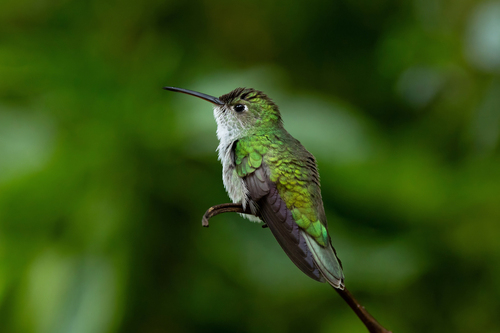
Buff-bellied Hermit

Buff-bellied Hermit

Phaethornis subochraceus

Silhouette: Andy Wilson · PhyloPic

LCLeast ConcernNTVUENCR
Daily sighting probability <5% · Rare
at Amboró National Park

In 3 days <5% in a week ~10%

7 Verified sightings at Amboró National Park From 2019 to 2026
80 In all 2 parks
January Best month
☀️ Diurnal When it's spotted

About the Buff-bellied Hermit

The buff-bellied hermit (Phaethornis subochraceus) is a species of bird in the family Trochilidae, the hummingbirds. It is found in Bolivia and Brazil. The buff-bellied hermit is closely related to the sooty-capped hermit (P. augusti) and planalto hermit (P. pretrei). It is monotypic.

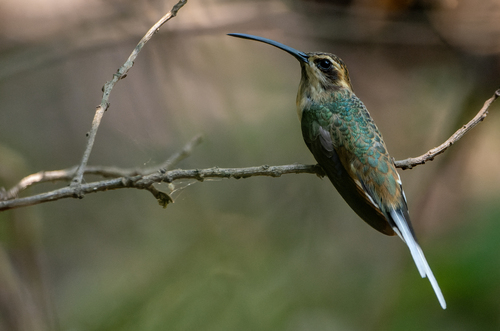
The buff-bellied hermit is 11 to 12 cm (4.3 to 4.7 in) long and weighs 3.5 to 4 g (0.12 to 0.14 oz). It has metallic green upperparts and ochre to buff underparts. The innermost pair of tail feathers are longer than the others and all have white tips.

The buff-bellied hermit is found in the eastern Andean foothills of Bolivia from southern Beni to eastern Santa Cruz departments and into the Brazilian states of Mato Grosso and Mato Grosso do Sul. It has also been recorded as a vagrant in Paraguay. It inhabits the understory of several landscapes including deciduous and semi-deciduous forest, secondary forest, open woodland, and shrubland. In elevation it ranges from 150 to 800 m (490 to 2,600 ft).

Observations of the buff-bellied hermit in eastern Bolivia showed no evidence of movement. Wikipedia →
Sounds

Song1:19

Brazil · 2017

© Marco Cruz · XC389777 · CC BY-NC-SA 4.0

Flight call0:05

Brazil · 2007

© Dante Buzzetti · XC720680 · CC BY-NC-SA 4.0

Song0:43

Bolivia · 2007

© Dan Lane · XC153677 · CC BY-NC-SA 3.0

Global Distribution

Parks Where Found

# Park Country Daily sighting probability
1 Parque Estadual Encontro das Águas 🇧🇷 Brazil
<5%
2 Amboró National Park 🇧🇴 Bolivia
<5%

Before you go

What are the chances of seeing a Buff-bellied Hermit in Amboró National Park?

Rare

Under 5% of wildlife watchers report a Buff-bellied Hermit sighting in Amboró National Park on a given day, based on 7 verified sightings from GBIF citizen-science data from 2019 to 2026. It is the 235th most-seen of the 273 birds we can rate there. Over three days the chance rises to under 5%, and over a week to about 10%, if each day is a fresh chance.

When is the best time to see a Buff-bellied Hermit in Amboró National Park?

January and February

In those months about 10% of wildlife watchers report a Buff-bellied Hermit in Amboró National Park on a given day, against under 5% in March–May and July–December, the lowest months. Those are among Amboró National Park's wettest months, with about 310 mm of rain a month against 90 mm in September. June has too few records to rate.

What time of day is best to see a Buff-bellied Hermit?

Between 6 and 9 am

Across all the parks we cover, that three-hour window holds the most Buff-bellied Hermit sightings with a recorded time, and about 9 in 10 of them come between 6 am and 6 pm: it is a daytime animal.

Is Amboró National Park the best place to see a Buff-bellied Hermit?

Among the best

Of the 2 parks where we can rate Buff-bellied Hermit sightings, Amboró National Park ranks 2nd at under 5%, level with the leaders once rounded. The best odds are in Parque Estadual Encontro das Águas (Brazil, under 5%).

Which relatives of the Buff-bellied Hermit live in Amboró National Park?

Same genus: Phaethornis

The closest relatives of the Buff-bellied Hermit that you can see in Amboró National Park (genus Phaethornis, Typical Hermits) are Planalto Hermit (about 20%) and Great-billed Hermit (about 10%), with each one's daily chance of a sighting.

Where does the Buff-bellied Hermit sighting chance come from?

GBIF citizen-science records

It is estimated from how often the Buff-bellied Hermit is recorded against all the birds logged in Amboró National Park (7 verified sightings from 2019 to 2026), calibrated against known sighting rates. Figures are rounded to the nearest 10% because citizen-science data supports honest approximations, not decimals, and months with records from fewer than five people show "—". How it works.

← Back to Amboró National Park