Planalto Hermit

Planalto Hermit

Phaethornis pretrei

Silhouette: Andy Wilson · PhyloPic

LCLeast ConcernNTVUENCR
Daily sighting probability ~20% · Possible
at Amboró National Park

In 3 days ~40% in a week ~70%

86 Verified sightings at Amboró National Park From 2019 to 2026
1,462 In all 9 parks
January Best month
☀️ Diurnal When it's spotted

About the Planalto Hermit

The planalto hermit (Phaethornis pretrei) is a species of hummingbird. It is found in Argentina, Bolivia, Brazil, Paraguay, and Peru. At one time, the planalto hermit was suggested to belong to a monotypic genus Anisoterus but this treatment was quickly rejected. It is closely related to the sooty-capped hermit (P. augusti) and may form a superspecies with it. It has no recognized subspecies, but several that have been proposed have been shown to be based on aberrant specimens or individual variation.

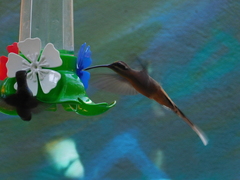
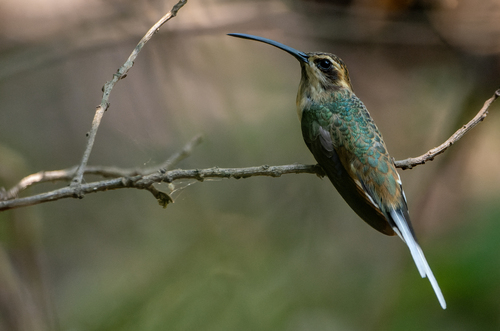
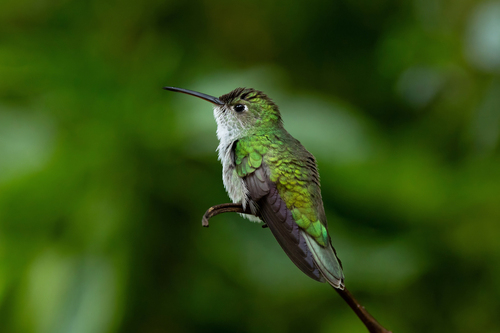
The planalto hermit is about 14 to 16.5 cm (5.5 to 6.5 in) long. Males weigh 4.5 to 7 g (0.16 to 0.25 oz) and females 3 to 5 g (0.11 to 0.18 oz). This medium-sized hermit has mostly olive green upperparts with reddish uppertail coverts. The next-to-inner tail feathers are longer than the others and all have white tips. Their underparts are cinnamon red. The face has a black "mask" with a white supercilium and gular stripe. The sexes are similar but the female has shorter wings and a less strongly decurved bill.

Major taxonomic systems place the planalto hermit in a wide swath of Brazil south of the Amazon rainforest... Wikipedia →

Sounds

Song0:08

Brazil · 2026

© JAYRSON ARAUJO DE OLIVEIRA · XC1150258 · CC BY-NC-SA 4.0

Flight call0:16

Brazil · 2016

© Fernando Igor de Godoy · XC496462 · CC BY-NC-SA 4.0

Canto0:24

Brazil · 2015

© Caio Brito · XC427763 · CC BY-NC-SA 4.0

Global Distribution

Parks Where Found

# Park Country Daily sighting probability
1 Chapada Diamantina National Park 🇧🇷 Brazil
~40%
2 Serra da Canastra National Park 🇧🇷 Brazil
~30%
3 Chapada dos Guimarães National Park 🇧🇷 Brazil
~20%
4 Amboró National Park 🇧🇴 Bolivia
~20%
5 Iguazú National Park 🇦🇷 Argentina
~10%
6 Iguaçu National Park 🇧🇷 Brazil
~10%
7 Itatiaia National Park 🇧🇷 Brazil
<5%
8 Parque Estadual Encontro das Águas 🇧🇷 Brazil
<5%
9 Serra dos Órgãos National Park 🇧🇷 Brazil
<5%

Cities Where Found

# City Country Daily sighting probability
1 Maceió 🇧🇷 Brazil
~10%
2 Campinas 🇧🇷 Brazil
~10%
3 Belo Horizonte 🇧🇷 Brazil
~10%
4 São Paulo 🇧🇷 Brazil
<5%

Zoos & Centres Where Found

# Zoo / Centre Country
1 Parque das Aves 🇧🇷 Brazil In captivity

Before you go

What are the chances of seeing a Planalto Hermit in Amboró National Park?

Possible

About 20% of wildlife watchers report a Planalto Hermit sighting in Amboró National Park on a given day, based on 86 verified sightings from GBIF citizen-science data from 2019 to 2026. It is the 74th most-seen of the 273 birds we can rate there. Over three days the chance rises to about 40%, and over a week to about 70%, if each day is a fresh chance.

When is the best time to see a Planalto Hermit in Amboró National Park?

January

In that month about 40% of wildlife watchers report a Planalto Hermit in Amboró National Park on a given day, against about 10% in February, May, August and October, the lowest months. That is one of Amboró National Park's wettest months, with about 340 mm of rain against 90 mm in September. June has too few records to rate.

What time of day is best to see a Planalto Hermit?

Between 8 and 11 am

Across all the parks we cover, that three-hour window holds the most Planalto Hermit sightings with a recorded time, and about 9 in 10 of them come between 6 am and 6 pm: it is a daytime animal.

Where does the Planalto Hermit sighting chance come from?

GBIF citizen-science records

It is estimated from how often the Planalto Hermit is recorded against all the birds logged in Amboró National Park (86 verified sightings from 2019 to 2026), calibrated against known sighting rates. Figures are rounded to the nearest 10% because citizen-science data supports honest approximations, not decimals, and months with records from fewer than five people show "—". How it works.

← Back to Amboró National Park