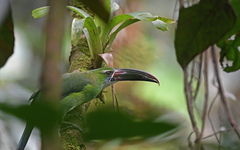
Chestnut-tipped Toucanet

Chestnut-tipped Toucanet

Aulacorhynchus derbianus

Silhouette: Jiekun He · PhyloPic

LCLeast ConcernNTVUENCR
Daily sighting probability ~10% · With luck
at Amboró National Park

In 3 days ~20% in a week ~50%

44 Verified sightings at Amboró National Park From 2019 to 2026
55 In all 2 parks
July Best month
☀️ Diurnal When it's spotted

About the Chestnut-tipped Toucanet

The chestnut-tipped toucanet (Aulacorhynchus derbianus) is a near-passerine bird in the toucan family Ramphastidae. It is found in Bolivia, Colombia, Ecuador, and Peru. The chestnut-tipped toucanet is monotypic. However, what is now the tepui toucanet (A. whitelianus) and it were for a time considered conspecific. They were separated by major taxonomic systems beginning in 2011. The chestnut-tipped and groove-billed toucanets (A. sulcatus) form a superspecies.

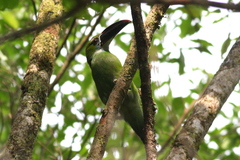
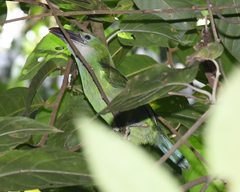
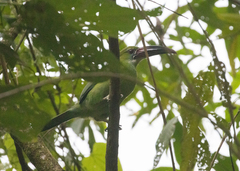
The chestnut-tipped toucanet is 33 to 41 cm (13 to 16 in) long and weighs 141 to 262 g (5.0 to 9.2 oz). Its bill is deep red and black with a vertical white line at its base and grooves on the maxilla. (Some individuals have an all-black bill). The sexes are alike. Their plumage is generally green, with a bluish nape, a white throat, and wide chestnut tips on the tail feathers. The red-brown eye has some blue below it.

The chestnut-tipped toucanet is found along the east slope of the Andes from extreme southern Colombia through Ecuador and Peru into western Bolivia as far as Cochabamba Department. It primarily inhabits subtropical montane cloudforest... Wikipedia →

Sounds

Call1:10

Peru · 2022

© Guilherme de Melo Becher · XC764398 · CC BY-NC-SA 4.0

Song0:59

Ecuador · 2002

© Jonas Nilsson · XC275765 · CC BY-NC-SA 4.0

Call0:14

Bolivia · 2020

© Jacob Wijpkema · XC607911 · CC BY-NC-SA 4.0

Global Distribution

Parks Where Found

# Park Country Daily sighting probability
1 Amboró National Park 🇧🇴 Bolivia
~10%
2 Podocarpus National Park 🇪🇨 Ecuador
<5%

Before you go

What are the chances of seeing a Chestnut-tipped Toucanet in Amboró National Park?

With luck

About 10% of wildlife watchers report a Chestnut-tipped Toucanet sighting in Amboró National Park on a given day, based on 44 verified sightings from GBIF citizen-science data from 2019 to 2026. It is the 97th most-seen of the 273 birds we can rate there. Over three days the chance rises to about 20%, and over a week to about 50%, if each day is a fresh chance.

When is the best time to see a Chestnut-tipped Toucanet in Amboró National Park?

July

In that month about 20% of wildlife watchers report a Chestnut-tipped Toucanet in Amboró National Park on a given day, against under 5% in November to February, the lowest months. That is one of Amboró National Park's driest months, with about 120 mm of rain against 340 mm in January. June has too few records to rate.

What time of day is best to see a Chestnut-tipped Toucanet?

Between 9 am and noon

Across all the parks we cover, that three-hour window holds the most Chestnut-tipped Toucanet sightings with a recorded time, and about 9 in 10 of them come between 6 am and 6 pm: it is a daytime animal.

Is Amboró National Park the best place to see a Chestnut-tipped Toucanet?

Yes

Of the 2 parks where we can rate Chestnut-tipped Toucanet sightings, Amboró National Park has the highest daily chance: about 10%. Next come Podocarpus National Park (Ecuador, under 5%).

Where does the Chestnut-tipped Toucanet sighting chance come from?

GBIF citizen-science records

It is estimated from how often the Chestnut-tipped Toucanet is recorded against all the birds logged in Amboró National Park (44 verified sightings from 2019 to 2026), calibrated against known sighting rates. Figures are rounded to the nearest 10% because citizen-science data supports honest approximations, not decimals, and months with records from fewer than five people show "—". How it works.

← Back to Amboró National Park