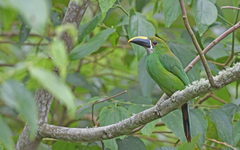
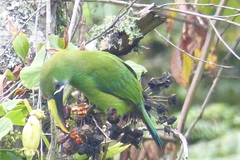
Southern Emerald-Toucanet

Southern Emerald-Toucanet

Aulacorhynchus albivitta

Silhouette: Jiekun He · PhyloPic

LCLeast ConcernNTVUENCR
Daily sighting probability <5% · Rare
at Amboró National Park

In 3 days ~10% in a week ~20%

11 Verified sightings at Amboró National Park From 2019 to 2026
1,197 In all 7 parks
November Best month
☀️ Diurnal When it's spotted

About the Southern Emerald-Toucanet

The southern emerald toucanet (Aulacorhynchus albivitta) is a near-passerine bird in the toucan family Ramphastidae. It is found in montane regions of Colombia, Ecuador, western Venezuela, Peru and northern Bolivia. The southern emerald toucanet was formally described in 1840 as Pteroglossus albivitta by the French ornithologist Auguste Boissonneau based on a specimen collected in Bogotá, Colombia. The specific epithet combines Latin albus meaning "white" with vitta meaning "band" or "head-band". The southern emerald toucanet is now one of eight toucanets placed in the genus Aulacorhynchus that was introduced in 1835 by John Gould.

For many years what was then known as the emerald toucanet was considered to have 14 subspecies. In 2008 the International Ornithological Committee (IOC) divided the subspecies into five species based on differences in morphology and mitochondrial DNA sequences. The five species were the emerald toucanet (A. prasinus) with four subspecies, the blue-throated toucanet (A. caeruleogularis) with two subspecies, the white-throated toucanet (A. albivitta) with four subspecies, the black-throated toucanet (A. atrogularis) with three subspecies and... Wikipedia →

Sounds

Call0:48

Colombia · 2022

© Frank Lambert · XC771743 · CC BY-NC-ND 4.0

Song1:30

Colombia · 1998

© Bernabé López-Lanus (Colección de Sonidos Ambientales - Instituto Humboldt) · XC518244 · CC BY-NC-SA 4.0

Call1:02

Colombia · 2019

© Rolf A. de By · XC481345 · CC BY-NC-SA 4.0

Global Distribution

Parks Where Found

# Park Country Daily sighting probability
1 Los Nevados National Natural Park 🇨🇴 Colombia
~10%
2 Manu National Park 🇵🇪 Peru
~10%
3 Farallones de Cali National Natural Park 🇨🇴 Colombia
<5%
4 Tambopata National Reserve 🇵🇪 Peru
<5%
5 Podocarpus National Park 🇪🇨 Ecuador
<5%
6 Amboró National Park 🇧🇴 Bolivia
<5%
7 Chingaza National Natural Park 🇨🇴 Colombia
<5%

Cities Where Found

# City Country Daily sighting probability
1 Medellín 🇨🇴 Colombia
<5%

Zoos & Centres Where Found

# Zoo / Centre Country
1 Parque de la Conservación 🇨🇴 Colombia In captivity
2 Dallas World Aquarium 🇺🇸 United States In captivity

Before you go

What are the chances of seeing a Southern Emerald-Toucanet in Amboró National Park?

Rare

Under 5% of wildlife watchers report a Southern Emerald-Toucanet sighting in Amboró National Park on a given day, based on 11 verified sightings from GBIF citizen-science data from 2019 to 2026. It is the 175th most-seen of the 273 birds we can rate there. Over three days the chance rises to about 10%, and over a week to about 20%, if each day is a fresh chance.

When is the best time to see a Southern Emerald-Toucanet in Amboró National Park?

July and November

In those months about 10% of wildlife watchers report a Southern Emerald-Toucanet in Amboró National Park on a given day, against under 5% in August–October and December–May, the lowest months. June has too few records to rate.

What time of day is best to see a Southern Emerald-Toucanet?

Between 9 am and noon

Across all the parks we cover, that three-hour window holds the most Southern Emerald-Toucanet sightings with a recorded time, and about 8 in 10 of them come between 6 am and 6 pm: it is a daytime animal.

Where does the Southern Emerald-Toucanet sighting chance come from?

GBIF citizen-science records

It is estimated from how often the Southern Emerald-Toucanet is recorded against all the birds logged in Amboró National Park (11 verified sightings from 2019 to 2026), calibrated against known sighting rates. Figures are rounded to the nearest 10% because citizen-science data supports honest approximations, not decimals, and months with records from fewer than five people show "—". How it works.

← Back to Amboró National Park