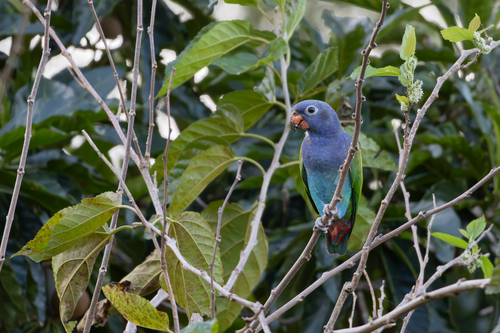
Red-billed Parrot

Red-billed Parrot

Pionus sordidus

Silhouette: Sheatherius · PhyloPic

LCLeast ConcernNTVUENCR
Daily sighting probability ~10% · With luck
at Amboró National Park

In 3 days ~20% in a week ~40%

32 Verified sightings at Amboró National Park From 2019 to 2026
151 In all 3 parks
July Best month
☀️ Diurnal When it's spotted

About the Red-billed Parrot

The red-billed parrot (Pionus sordidus), also known as coral-billed pionus or red-billed pionus, is a species of bird in subfamily Arinae of the family Psittacidae, the African and New World parrots. It is found in Bolivia, Colombia, Ecuador, Peru, and Venezuela.

In 1751 the English naturalist George Edwards included an illustration and a description of the red-billed parrot in the fourth volume of his A Natural History of Uncommon Birds. He used the English name "The dusky parrot". Edwards based his hand-colored etching on a live bird in London that was owned by the botanist and Fellow of the Royal Society Peter Collinson. Collinson believed his parrot had come from New Spain. When in 1758 the Swedish naturalist Carl Linnaeus updated his Systema Naturae for the tenth edition, he placed the red-billed parrot with the other parrots in the genus Psittacus. Linnaeus included a brief description, coined the binomial name Psittacus sordidus, and cited Edwards' work. The red-billed parrot is now one of eight species of parrot placed in the genus Pionus that was introduced in 1832 by the German naturalist Johann Georg Wagler. The genus name is from Ancient Greek... Wikipedia →

Sounds

Flight call0:30

Ecuador · 2017

© Manuel Sánchez-Nivicela · XC1163103 · CC BY-NC-ND 4.0

Call0:40

Bolivia · 2021

© Jacob Wijpkema · XC631556 · CC BY-NC-SA 4.0

Uncertain0:33

Ecuador · 2021

© Ma. Cristina Ríos · XC626090 · CC BY-NC-SA 4.0

Global Distribution

Parks Where Found

# Park Country Daily sighting probability
1 Henri Pittier National Park 🇻🇪 Venezuela
~20%
2 Amboró National Park 🇧🇴 Bolivia
~10%
3 Podocarpus National Park 🇪🇨 Ecuador
<5%

Zoos & Centres Where Found

# Zoo / Centre Country
1 Zoo. La Isla del Tapir 🇪🇨 Ecuador In captivity
2 El Nispero Zoo 🇵🇦 Panama In captivity
3 Wiwa Quito 🇪🇨 Ecuador In captivity

Before you go

What are the chances of seeing a Red-billed Parrot in Amboró National Park?

With luck

About 10% of wildlife watchers report a Red-billed Parrot sighting in Amboró National Park on a given day, based on 32 verified sightings from GBIF citizen-science data from 2019 to 2026. It is the 105th most-seen of the 273 birds we can rate there. Over three days the chance rises to about 20%, and over a week to about 40%, if each day is a fresh chance.

When is the best time to see a Red-billed Parrot in Amboró National Park?

May and July–December

In those months about 10% of wildlife watchers report a Red-billed Parrot in Amboró National Park on a given day, against under 5% in January to April, the lowest months. June has too few records to rate.

What time of day is best to see a Red-billed Parrot?

Between 7 and 10 am

Across all the parks we cover, that three-hour window holds the most Red-billed Parrot sightings with a recorded time, and about 9 in 10 of them come between 6 am and 6 pm: it is a daytime animal.

Is Amboró National Park the best place to see a Red-billed Parrot?

2nd of 3

Of the 3 parks where we can rate Red-billed Parrot sightings, Amboró National Park ranks 2nd at about 10%. The best odds are in Henri Pittier National Park (Venezuela, about 20%).

Where does the Red-billed Parrot sighting chance come from?

GBIF citizen-science records

It is estimated from how often the Red-billed Parrot is recorded against all the birds logged in Amboró National Park (32 verified sightings from 2019 to 2026), calibrated against known sighting rates. Figures are rounded to the nearest 10% because citizen-science data supports honest approximations, not decimals, and months with records from fewer than five people show "—". How it works.

← Back to Amboró National Park