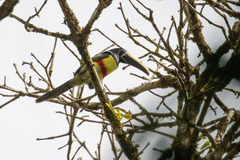
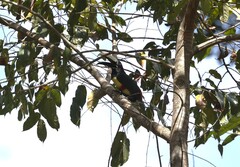
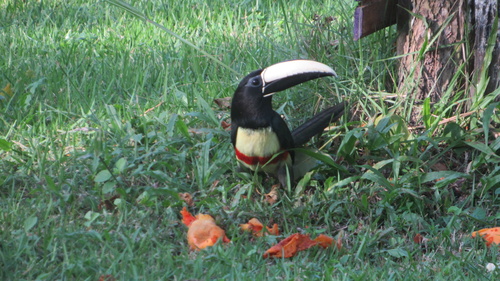
Black-necked Aracari

Black-necked Aracari

Pteroglossus aracari

Silhouette: Edwin Price · PhyloPic

LCLeast ConcernNTVUENCR
Daily sighting probability <5% · Rare
at Anavilhanas National Park

In 3 days ~10% in a week ~20%

11 Verified sightings at Anavilhanas National Park From 2019 to 2026
46 In all 3 parks
May Best month
☀️ Diurnal When it's spotted

About the Black-necked Aracari

The black-necked aracari or black-necked araçari (Pteroglossus aracari) is a near-passerine bird in the toucan family Ramphastidae. It is found in Brazil, French Guiana, Guyana, Suriname, and Venezuela. The black-necked aracari was formally described by the Swedish naturalist Carl Linnaeus in 1758 in the tenth edition of his Systema Naturae. He placed it with the toucans in the genus Ramphastos and coined the binomial name Ramphastos aracari. Linnaeus based his description on the "Aracari" that had been described and illustrated by the German naturalist Georg Marcgrave in 1648 and the "Toucan or Brazilian Pye" that had been described and illustrated by the English naturalist George Edwards in 1747. The black-necked aracari is now placed in genus Pteroglossus that was introduced in 1811 by the German zoologist Johann Karl Wilhelm Illiger. The genus name combines the Ancient Greek pteron meaning "feather" with glōssa meaning "tongue". The specific epithet aracari comes from Arassari, the name of the species in the Tupi language. Alternative common names include Wied's aracari and Maximilian's aracari.

Three subspecies of black-necked aracari... Wikipedia →

Sounds

Call0:40

Brazil · 2024

© JAYRSON ARAUJO DE OLIVEIRA · XC944370 · CC BY-NC-SA 4.0

Song0:31

Brazil · 2023

© Ricardo José Mitidieri · XC808530 · CC BY-NC-SA 4.0

Call0:20

Brazil · 2018

© Luiz Fernando Matos · XC656934 · CC BY-NC-SA 4.0

Global Distribution

Parks Where Found

# Park Country Daily sighting probability
1 Serra dos Órgãos National Park 🇧🇷 Brazil
<5%
2 Brownsberg Nature Park 🇸🇷 Suriname
<5%
3 Anavilhanas National Park 🇧🇷 Brazil
<5%

Cities Where Found

# City Country Daily sighting probability
1 Belém 🇧🇷 Brazil
~20%
2 Manaus 🇧🇷 Brazil
~10%
3 Maceió 🇧🇷 Brazil
<5%

Zoos & Centres Where Found

# Zoo / Centre Country
1 Leipzig Zoological Garden 🇩🇪 Germany In captivity
2 Parque das Aves 🇧🇷 Brazil In captivity
3 Walsrode World Bird Park 🇩🇪 Germany In captivity
4 Zoo Miami 🇺🇸 United States In captivity
5 Bronx Zoo 🇺🇸 United States In captivity
6 Beijing Zoo 🇨🇳 China In captivity
7 Parque y Zoológico Nacional Arquitecto Manuel Valverde Podestá 🇩🇴 Dominican Republic In captivity
8 Berlin Zoological Garden 🇩🇪 Germany In captivity
9 Caldwell Zoo 🇺🇸 United States In captivity
10 Parque Zoobotânico Getúlio Vargas 🇧🇷 Brazil In captivity
11 Zoologischer Garten Leipzig 🇩🇪 Germany In captivity
12 San Antonio Zoo 🇺🇸 United States In captivity
13 Emirates Park Zoo 🇦🇪 United Arab Emirates In captivity
14 Rio de Janeiro Zoological Garden 🇧🇷 Brazil In captivity
15 Paphos Zoo 🇨🇾 Cyprus In captivity
16 Discovery Cove 🇺🇸 United States In captivity
17 Leningrad Zoo 🇷🇺 Russia In captivity
18 Zoopark Limpopo 🇷🇺 Russia In captivity
19 Mangal das Garças 🇧🇷 Brazil In captivity
20 Vogelpark Heiligenkirchen 🇩🇪 Germany In captivity
21 Almere Jungle 🇳🇱 Netherlands In captivity
22 Aquarium Berlin 🇩🇪 Germany In captivity
23 Dallas World Aquarium 🇺🇸 United States In captivity
24 Wolfgang-Köhler-Primaten-Forschungszentrum 🇩🇪 Germany In captivity
25 Zoológico Miguél Álvarez del Toro 🇲🇽 Mexico In captivity

Before you go

What are the chances of seeing a Black-necked Aracari in Anavilhanas National Park?

Rare

Under 5% of wildlife watchers report a Black-necked Aracari sighting in Anavilhanas National Park on a given day, based on 11 verified sightings from GBIF citizen-science data from 2019 to 2026. It is the 219th most-seen of the 291 birds we can rate there. Over three days the chance rises to about 10%, and over a week to about 20%, if each day is a fresh chance.

When is the best time to see a Black-necked Aracari in Anavilhanas National Park?

May and October

In those months about 10% of wildlife watchers report a Black-necked Aracari in Anavilhanas National Park on a given day, against under 5% in June–September and November–April, the lowest months.

What time of day is best to see a Black-necked Aracari?

Between 7 and 10 am

Across all the parks we cover, that three-hour window holds the most Black-necked Aracari sightings with a recorded time, and about 9 in 10 of them come between 6 am and 6 pm: it is a daytime animal.

Is Anavilhanas National Park the best place to see a Black-necked Aracari?

Among the best

Of the 3 parks where we can rate Black-necked Aracari sightings, Anavilhanas National Park ranks 3rd at under 5%, level with the leaders once rounded. The best odds are in Serra dos Órgãos National Park (Brazil, under 5%) and Brownsberg Nature Park (Suriname, under 5%).

Where does the Black-necked Aracari sighting chance come from?

GBIF citizen-science records

It is estimated from how often the Black-necked Aracari is recorded against all the birds logged in Anavilhanas National Park (11 verified sightings from 2019 to 2026), calibrated against known sighting rates. Figures are rounded to the nearest 10% because citizen-science data supports honest approximations, not decimals, and months with records from fewer than five people show "—". How it works.
← Back to Anavilhanas National Park