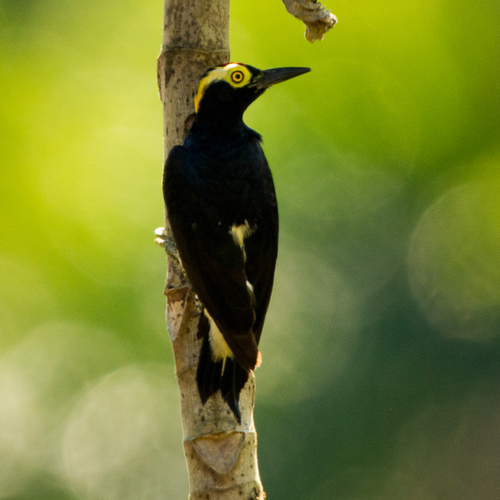
Swallow-wing Puffbird

Swallow-wing Puffbird

Chelidoptera tenebrosa

Silhouette: Matt Wilkins (Photo by Len Blumin) · PhyloPic

LCLeast ConcernNTVUENCR
Daily sighting probability ~30% · Possible
at Anavilhanas National Park

In 3 days ~60% in a week ~90%

119 Verified sightings at Anavilhanas National Park From 2019 to 2026
3,115 In all 8 parks
November Best month
☀️ Diurnal When it's spotted

About the Swallow-wing Puffbird

The swallow-winged puffbird (Chelidoptera tenebrosa) is a species of near-passerine bird in the family Bucconidae, the puffbirds, nunlets, and nunbirds. It is also called the swallow-wing. It is found in Bolivia, Brazil, Colombia, Ecuador, French Guiana, Guyana, Peru, Suriname, and Venezuela.

The swallow-winged puffbird was previously known as simply "swallow-wing" but its current name has been widely accepted since the late twentieth century. It is the only member of its genus. The swallow-winged puffbird is 14 to 15 cm (5.5 to 5.9 in) long and weighs 30 to 41.5 g (1.1 to 1.5 oz). The nominate subspecies has sooty black upperparts with some bluish iridescence. The lower back and rump are white. Its tail is short and black with white tips to the feathers that quickly wear away. The wings are long and pointed. The chin is whitish, the throat grayish, and the breast sooty black fading to gray in its lower part. Its belly is orange-chestnut. The bill is black, the eye dark brown, and the feet dark gray or black. C. t. brasiliensis is larger than... Wikipedia →

Sounds

Call0:11

Ecuador · 2025

© Marc Anderson · XC981669 · CC BY-NC-ND 4.0

Song0:08

Brazil · 2023

© JAYRSON ARAUJO DE OLIVEIRA · XC838015 · CC BY-NC-SA 4.0

Begging call0:22

Brazil · 2005

© Jeremy Minns · XC87282 · CC BY-NC-ND 2.5

Global Distribution

Parks Where Found

# Park Country Daily sighting probability
1 Manu National Park 🇵🇪 Peru
~30%
2 Anavilhanas National Park 🇧🇷 Brazil
~30%
3 Cuyabeno Wildlife Reserve 🇪🇨 Ecuador
~20%
4 Sierra de la Macarena National Park 🇨🇴 Colombia
~20%
5 Yasuní National Park 🇪🇨 Ecuador
~20%
6 Tambopata National Reserve 🇵🇪 Peru
~20%
7 Chapada dos Guimarães National Park 🇧🇷 Brazil
~10%
8 Amacayacu National Natural Park 🇨🇴 Colombia
~10%

Before you go

What are the chances of seeing a Swallow-wing Puffbird in Anavilhanas National Park?

Possible

About 30% of wildlife watchers report a Swallow-wing Puffbird sighting in Anavilhanas National Park on a given day, based on 119 verified sightings from GBIF citizen-science data from 2019 to 2026. It is the 42nd most-seen of the 291 birds we can rate there. Over three days the chance rises to about 60%, and over a week to about 90%, if each day is a fresh chance.

When is the best time to see a Swallow-wing Puffbird in Anavilhanas National Park?

November

In that month about 40% of wildlife watchers report a Swallow-wing Puffbird in Anavilhanas National Park on a given day, against about 20% in May–June and December–March, the lowest months.

What time of day is best to see a Swallow-wing Puffbird?

Between 8 and 11 am

Across all the parks we cover, that three-hour window holds the most Swallow-wing Puffbird sightings with a recorded time, and about 9 in 10 of them come between 6 am and 6 pm: it is a daytime animal.

Is Anavilhanas National Park the best place to see a Swallow-wing Puffbird?

Among the best

Of the 8 parks where we can rate Swallow-wing Puffbird sightings, Anavilhanas National Park ranks 2nd at about 30%, level with the leaders once rounded. The best odds are in Manu National Park (Peru, about 30%).

Which relatives of the Swallow-wing Puffbird live in Anavilhanas National Park?

Same family: Bucconidae

The closest relatives of the Swallow-wing Puffbird that you can see in Anavilhanas National Park (family Bucconidae, Puffbirds) are Black-fronted Nunbird (about 40%) and Black Nunbird (about 10%), with each one's daily chance of a sighting.

Where does the Swallow-wing Puffbird sighting chance come from?

GBIF citizen-science records

It is estimated from how often the Swallow-wing Puffbird is recorded against all the birds logged in Anavilhanas National Park (119 verified sightings from 2019 to 2026), calibrated against known sighting rates. Figures are rounded to the nearest 10% because citizen-science data supports honest approximations, not decimals, and months with records from fewer than five people show "—". How it works.

← Back to Anavilhanas National Park