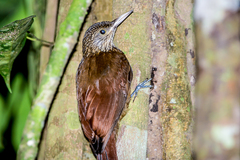
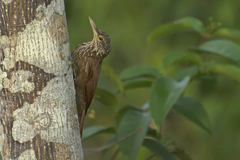

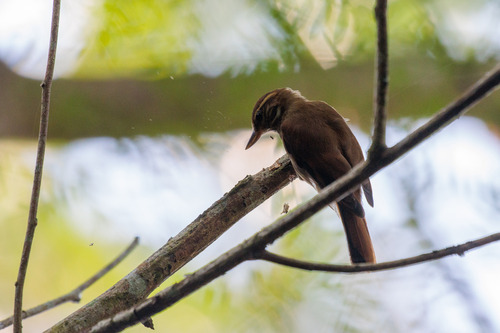
Zimmer's Woodcreeper

Zimmer's Woodcreeper

Dendroplex kienerii

Silhouette: Sheatherius · PhyloPic

LCLeast ConcernNTVUENCR
Daily sighting probability ~20% · Possible
at Anavilhanas National Park

In 3 days ~50% in a week ~80%

94 Verified sightings at Anavilhanas National Park From 2019 to 2026
105 In all 2 parks
September Best month
☀️ Diurnal When it's spotted

About the Zimmer's Woodcreeper

Zimmer's woodcreeper (Dendroplex kienerii) is a species of bird in the subfamily Dendrocolaptinae of the ovenbird family Furnariidae. It is found in Brazil, Colombia, and Peru. Zimmer's woodcreeper was originally described as Dendrornis kienerii. In 1934 Zimmer described what he believed was a new species, naming it Xiphorhynchus necopinus. By 2002 it was realized that the species was actually the earlier-described D. kienerii, so by the principle of priority, the specific epithet reverted to kienerii. In the 1950s genus Dendroplex had been merged into genus Xyphorhynchus but in the early 2000s it was resurrected for this species and the straight-billed woodcreeper (D. picus).

Zimmer's woodcreeper is monotypic. Zimmer's woodcreeper is 21 to 24 cm (8.3 to 9.4 in) long and weighs 40 to 50 g (1.4 to 1.8 oz). It is a slim, medium-sized woodcreeper with a short bill whose culmen curves gently down to a sharp tip. The sexes have the same plumage. Adults have whitish lores and supercilium on a blackish and white streaked face. Their crown is grayish brown with light buffy spots and blackish tips on the feathers. Their nape is lighter and browner... Wikipedia →

Sounds

Song0:04

Brazil · 2024

© JAYRSON ARAUJO DE OLIVEIRA · XC939965 · CC BY-NC-SA 4.0

Call0:04

Brazil · 2020

© Jerome Fischer · XC591893 · CC BY-NC-SA 4.0

Song0:27

Peru · 2019

© Juan Díaz Alván · XC471098 · CC BY-NC-SA 4.0

Global Distribution

Parks Where Found

# Park Country Daily sighting probability
1 Anavilhanas National Park 🇧🇷 Brazil
~20%
2 Amacayacu National Natural Park 🇨🇴 Colombia
<5%

Before you go

What are the chances of seeing a Zimmer's Woodcreeper in Anavilhanas National Park?

Possible

About 20% of wildlife watchers report a Zimmer's Woodcreeper sighting in Anavilhanas National Park on a given day, based on 94 verified sightings from GBIF citizen-science data from 2019 to 2026. It is the 48th most-seen of the 291 birds we can rate there. Over three days the chance rises to about 50%, and over a week to about 80%, if each day is a fresh chance.

When is the best time to see a Zimmer's Woodcreeper in Anavilhanas National Park?

May–September and November

In those months about 30% of wildlife watchers report a Zimmer's Woodcreeper in Anavilhanas National Park on a given day, against about 10% in January and March–April, the lowest months.

What time of day is best to see a Zimmer's Woodcreeper?

Between 8 and 11 am

Across all the parks we cover, that three-hour window holds the most Zimmer's Woodcreeper sightings with a recorded time, and about 8 in 10 of them come between 6 am and 6 pm: it is a daytime animal.

Is Anavilhanas National Park the best place to see a Zimmer's Woodcreeper?

Yes

Of the 2 parks where we can rate Zimmer's Woodcreeper sightings, Anavilhanas National Park has the highest daily chance: about 20%. Next come Amacayacu National Natural Park (Colombia, under 5%).

Which relatives of the Zimmer's Woodcreeper live in Anavilhanas National Park?

Same family: Furnariidae

The closest relatives of the Zimmer's Woodcreeper that you can see in Anavilhanas National Park (family Furnariidae, Ovenbirds and Woodcreepers) are Long-billed Woodcreeper (about 30%), Striped Woodcreeper (about 30%) and Straight-billed Woodcreeper (about 20%), with each one's daily chance of a sighting.

Where does the Zimmer's Woodcreeper sighting chance come from?

GBIF citizen-science records

It is estimated from how often the Zimmer's Woodcreeper is recorded against all the birds logged in Anavilhanas National Park (94 verified sightings from 2019 to 2026), calibrated against known sighting rates. Figures are rounded to the nearest 10% because citizen-science data supports honest approximations, not decimals, and months with records from fewer than five people show "—". How it works.

← Back to Anavilhanas National Park