Grey Mouse-lemur

Grey Mouse-lemur

Microcebus murinus

Silhouette: Maky (vectorization), Gabriella Skollar (photography), Rebecca Lewis (editing) · PhyloPic

LCLeast ConcernNTVUENCR Endemic
Daily sighting probability ~50% · Likely
at Ankarafantsika National Park

In 3 days ~90% in a week >90%

14 Verified sightings at Ankarafantsika National Park From 2019 to 2026
14 In 1 park
May Best month
🌅 Crepuscular When it's spotted

About the Grey Mouse-lemur

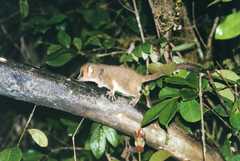
The gray mouse lemur (Microcebus murinus), grey mouse lemur or lesser mouse lemur is a small lemur, a type of strepsirrhine primate, found only on the island of Madagascar. Weighing 58 to 67 grams (2.0 to 2.4 oz), it is the largest of the mouse lemurs (genus Microcebus), a group that includes the smallest primates in the world. The species is named for its mouse-like size and coloration and is known locally (in Malagasy) as tsidy, koitsiky, titilivaha, pondiky, and vakiandry. The gray mouse lemur and all other mouse lemurs are considered cryptic species, as they are nearly indistinguishable from each other by appearance. For this reason, the gray mouse lemur was considered the only mouse lemur species for decades until more recent studies began to distinguish between the species.

Like all mouse lemurs, this species is nocturnal and arboreal. It is very active, and though it forages alone, groups of males and females form sleeping groups and share tree holes during the day. It exhibits a form of dormancy called torpor during the cool, dry winter months, and in some cases undergoes seasonal torpor (or hibernation), which is unusual for primates. The gray mouse lemur can be found in several types of forest throughout western and southern Madagascar. Its diet consists primarily of fruit, insects, flowers, and nectar. In the wild, its natural predators include owls, snakes, and endemic mammalian predators. Predation pressure is higher for this species than among any other primate species, with one out of four individuals taken by a predator each year. This is counterbalanced by its high reproductive rate. Breeding is seasonal, and distinct vocalizations are used to prevent hybridization with species that overlap its range. Gestation lasts approximately 60 days, and typically two young are born. The offspring are usually independent in two months, and can reproduce after one year. The gray mouse lemur has a reproductive lifespan of five years, although captive individuals have been reported to live up to 15 years.

Although threatened by deforestation, habitat degradation, and live capture for the pet trade, it is considered one of Madagascar's most abundant small native mammals. It can tolerate moderate food shortages by experiencing daily torpor to conserve energy, but extended food shortages due to climate change may pose a significant risk to the species. Wikipedia →

Global Distribution

Parks Where Found

# Park Country Daily sighting probability
1 Ankarafantsika National Park 🇲🇬 Madagascar
~50%

More parks will be added in future updates.

Zoos & Centres Where Found

# Zoo / Centre Country
1 Natura Artis Magistra 🇳🇱 Netherlands In captivity
2 North Carolina Zoo 🇺🇸 United States In captivity
3 Frankfurt Zoological Garden 🇩🇪 Germany In captivity
4 Five Sisters Zoo 🇬🇧 United Kingdom In captivity

Before you go

What are the chances of seeing a Grey Mouse-lemur in Ankarafantsika National Park?

Likely

About 50% of wildlife watchers report a Grey Mouse-lemur sighting in Ankarafantsika National Park on a given day, based on 14 verified sightings from GBIF citizen-science data from 2019 to 2026. It is the 5th most-seen of the 9 mammals we can rate there. Over three days the chance rises to about 90%, and over a week to over 90%, if each day is a fresh chance.

When is the best time to see a Grey Mouse-lemur in Ankarafantsika National Park?

May

In that month about 70% of wildlife watchers report a Grey Mouse-lemur in Ankarafantsika National Park on a given day, against under 5% in November, the lowest month. That is one of Ankarafantsika National Park's driest months, with about 5 mm of rain against 560 mm in January. February and March have too few records to rate.

What time of day is best to see a Grey Mouse-lemur?

Between 5 and 8 pm

Across all the parks we cover, that three-hour window holds the most Grey Mouse-lemur sightings with a recorded time, and about half of them come between 6 pm and 6 am: it is most active around dawn and dusk.

Where else can you see a Grey Mouse-lemur?

Only Ankarafantsika National Park, in our data

Ankarafantsika National Park is the only park on Wallace's Line with enough records to rate Grey Mouse-lemur sightings: about 50% of wildlife watchers there report one on a given day.

Where does the Grey Mouse-lemur sighting chance come from?

GBIF citizen-science records

It is estimated from how often the Grey Mouse-lemur is recorded against all the mammals logged in Ankarafantsika National Park (14 verified sightings from 2019 to 2026), calibrated against known sighting rates. Figures are rounded to the nearest 10% because citizen-science data supports honest approximations, not decimals, and months with records from fewer than five people show "—". How it works.

← Back to Ankarafantsika National Park
