



Completed


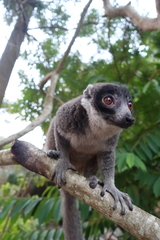

Mongoose Lemur
Eulemur mongoz
Silhouette: Andy Wilson · PhyloPic
- KingdomAnimalia (Animals)
- PhylumChordata (Chordates)
- ClassMammalia (Mammals)
- OrderPrimates
- FamilyLemuridae (Typical Lemurs)
- GenusEulemur (Brown Lemurs)
- SpeciesEulemur mongoz (Mongoose Lemur)
In 3 days ~80% in a week >90%
14 Verified sightings at Ankarafantsika National Park From 2019 to 2026
14 In 1 park
October Best month
☀️ Diurnal When it's spotted
About the Mongoose Lemur
The mongoose lemur (Eulemur mongoz) is a small primate in the family Lemuridae, native to Madagascar and introduced to the Comoros Islands. These arboreal animals have pointed faces, long, bushy tails, dark-brown upper parts, pale bellies, and beards, which are reddish in males and white in females. They live in family groups and feed primarily on fruit, but also eat leaves, flowers, and nectar, with nectar from Ceiba pentandra trees making up a large part of their diet during the dry season. They have declined sharply in numbers because of habitat destruction and hunting, and the International Union for Conservation of Nature has rated their conservation status as "critically endangered".
The mongoose lemur ranges in size from 12 to 18 in (300 to 460 mm) long plus a tail of 16 to 25 in (410 to 640 mm). Both sexes are born with white beards, but become obviously dimorphic around six weeks of age when the males develop red beards and red cheeks. The males also have lighter faces than the females. Males may further distinguish themselves when scent-marking territory, as they occasionally develop a bald patch on top of their heads from rubbing.
The... Wikipedia →
Recent sightings of Mongoose Lemur in Ankarafantsika National Park
LIVEiNaturalistGlobal Distribution
Parks Where Found
| # | Park | Country | Daily sighting probability |
|---|---|---|---|
| 1 | Ankarafantsika National Park | 🇲🇬 Madagascar |
More parks will be added in future updates.
Zoos & Centres Where Found
| # | Zoo / Centre | Country | |
|---|---|---|---|
| 1 | Ostrava Zoo | 🇨🇿 Czechia | |
| 2 | Omaha’s Henry Doorly Zoo and Aquarium | 🇺🇸 United States | |
| 3 | Jacksonville Zoo and Gardens | 🇺🇸 United States | |
| 4 | Duke Lemur Center | 🇺🇸 United States | |
| 5 | Bristol Zoo Project | 🇬🇧 United Kingdom | |
| 6 | Parc Zoologique et Botanique de Mulhouse | 🇫🇷 France | |
| 7 | Botanical and Zoological Garden of Tsimbazaza | 🇲🇬 Madagascar | |
| 8 | Edmonton Valley Zoo | 🇨🇦 Canada | |
| 9 | Akron Zoo | 🇺🇸 United States | |
| 10 | Valencia Bioparc | 🇪🇸 Spain | |
| 11 | Sacramento Zoo | 🇺🇸 United States | |
| 12 | Lemurs Park | 🇲🇬 Madagascar | |
| 13 | Adventure Aquarium | 🇺🇸 United States | |
| 14 | Charles Paddock Zoo | 🇺🇸 United States |
Closest Relatives at Ankarafantsika National Park


Before you go
What are the chances of seeing a Mongoose Lemur in Ankarafantsika National Park?
Likely
About 40% of wildlife watchers report a Mongoose Lemur sighting in Ankarafantsika National Park on a given day, based on 14 verified sightings from GBIF citizen-science data from 2019 to 2026. It is the 6th most-seen of the 9 mammals we can rate there. Over three days the chance rises to about 80%, and over a week to over 90%, if each day is a fresh chance.
When is the best time to see a Mongoose Lemur in Ankarafantsika National Park?
October and December
In those months about 60% of wildlife watchers report a Mongoose Lemur in Ankarafantsika National Park on a given day, against about 10% in April and June–September, the lowest months. February has too few records to rate.
What time of day is best to see a Mongoose Lemur?
Between 3 and 6 pm
Across all the parks we cover, that three-hour window holds the most Mongoose Lemur sightings with a recorded time, and about 8 in 10 of them come between 6 am and 6 pm: it is a daytime animal.
Where else can you see a Mongoose Lemur?
Only Ankarafantsika National Park, in our data
Ankarafantsika National Park is the only park on Wallace's Line with enough records to rate Mongoose Lemur sightings: about 40% of wildlife watchers there report one on a given day.
Where does the Mongoose Lemur sighting chance come from?
GBIF citizen-science records
It is estimated from how often the Mongoose Lemur is recorded against all the mammals logged in Ankarafantsika National Park (14 verified sightings from 2019 to 2026), calibrated against known sighting rates. Figures are rounded to the nearest 10% because citizen-science data supports honest approximations, not decimals, and months with records from fewer than five people show "—". How it works.
