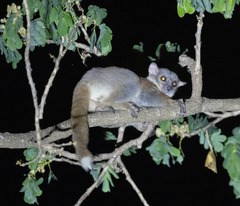
Milne-Edwards' Sportive Lemur

Milne-Edwards' Sportive Lemur

Lepilemur edwardsi

Silhouette: Zhengwei Xie · PhyloPic

LCNTVUENEndangeredCR Endemic
Daily sighting probability ~70% · Very likely
at Ankarafantsika National Park

In 3 days >90%

39 Verified sightings at Ankarafantsika National Park From 2019 to 2026
39 In 1 park
August Best month
🌅 Crepuscular When it's spotted

About the Milne-Edwards' Sportive Lemur

Milne-Edwards' sportive lemur (Lepilemur edwardsi), or Milne-Edwards' weasel lemur, is a species of lemur in the family Lepilemuridae. It is endemic to Madagascar. Its natural habitat is subtropical or tropical dry forests. It is threatened by habitat loss.

An enormous problem for these animals is the limited resource of safe sleeping sites. These are essential for their survival since they provide shelter from predators and weather conditions. Milne-Edwards' sportive lemurs occupy the northern-eastern region of Madagascar, and is commonly known to live in the National Park of Akanrafantsika, but can be found in the Mariarano Classified Forest. They are arboreal and terrestrial, mainly prioritizing broadleaves trees in equatorial climate. They are also establishing their habitat over one hectare of forest. The habitat undergoes important changes in vegetation, temperature, and climate between the rainy and dry seasons.

Deforestation in Madagascar rises to nearly 1% per year on the entire territory. Conservation efforts of Madagascar have been under work since the 1980s, with aid from countries such as the US and France, aiding with funds and management. This aid includes... Wikipedia →

Global Distribution

Parks Where Found

# Park Country Daily sighting probability
1 Ankarafantsika National Park 🇲🇬 Madagascar
~70%

More parks will be added in future updates.

Before you go

What are the chances of seeing a Milne-Edwards' Sportive Lemur in Ankarafantsika National Park?

Very likely

About 70% of wildlife watchers report a Milne-Edwards' Sportive Lemur sighting in Ankarafantsika National Park on a given day, based on 39 verified sightings from GBIF citizen-science data from 2019 to 2026. It is the 2nd most-seen of the 9 mammals we can rate there. Over three days the chance rises to over 90%, if each day is a fresh chance.

When is the best time to see a Milne-Edwards' Sportive Lemur in Ankarafantsika National Park?

August and October

In those months about 80% of wildlife watchers report a Milne-Edwards' Sportive Lemur in Ankarafantsika National Park on a given day, against about 10% in April, the lowest month. Those are among Ankarafantsika National Park's driest months, with about 20 mm of rain a month against 560 mm in January. February and March have too few records to rate.

What time of day is best to see a Milne-Edwards' Sportive Lemur?

Between 6 and 9 am

Across all the parks we cover, that three-hour window holds the most Milne-Edwards' Sportive Lemur sightings with a recorded time, and about 6 in 10 of them come between 6 am and 6 pm: it is most active around dawn and dusk.

Where else can you see a Milne-Edwards' Sportive Lemur?

Only Ankarafantsika National Park, in our data

Ankarafantsika National Park is the only park on Wallace's Line with enough records to rate Milne-Edwards' Sportive Lemur sightings: about 70% of wildlife watchers there report one on a given day.

Which relatives of the Milne-Edwards' Sportive Lemur live in Ankarafantsika National Park?

Same order: Primates

The closest relatives of the Milne-Edwards' Sportive Lemur that you can see in Ankarafantsika National Park (order Primates) are Coquerel's Sifaka (about 90%), Lorenz Von Liburnau’s Woolly Lemur (about 60%) and Common Brown Lemur (about 60%), with each one's daily chance of a sighting.

Where does the Milne-Edwards' Sportive Lemur sighting chance come from?

GBIF citizen-science records

It is estimated from how often the Milne-Edwards' Sportive Lemur is recorded against all the mammals logged in Ankarafantsika National Park (39 verified sightings from 2019 to 2026), calibrated against known sighting rates. Figures are rounded to the nearest 10% because citizen-science data supports honest approximations, not decimals, and months with records from fewer than five people show "—". How it works.

← Back to Ankarafantsika National Park