Grey Warbler

Grey Warbler

Gerygone igata

Silhouette: Sheatherius · PhyloPic

LCLeast ConcernNTVUENCR Endemic
Daily sighting probability ~80% · Very likely
at Aoraki Mount Cook National Park

In 3 days >90%

269 Verified sightings at Aoraki Mount Cook National Park From 2019 to 2026
5,207 In all 6 parks
November Best month
☀️ Diurnal When it's spotted

About the Grey Warbler

The grey warbler (Gerygone igata), also known by its Māori name riroriro, is an insectivorous bird in the family Acanthizidae endemic to New Zealand. Internationally, ornithologists usually refer to it as the grey gerygone or New Zealand gerygone to avoid confusion with unrelated birds also known as warblers. It is also sometimes known as the rainbird. The specific name igata was given by French naturalists Jean René Constant Quoy and Joseph Paul Gaimard, who claimed that this was the local name among the Māori inhabitants of Tasman Bay; this was likely a misunderstanding as no iwi are known to have a name resembling "igata" for the bird. Its natural habitat is forests, but also tends to occupy lower vegetation habitats. These insectivorous birds feed on insects living in shrubs, and often feed on the wing. They are found throughout New Zealand, as well as offshore islands where shrub exists. They also flourish in suburban areas where there is vegetation present.

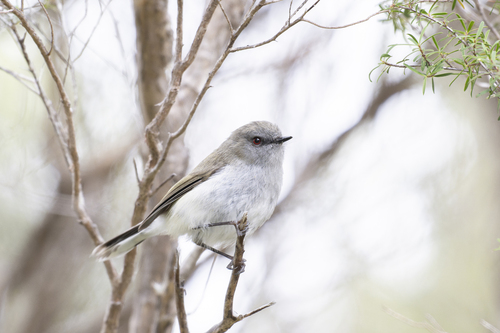
The grey warbler has a long tail that is darker than its grey-brown body, with white tail end markings as well as a white tail underside. There is little sexual dimorphism between males and females, aside... Wikipedia →

Sounds

Song0:17

New Zealand · 2025

© craig wilson · XC1063601 · CC BY 4.0

Call0:27

New Zealand · 2018

© Romuald Mikusek · XC404847 · CC BY-NC-SA 4.0

Song0:07

New Zealand · 2019

© Hugo Caverzasi · XC506502 · CC BY-NC-SA 4.0

Global Distribution

Parks Where Found

# Park Country Daily sighting probability
1 Arthur's Pass National Park 🇳🇿 New Zealand
~90%
2 Aoraki Mount Cook National Park 🇳🇿 New Zealand
~80%
3 Egmont National Park 🇳🇿 New Zealand
~70%
4 Rakiura National Park 🇳🇿 New Zealand
~60%
5 Fiordland National Park 🇳🇿 New Zealand
~50%
6 Abel Tasman National Park 🇳🇿 New Zealand
~50%

Cities Where Found

# City Country Daily sighting probability
1 Auckland 🇳🇿 New Zealand
~50%

Before you go

What are the chances of seeing a Grey Warbler in Aoraki Mount Cook National Park?

Very likely

About 80% of wildlife watchers report a Grey Warbler sighting in Aoraki Mount Cook National Park on a given day, based on 269 verified sightings from GBIF citizen-science data from 2019 to 2026. It is the 3rd most-seen of the 36 birds we can rate there. Over three days the chance rises to over 90%, if each day is a fresh chance.

When is the best time to see a Grey Warbler in Aoraki Mount Cook National Park?

November

In that month about 90% of wildlife watchers report a Grey Warbler in Aoraki Mount Cook National Park on a given day, against about 40% in July, the lowest month.

What time of day is best to see a Grey Warbler?

Between noon and 3 pm

Across all the parks we cover, that three-hour window holds the most Grey Warbler sightings with a recorded time, and about 9 in 10 of them come between 6 am and 6 pm: it is a daytime animal.

Is Aoraki Mount Cook National Park the best place to see a Grey Warbler?

2nd of 6

Of the 6 parks where we can rate Grey Warbler sightings, Aoraki Mount Cook National Park ranks 2nd at about 80%. The best odds are in Arthur's Pass National Park (New Zealand, about 90%). All parks ranked.

Which relatives of the Grey Warbler live in Aoraki Mount Cook National Park?

Same order: Passeriformes

The closest relatives of the Grey Warbler that you can see in Aoraki Mount Cook National Park (order Passeriformes, Perching Birds) are Chaffinch (about 90%), Eurasian Blackbird (about 90%) and Silvereye (about 80%), with each one's daily chance of a sighting.

Where does the Grey Warbler sighting chance come from?

GBIF citizen-science records

It is estimated from how often the Grey Warbler is recorded against all the birds logged in Aoraki Mount Cook National Park (269 verified sightings from 2019 to 2026), calibrated against known sighting rates. Figures are rounded to the nearest 10% because citizen-science data supports honest approximations, not decimals, and months with records from fewer than five people show "—". How it works.
← Back to Aoraki Mount Cook National Park