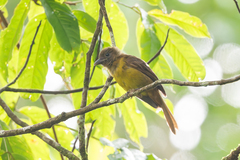
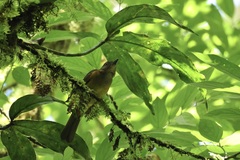
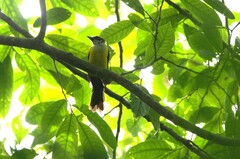

White-throated Shrike-Tanager

White-throated Shrike-Tanager

Lanio leucothorax

Silhouette: Sheatherius · PhyloPic

LCNTNear ThreatenedVUENCR
Daily sighting probability ~10% · With luck
at Arenal Volcano National Park

In 3 days ~20% in a week ~50%

1,330 Verified sightings at Arenal Volcano National Park From 2019 to 2026
2,300 In all 7 parks
September Best month
☀️ Diurnal When it's spotted

About the White-throated Shrike-Tanager

The white-throated shrike-tanager (Lanio leucothorax) is a Near Threatened species of bird in the family Thraupidae, the tanagers and allies. It is found in Costa Rica, Honduras, Nicaragua, and Panama. The white-throated shrike-tanager was formally described in 1865 with its present binomial Lanio leucothorax. For a time it and the black-throated shrike-tanager (L. aurantius) were treated as conspecific. They form a superspecies.

The white-throated shrike-tanager has these four subspecies: It has a shrike-like "toothed" bill with a hooked end. The species is sexually dimorphic. Adult males of the nominate subspecies L. l. leucothorax have rich yellow upperparts. Their head, nape, wings, and tail are black, with white on the lesser wing coverts. Their chin is black, their throat white, their breast buff-tinged white, their belly and undertail coverts bright yellow, their thighs black, and... Wikipedia →

Sounds

Call0:22

Costa Rica · 2020

© Johan Chaves · XC557127 · CC BY-NC-SA 4.0

Song0:38

Costa Rica · 2010

© Peter Boesman · XC274206 · CC BY-NC-ND 4.0

Call0:12

Honduras · 2017

© Roland Rumm · XC371537 · CC BY-NC-SA 4.0

Global Distribution

Parks Where Found

# Park Country Daily sighting probability
1 Corcovado National Park 🇨🇷 Costa Rica
~20%
2 Arenal Volcano National Park 🇨🇷 Costa Rica
~10%
3 Braulio Carrillo National Park 🇨🇷 Costa Rica
~10%
4 Marino Ballena National Park 🇨🇷 Costa Rica
<5%
5 Piedras Blancas National Park 🇨🇷 Costa Rica
<5%
6 Tenorio Volcano National Park 🇨🇷 Costa Rica
<5%
7 Carara National Park 🇨🇷 Costa Rica
<5%

Before you go

What are the chances of seeing a White-throated Shrike-Tanager in Arenal Volcano National Park?

With luck

About 10% of wildlife watchers report a White-throated Shrike-Tanager sighting in Arenal Volcano National Park on a given day, based on 1,330 verified sightings from GBIF citizen-science data from 2019 to 2026. It is the 151st most-seen of the 503 birds we can rate there. Over three days the chance rises to about 20%, and over a week to about 50%, if each day is a fresh chance.

When is the best time to see a White-throated Shrike-Tanager in Arenal Volcano National Park?

Any time of year

In every month with enough records, about 10% of wildlife watchers report a White-throated Shrike-Tanager in Arenal Volcano National Park on a given day, so our monthly data shows no clear season.

What time of day is best to see a White-throated Shrike-Tanager?

Between 9 am and noon

Across all the parks we cover, that three-hour window holds the most White-throated Shrike-Tanager sightings with a recorded time, and about 9 in 10 of them come between 6 am and 6 pm: it is a daytime animal.

Is Arenal Volcano National Park the best place to see a White-throated Shrike-Tanager?

2nd of 7

Of the 7 parks where we can rate White-throated Shrike-Tanager sightings, Arenal Volcano National Park ranks 2nd at about 10%. The best odds are in Corcovado National Park (Costa Rica, about 20%).

Which relatives of the White-throated Shrike-Tanager live in Arenal Volcano National Park?

Same family: Thraupidae

The closest relatives of the White-throated Shrike-Tanager that you can see in Arenal Volcano National Park (family Thraupidae, Tanagers and Allies) are Scarlet-rumped Tanager (about 80%), Blue-gray Tanager (about 70%) and Bananaquit (about 60%), with each one's daily chance of a sighting.

Where does the White-throated Shrike-Tanager sighting chance come from?

GBIF citizen-science records

It is estimated from how often the White-throated Shrike-Tanager is recorded against all the birds logged in Arenal Volcano National Park (1,330 verified sightings from 2019 to 2026), calibrated against known sighting rates. Figures are rounded to the nearest 10% because citizen-science data supports honest approximations, not decimals, and months with records from fewer than five people show "—". How it works.

← Back to Arenal Volcano National Park