Abyssinian Crimson-wing

Abyssinian Crimson-wing

Cryptospiza salvadorii

Silhouette: Sheatherius · PhyloPic

LCLeast ConcernNTVUENCR
Daily sighting probability ~10% · With luck
at Arusha National Park

In 3 days ~20% in a week ~30%

39 Verified sightings at Arusha National Park From 2019 to 2026
112 In all 5 parks
September Best month
☀️ Diurnal When it's spotted

About the Abyssinian Crimson-wing

The Abyssinian crimsonwing (Cryptospiza salvadorii), also known as the Ethiopian crimsonwing, Salvadori's crimsonwing or crimson-backed forest finch, is a common species of estrildid finch found in eastern Africa. It has an estimated global extent of occurrence of 190,000 km2 (73,000 mi2).

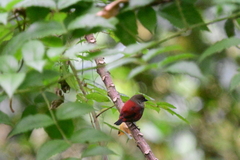
The Abyssinian crimsonwing is a small, shy greyish olive finch with bright crimson wings, mantle, back and rump. It is sexually dimorphic. In the males the head and upper mantle are greyish olive apart from the blackish lores, while the rest of the upper parts, except for the short, rounded, black tail, are deep crimson. The chin is dull yellow and the rest of the underparts are greyish-olive, with some flank feathers having red tips. The bill is black, and the eyes and legs are dark brown. The females is similar to the male, but duller red above and pale olive below. The juveniles are browner above with only patches of red colour. It measures 10–11 cm (3.9–4.3 in) in length and weighs 10.9–14 g (0.38–0.49 oz).

The call of the Abyssinian crimsonwing is a soft "tsip-tsip" which is given when the bird is flushed. The song is the call repeated but with a soft melodic sub... Wikipedia →

Sounds

Call0:53

Kenya · 2020

© James Bradley · XC536423 · CC BY-NC-SA 4.0

Global Distribution

Parks Where Found

# Park Country Daily sighting probability
1 Bale Mountains National Park 🇪🇹 Ethiopia
~10%
2 Arusha National Park 🇹🇿 Tanzania
~10%
3 Ngorongoro Conservation Area 🇹🇿 Tanzania
<5%
4 Aberdare National Park 🇰🇪 Kenya
<5%
5 Nyungwe National Park 🇷🇼 Rwanda
<5%

Before you go

What are the chances of seeing an Abyssinian Crimson-wing in Arusha National Park?

With luck

About 10% of wildlife watchers report an Abyssinian Crimson-wing sighting in Arusha National Park on a given day, based on 39 verified sightings from GBIF citizen-science data from 2019 to 2026. It is the 196th most-seen of the 373 birds we can rate there. Over three days the chance rises to about 20%, and over a week to about 30%, if each day is a fresh chance.

When is the best time to see an Abyssinian Crimson-wing in Arusha National Park?

August and September

In those months about 20% of wildlife watchers report an Abyssinian Crimson-wing in Arusha National Park on a given day, against under 5% in May–June and December–March, the lowest months. Those are among Arusha National Park's driest months, with about 65 mm of rain a month against 440 mm in April.

What time of day is best to see an Abyssinian Crimson-wing?

Between 9 am and noon

Across all the parks we cover, that three-hour window holds the most Abyssinian Crimson-wing sightings with a recorded time, and about 8 in 10 of them come between 6 am and 6 pm: it is a daytime animal.

Is Arusha National Park the best place to see an Abyssinian Crimson-wing?

Among the best

Of the 5 parks where we can rate Abyssinian Crimson-wing sightings, Arusha National Park ranks 2nd at about 10%, level with the leaders once rounded. The best odds are in Bale Mountains National Park (Ethiopia, about 10%).

Which relatives of the Abyssinian Crimson-wing live in Arusha National Park?

Same family: Estrildidae

The closest relatives of the Abyssinian Crimson-wing that you can see in Arusha National Park (family Estrildidae, Waxbills and Allies) are Black-and-white Mannikin (about 20%), Bronze Mannikin (about 20%) and Red-billed Firefinch (about 10%), with each one's daily chance of a sighting.

Where does the Abyssinian Crimson-wing sighting chance come from?

GBIF citizen-science records

It is estimated from how often the Abyssinian Crimson-wing is recorded against all the birds logged in Arusha National Park (39 verified sightings from 2019 to 2026), calibrated against known sighting rates. Figures are rounded to the nearest 10% because citizen-science data supports honest approximations, not decimals, and months with records from fewer than five people show "—". How it works.

← Back to Arusha National Park

