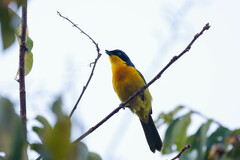
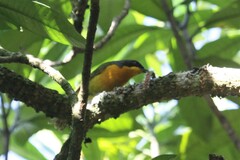
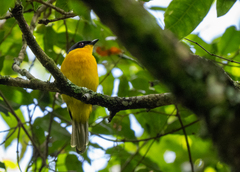
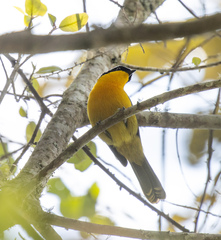
Black-Fronted Bushshrike

Black-Fronted Bushshrike

Chlorophoneus nigrifrons

Daily sighting probability ~20% · Possible
at Arusha National Park

In 3 days ~50% in a week ~80%

131 Verified sightings at Arusha National Park From 2019 to 2026
205 In all 4 parks
August Best month
☀️ Diurnal When it's spotted

About the Black-Fronted Bushshrike

The black-fronted bushshrike (Chlorophoneus nigrifrons) is a passerine bird of the bushshrike family, Malaconotidae. It inhabits forests mainly in East Africa. It forms a superspecies with the many-colored bushshrike (C. multicolor) and the two are sometimes considered to be a single species.

The bird is 18–19 centimetres long. It is variable in appearance and has several different colour morphs. All birds have green upperparts, grey crown and upper back, yellow tip to the tail and dark bill and legs. The orange morph has a black mask and forehead and orange underparts, shading to yellow under the tail. The red morph is similar but redder on the throat and breast with yellow on the belly and undertail-coverts. The buff form has buff underparts and a pale throat. The black morph has an entirely black face, forehead, throat and breast and green belly and undertail-coverts. Females are duller than the males with less black on the forehead. Juvenile birds have buffish underparts with dark barring and yellow edges to the wing-feathers. The song includes repeated bell-like phrases. Pairs often duet together.

It has a patchy distribution and... Wikipedia →

Global Distribution

Parks Where Found

# Park Country Daily sighting probability
1 Arusha National Park 🇹🇿 Tanzania
~20%
2 Mkomazi National Park 🇹🇿 Tanzania
~10%
3 Gorongosa National Park 🇲🇿 Mozambique
<5%
4 Ngorongoro Conservation Area 🇹🇿 Tanzania
<5%

Before you go

What are the chances of seeing a Black-Fronted Bushshrike in Arusha National Park?

Possible

About 20% of wildlife watchers report a Black-Fronted Bushshrike sighting in Arusha National Park on a given day, based on 131 verified sightings from GBIF citizen-science data from 2019 to 2026. It is the 81st most-seen of the 373 birds we can rate there. Over three days the chance rises to about 50%, and over a week to about 80%, if each day is a fresh chance.

When is the best time to see a Black-Fronted Bushshrike in Arusha National Park?

August

In that month about 40% of wildlife watchers report a Black-Fronted Bushshrike in Arusha National Park on a given day, against about 10% in December, the lowest month. That is one of Arusha National Park's driest months, with about 65 mm of rain against 440 mm in April.

What time of day is best to see a Black-Fronted Bushshrike?

Between 9 am and noon

Across all the parks we cover, that three-hour window holds the most Black-Fronted Bushshrike sightings with a recorded time, and about 9 in 10 of them come between 6 am and 6 pm: it is a daytime animal.

Is Arusha National Park the best place to see a Black-Fronted Bushshrike?

Yes

Of the 4 parks where we can rate Black-Fronted Bushshrike sightings, Arusha National Park has the highest daily chance: about 20%. Next come Mkomazi National Park (Tanzania, about 10%) and Gorongosa National Park (Mozambique, under 5%).

Where does the Black-Fronted Bushshrike sighting chance come from?

GBIF citizen-science records

It is estimated from how often the Black-Fronted Bushshrike is recorded against all the birds logged in Arusha National Park (131 verified sightings from 2019 to 2026), calibrated against known sighting rates. Figures are rounded to the nearest 10% because citizen-science data supports honest approximations, not decimals, and months with records from fewer than five people show "—". How it works.

← Back to Arusha National Park