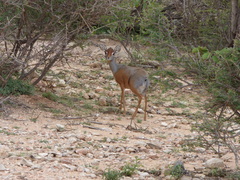
Salt's Dik-dik

Salt's Dik-dik

Madoqua saltiana

Silhouette: Kai Caspar · PhyloPic

LCLeast ConcernNTVUENCR
Daily sighting probability ~80% · Very likely
at Awash National Park

In 3 days >90%

12 Verified sightings at Awash National Park From 2019 to 2026
12 In 1 park
November Best month
☀️ Diurnal When it's spotted

About the Salt's Dik-dik

Salt's dik-dik (Madoqua saltiana) is a small antelope found in semidesert, bushland, and thickets in the Horn of Africa, but marginally also in northern Kenya and eastern Sudan. It is named after Henry Salt, who was the first European to acknowledge the species in Abyssinia in the early 19th century.

Salt's dik-diks are 52–67 cm (20–26 in) long, 33–41 cm (13–16 in) high, and weigh 2.5–4.0 kg (5.5–8.8 lb). As in other dik-diks, the small, pointed horns are only present in the male. Their colour varies significantly depending on the subspecies.

Together with the closely related silver dik-dik, this species forms the subgenus Madoqua in the genus Madoqua (other dik-diks are also in the genus Madoqua, but the subgenus Rhynchotragus). The taxonomy of this subgenus is complex and a matter of dispute. Today, the most widely used treatment is based on a review in 1978, but a significantly different treatment was presented in a review in 1972. Following the review in 1978, the silver dik-dik is treated as a separate monotypic species, and Salt's dik-dik has five subspecies:

M. s. saltiana is found from northern Ethiopia to Eritrea and far eastern Sudan, and... Wikipedia →

Global Distribution

Parks Where Found

# Park Country Daily sighting probability
1 Awash National Park 🇪🇹 Ethiopia
~80%

More parks will be added in future updates.

Zoos & Centres Where Found

# Zoo / Centre Country
1 Ralph Perkins II Wildlife Center and Woods Garden 🇺🇸 United States In captivity

Before you go

What are the chances of seeing a Salt's Dik-dik in Awash National Park?

Very likely

About 80% of wildlife watchers report a Salt's Dik-dik sighting in Awash National Park on a given day, based on 12 verified sightings from GBIF citizen-science data from 2019 to 2026. It is the most-seen of the 6 mammals we can rate there. Over three days the chance rises to over 90%, if each day is a fresh chance.

When is the best time to see a Salt's Dik-dik in Awash National Park?

March and November

In those months about 80% of wildlife watchers report a Salt's Dik-dik in Awash National Park on a given day, against about 40% in July and September, the lowest months. April–June, August and December have too few records to rate.

What time of day is best to see a Salt's Dik-dik?

Between 6 and 9 am

Across all the parks we cover, that three-hour window holds the most Salt's Dik-dik sightings with a recorded time, and about 8 in 10 of them come between 6 am and 6 pm: it is a daytime animal.

Where else can you see a Salt's Dik-dik?

Only Awash National Park, in our data

Awash National Park is the only park on Wallace's Line with enough records to rate Salt's Dik-dik sightings: about 80% of wildlife watchers there report one on a given day.

Which relatives of the Salt's Dik-dik live in Awash National Park?

Same family: Bovidae

The closest relatives of the Salt's Dik-dik that you can see in Awash National Park (family Bovidae, Bovids) are East African Oryx (about 70%), Sömmerring's Gazelle (about 70%) and Lesser Kudu (about 40%), with each one's daily chance of a sighting.

Where does the Salt's Dik-dik sighting chance come from?

GBIF citizen-science records

It is estimated from how often the Salt's Dik-dik is recorded against all the mammals logged in Awash National Park (12 verified sightings from 2019 to 2026), calibrated against known sighting rates. Figures are rounded to the nearest 10% because citizen-science data supports honest approximations, not decimals, and months with records from fewer than five people show "—". How it works.

← Back to Awash National Park