


Completed

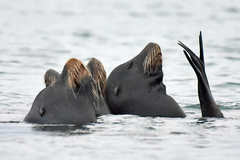
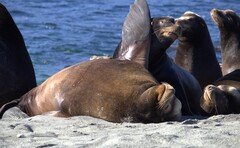
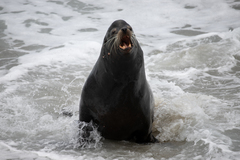
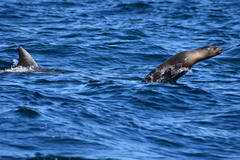

California Sea Lion
Zalophus californianus
Silhouette: Margot Michaud · PhyloPic
- KingdomAnimalia (Animals)
- PhylumChordata (Chordates)
- ClassMammalia (Mammals)
- OrderCarnivora (Carnivorans)
- FamilyOtariidae (Eared Seals)
- GenusZalophus (California, Galápagos, and Japanese Sea Lions)
- SpeciesZalophus californianus (California Sea Lion)
In 3 days ~80% in a week >90%
130 Verified sightings at Bahía de Loreto National Park From 2019 to 2026
927 In all 8 parks
May Best month
☀️ Diurnal When it's spotted
About the California Sea Lion
The California sea lion (Zalophus californianus) is a coastal eared seal native to western North America. It is one of six species of sea lions. Its natural habitat ranges from southeast Alaska to central Mexico, including the Gulf of California. California sea lions are sexually dimorphic; males are larger than females, and have a thicker neck, and a protruding sagittal crest. They mainly haul out on sandy or rocky beaches, but they also frequent manmade environments such as marinas and wharves. California sea lions feed on a number of species of fish and squid, and are preyed on by orcas and great white sharks.
California sea lions have a polygynous breeding pattern. From May to August, males establish territories and try to attract females with which to mate. Females are free to move in between territories, and are not coerced by males. Mothers nurse their pups in between foraging trips. California sea lions communicate with numerous vocalizations, notably with barks and mother-pup contact calls. Outside their breeding season, California sea lions spend much of their time at sea, but they come to shore to molt.
California sea lions are particularly intelligent, can be trained to perform various tasks and display limited fear of humans if accustomed to them. Because of this, California sea lions are a popular choice for public display in zoos, circuses and oceanariums, and are trained by the United States Navy for certain military operations. The International Union for Conservation of Nature (IUCN) lists the species as Least Concern due to its abundance. To protect fish, the US states of Oregon and Washington engage in annual kill quotas of California sea lions. Wikipedia →
Sounds
Recording0:13
Canada · 2023
© John D Reynolds · iNaturalist · CC BY-NC 4.0
Recording0:15
United States · 2024
© jdiversitybrown · iNaturalist · CC BY-NC 4.0
Recording0:11
Canada · 2025
© Andrew Jacobs · iNaturalist · CC BY-NC 4.0
Recent sightings of California Sea Lion in Bahía de Loreto National Park
LIVEiNaturalistGlobal Distribution
Parks Where Found
| # | Park | Country | Daily sighting probability |
|---|---|---|---|
| 1 | Channel Islands National Park | 🇺🇸 United States | |
| 2 | Cabo Pulmo National Park | 🇲🇽 Mexico | |
| 3 | Redwood National Park | 🇺🇸 United States | |
| 4 | Bahía de Loreto National Park | 🇲🇽 Mexico | |
| 5 | El Vizcaíno Biosphere Reserve | 🇲🇽 Mexico | |
| 6 | Pacific Rim National Park Reserve | 🇨🇦 Canada | |
| 7 | Great Bear Rainforest | 🇨🇦 Canada | |
| 8 | Olympic National Park | 🇺🇸 United States |
Cities Where Found
| # | City | Country | Daily sighting probability |
|---|---|---|---|
| 1 | San Diego | 🇺🇸 United States | |
| 2 | San Francisco | 🇺🇸 United States | |
| 3 | Sacramento | 🇺🇸 United States | |
| 4 | Seattle | 🇺🇸 United States | |
| 5 | Los Angeles | 🇺🇸 United States | |
| 6 | Vancouver | 🇨🇦 Canada | |
| 7 | Portland | 🇺🇸 United States |
Zoos & Centres Where Found
Closest Relatives at Bahía de Loreto National Park


Before you go
What are the chances of seeing a California Sea Lion in Bahía de Loreto National Park?
Likely
About 50% of wildlife watchers report a California Sea Lion sighting in Bahía de Loreto National Park on a given day, based on 130 verified sightings from GBIF citizen-science data from 2019 to 2026. It is the most-seen of the 13 mammals we can rate there. Over three days the chance rises to about 80%, and over a week to over 90%, if each day is a fresh chance.
When is the best time to see a California Sea Lion in Bahía de Loreto National Park?
March and May
In those months about 60% of wildlife watchers report a California Sea Lion in Bahía de Loreto National Park on a given day, against about 20% in November, the lowest month. Those are among Bahía de Loreto National Park's driest months, with almost no rain against 80 mm in September.
What time of day is best to see a California Sea Lion?
Between 2 and 5 pm
Across all the parks we cover, that three-hour window holds the most California Sea Lion sightings with a recorded time, and about 9 in 10 of them come between 6 am and 6 pm: it is a daytime animal.
Is Bahía de Loreto National Park the best place to see a California Sea Lion?
4th of 8
Of the 8 parks where we can rate California Sea Lion sightings, Bahía de Loreto National Park ranks 4th at about 50%. The best odds are in Channel Islands National Park (United States, about 60%), Cabo Pulmo National Park (Mexico, about 50%) and Redwood National Park (United States, about 50%). All parks ranked.
Which relatives of the California Sea Lion live in Bahía de Loreto National Park?
Same order: Carnivora
The closest relatives of the California Sea Lion that you can see in Bahía de Loreto National Park (order Carnivora, Carnivorans) are Common Raccoon (about 20%), Gray Fox (about 20%) and Bobcat (about 10%), with each one's daily chance of a sighting.
Where does the California Sea Lion sighting chance come from?
GBIF citizen-science records
It is estimated from how often the California Sea Lion is recorded against all the mammals logged in Bahía de Loreto National Park (130 verified sightings from 2019 to 2026), calibrated against known sighting rates. Figures are rounded to the nearest 10% because citizen-science data supports honest approximations, not decimals, and months with records from fewer than five people show "—". How it works.
