


Completed



Sea Otter
Enhydra lutris
Silhouette: Margot Michaud · PhyloPic
- KingdomAnimalia (Animals)
- PhylumChordata (Chordates)
- ClassMammalia (Mammals)
- OrderCarnivora (Carnivorans)
- FamilyMustelidae (Mustelids)
- GenusEnhydra (sea otters)
- SpeciesEnhydra lutris (Sea Otter)
In 3 days >90%
429 Verified sightings at Kenai Fjords National Park From 2019 to 2026
1,062 In all 6 parks
April Best month
☀️ Diurnal When it's spotted
About the Sea Otter
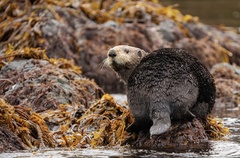
The sea otter (Enhydra lutris) is a marine mammal native to the coasts of the northern and eastern North Pacific Ocean. Adult sea otters typically weigh between 14 and 45 kg (30–100 lb), making them the heaviest members of the weasel family, but among the smallest marine mammals. Unlike most marine mammals, the sea otter's primary form of insulation is an exceptionally thick coat of fur, the densest in the animal kingdom. Although it can walk on land, the sea otter is capable of living exclusively in the ocean.
The sea otter inhabits nearshore environments, where it dives to the sea floor to forage. It preys mostly on marine invertebrates such as sea urchins, various mollusks and crustaceans, and some species of fish. Its foraging and eating habits are noteworthy in several respects. Its use of rocks to dislodge prey and to open shells makes it one of the few mammal species to use tools. In most of its range, it is a keystone species, controlling sea urchin populations which would otherwise inflict extensive damage to kelp forest ecosystems. Its diet includes prey species that are also valued by humans as food, leading to conflicts between sea otters and fisheries.
Sea otters, whose numbers were once estimated at 150,000–300,000, were hunted extensively for their fur between 1741 and 1911, and the world population fell to 1,000–2,000 individuals living in a fraction of their historic range. A subsequent international ban on hunting, sea otter conservation efforts, and reintroduction programs into previously populated areas have contributed to numbers rebounding, and the species occupies about two-thirds of its former range. The recovery of the sea otter is considered an important success in marine conservation, although populations in the Aleutian Islands, in California, and in Russia have recently declined or have plateaued at depressed levels. The population in Japan likewise remains small and precarious. For these reasons, the sea otter remains classified as an endangered species. Wikipedia →
Sounds
Recording0:09
United States · 2022
© Tuoichen · iNaturalist · CC BY 4.0
Recording0:36
United States · 2015
© Gena Bentall · iNaturalist · CC BY-NC 4.0
Recent sightings of Sea Otter in Kenai Fjords National Park
LIVEiNaturalistGlobal Distribution
Parks Where Found
| # | Park | Country | Daily sighting probability |
|---|---|---|---|
| 1 | Kenai Fjords National Park | 🇺🇸 United States | |
| 2 | Katmai National Park | 🇺🇸 United States | |
| 3 | Great Bear Rainforest | 🇨🇦 Canada | |
| 4 | Wrangell-St. Elias National Park | 🇺🇸 United States | |
| 5 | Pacific Rim National Park Reserve | 🇨🇦 Canada | |
| 6 | Olympic National Park | 🇺🇸 United States |
Zoos & Centres Where Found
| # | Zoo / Centre | Country | |
|---|---|---|---|
| 1 | SeaWorld San Diego | 🇺🇸 United States | |
| 2 | Shedd Aquarium | 🇺🇸 United States | |
| 3 | The Blue Planet | 🇩🇰 Denmark | |
| 4 | Lisbon Oceanarium | 🇵🇹 Portugal | |
| 5 | Toba Aquarium | 🇯🇵 Japan | |
| 6 | Toronto Zoo | 🇨🇦 Canada | |
| 7 | Minnesota Zoo | 🇺🇸 United States | |
| 8 | Kadoorie Farm and Botanic Garden | 🇭🇰 Hong Kong SAR China | |
| 9 | Detroit Zoo | 🇺🇸 United States | |
| 10 | Woodland Park Zoo | 🇺🇸 United States | |
| 11 | Oregon Zoo | 🇺🇸 United States | |
| 12 | Lisbon Zoo | 🇵🇹 Portugal | |
| 13 | Emirates Park Zoo | 🇦🇪 United Arab Emirates | |
| 14 | Zoo Atlanta | 🇺🇸 United States | |
| 15 | Pittsburgh Zoo & Aquarium | 🇺🇸 United States | |
| 16 | Point Defiance Zoo & Aquarium | 🇺🇸 United States | |
| 17 | Lincoln Park Zoo | 🇺🇸 United States | |
| 18 | New York Aquarium | 🇺🇸 United States | |
| 19 | Notojima Aquarium | 🇯🇵 Japan | |
| 20 | Oceanopolis | 🇫🇷 France | |
| 21 | Georgia Aquarium | 🇺🇸 United States | |
| 22 | Aquarium of the Pacific | 🇺🇸 United States | |
| 23 | Vancouver Aquarium | 🇨🇦 Canada | |
| 24 | Monterey Bay Aquarium | 🇺🇸 United States | |
| 25 | Seattle Aquarium | 🇺🇸 United States | |
| 26 | Birch Aquarium | 🇺🇸 United States | |
| 27 | Aquário Vasco da Gama | 🇵🇹 Portugal | |
| 28 | Bird Alliance of Oregon | 🇺🇸 United States | |
| 29 | Westport Aquarium | 🇺🇸 United States | |
| 30 | Centro de Recuperação de Animais Silvestres | 🇵🇹 Portugal | |
| 31 | Dream Catcher Stables | 🇺🇸 United States | |
| 32 | Free Rein Foundation | 🇺🇸 United States | |
| 33 | Oregon Undersea Gardens | 🇺🇸 United States | |
| 34 | Seattle Marine Aquarium | 🇺🇸 United States |
Closest Relatives at Kenai Fjords National Park




Before you go
What are the chances of seeing a Sea Otter in Kenai Fjords National Park?
Very likely
About 90% of wildlife watchers report a Sea Otter sighting in Kenai Fjords National Park on a given day, based on 429 verified sightings from GBIF citizen-science data from 2019 to 2026. It is the most-seen of the 14 mammals we can rate there. Over three days the chance rises to over 90%, if each day is a fresh chance.
When is the best time to see a Sea Otter in Kenai Fjords National Park?
Any time of year
In every month with enough records, about 90% of wildlife watchers report a Sea Otter in Kenai Fjords National Park on a given day, so our monthly data shows no clear season. March and October–December have too few records to rate.
What time of day is best to see a Sea Otter?
Between 10 am and 1 pm
Across all the parks we cover, that three-hour window holds the most Sea Otter sightings with a recorded time, and about 9 in 10 of them come between 6 am and 6 pm: it is a daytime animal.
Is Kenai Fjords National Park the best place to see a Sea Otter?
Yes
Of the 6 parks where we can rate Sea Otter sightings, Kenai Fjords National Park has the highest daily chance: about 90%. Next come Katmai National Park (United States, about 40%) and Great Bear Rainforest (Canada, about 40%). All parks ranked.
Which relatives of the Sea Otter live in Kenai Fjords National Park?
Same order: Carnivora
The closest relatives of the Sea Otter that you can see in Kenai Fjords National Park (order Carnivora, Carnivorans) are Harbor Seal (about 80%), Northern Sea Lion (about 80%) and American Black Bear (about 50%), with each one's daily chance of a sighting.
Where does the Sea Otter sighting chance come from?
GBIF citizen-science records
It is estimated from how often the Sea Otter is recorded against all the mammals logged in Kenai Fjords National Park (429 verified sightings from 2019 to 2026), calibrated against known sighting rates. Figures are rounded to the nearest 10% because citizen-science data supports honest approximations, not decimals, and months with records from fewer than five people show "—". How it works.
